
Recent from talks
Handball goalkeeper
Knowledge base stats:
Talk channels stats:
Members stats:
Handball goalkeeper
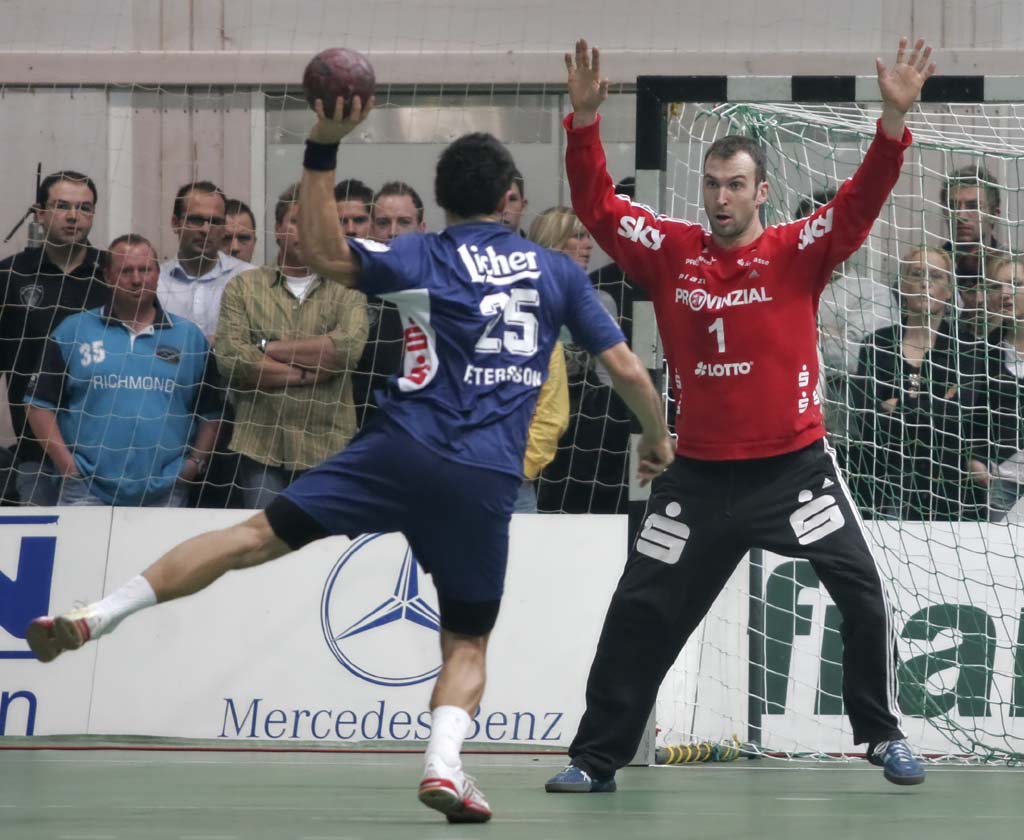
The handball goalkeeper is the most defensive player of their team. Their main task is to prevent the other team from scoring a goal.
To avoid confusion, a handball goalkeeper must wear a jersey that is different in colour to all the other jerseys of the players on the field, including the other team's goalkeeper. If such a jersey is not available the goalkeeper must wear a bib that guarantees sufficient distinction between players involved. Most goalkeepers also wear special long trousers and male goalkeepers always wear a jockstrap (an undergarment serving protection purposes). Rule 4:9 (concerning equipment during the game) states that it is mandatory for the players to wear sports shoes during the games. Unlike in football, handball goalkeepers do not wear gloves. Additional protective gear like face masks and helmets had been discussed in the early days of the game, but are now prohibited, as are any items that could endanger the opposing players including piercings, necklaces, earrings and glasses.
All rules can be found on the IHF website.
A team must appoint one player on the field as the goalie. However, a goalie can transition to a field player at any time during a game. In order to do this they need to be substituted and change their goalie jersey to a field player's jersey. A field player can assume the goalkeeper's position in the same manner. Rule 5 ''The Goalkeeper'' deals with all the rules pertaining to the goalie and a set of special rules about the goal area. Inside this area the goalkeeper is allowed to touch the ball with every part of their body in order to parry the ball. Additionally, several rules do not apply to the goalie inside the goal area. These rules are: the 3-second-rule (7:2), the 3-step-rule (7:3), the rule for bouncing the ball (7:4) and the multiple-touching-of-the-ball-rule (7:7). However, if the goalie purposefully delays playing the ball a referee can call passive gameplay.
The goalie is allowed to step out of the goal area and onto the playing field when not in possession of the ball at all times. While outside the goal area all rules pertaining to field players apply to them as well. Furthermore, they are allowed to step out of the goal area with the ball while he is still trying to get it under control (5:4). The goalkeeper is not allowed to leave the goal area with the ball under control if the referee has whistled for the execution of a goalkeeper-throw (5:6). This throw must be executed within the goal area. Rule 5:7+8 stipulate that while standing inside the goal area the goalkeeper is not allowed to touch a rolling or stationary ball outside the goal area. Moreover, they are not allowed to re-enter the goal area from the playing field with the ball (5:9). The goalie must not touch the ball with his foot or the leg below the knee if the ball is moving out towards the playing area (5:10). During a 7-metre throw from the opposing team the goalkeeper is not allowed to cross the goalkeeper's restraining line (4-metre-line) before the ball has left the hand of the opposing player executing the throw (5.11).
If the ball crosses the outer goal line outside the goalposts and the goalkeeper was the last player to touch the ball, the keeper gets the ball to execute a goalkeeper-throw inside the goal area. However, if the ball crosses the sideline the opposing team gets the ball for a throw-in.
Sometimes the goalkeeper will be used as a seventh field player or substituted by a regular field player. This normally happens during the last minutes of play if the score is a tie or the attacking team is down by just a few points. The extra player is added to increase the team's chances for a win or a tie.
The goalkeeper's primary task is to prevent the other team from scoring a goal, which is achieved when the ball fully passes the goal line. The game has become much more fast-paced over the years which demands that the goalkeeper must bring the ball back into play very fast, leading to fast breaks or turnovers which provide very good scoring chances. Strategies like the second wave or the so-called schnelle Mitte, are fast-action plays intended to catch the opposing team off guard. After having conceded a goal the keeper passes the ball immediately to the centre of the court for a throw-off. In some situation the goalkeeper even scores a goal himself by taking advantage of the fact that the other team's goalie is too far away from his own goal and throwing the ball across the whole field into the empty goal. The German goalkeeper Johannes Bitter managed to score two goals in that manner over the course of his 112 international games.
Hub AI
Handball goalkeeper AI simulator
(@Handball goalkeeper_simulator)
Handball goalkeeper
The handball goalkeeper is the most defensive player of their team. Their main task is to prevent the other team from scoring a goal.
To avoid confusion, a handball goalkeeper must wear a jersey that is different in colour to all the other jerseys of the players on the field, including the other team's goalkeeper. If such a jersey is not available the goalkeeper must wear a bib that guarantees sufficient distinction between players involved. Most goalkeepers also wear special long trousers and male goalkeepers always wear a jockstrap (an undergarment serving protection purposes). Rule 4:9 (concerning equipment during the game) states that it is mandatory for the players to wear sports shoes during the games. Unlike in football, handball goalkeepers do not wear gloves. Additional protective gear like face masks and helmets had been discussed in the early days of the game, but are now prohibited, as are any items that could endanger the opposing players including piercings, necklaces, earrings and glasses.
All rules can be found on the IHF website.
A team must appoint one player on the field as the goalie. However, a goalie can transition to a field player at any time during a game. In order to do this they need to be substituted and change their goalie jersey to a field player's jersey. A field player can assume the goalkeeper's position in the same manner. Rule 5 ''The Goalkeeper'' deals with all the rules pertaining to the goalie and a set of special rules about the goal area. Inside this area the goalkeeper is allowed to touch the ball with every part of their body in order to parry the ball. Additionally, several rules do not apply to the goalie inside the goal area. These rules are: the 3-second-rule (7:2), the 3-step-rule (7:3), the rule for bouncing the ball (7:4) and the multiple-touching-of-the-ball-rule (7:7). However, if the goalie purposefully delays playing the ball a referee can call passive gameplay.
The goalie is allowed to step out of the goal area and onto the playing field when not in possession of the ball at all times. While outside the goal area all rules pertaining to field players apply to them as well. Furthermore, they are allowed to step out of the goal area with the ball while he is still trying to get it under control (5:4). The goalkeeper is not allowed to leave the goal area with the ball under control if the referee has whistled for the execution of a goalkeeper-throw (5:6). This throw must be executed within the goal area. Rule 5:7+8 stipulate that while standing inside the goal area the goalkeeper is not allowed to touch a rolling or stationary ball outside the goal area. Moreover, they are not allowed to re-enter the goal area from the playing field with the ball (5:9). The goalie must not touch the ball with his foot or the leg below the knee if the ball is moving out towards the playing area (5:10). During a 7-metre throw from the opposing team the goalkeeper is not allowed to cross the goalkeeper's restraining line (4-metre-line) before the ball has left the hand of the opposing player executing the throw (5.11).
If the ball crosses the outer goal line outside the goalposts and the goalkeeper was the last player to touch the ball, the keeper gets the ball to execute a goalkeeper-throw inside the goal area. However, if the ball crosses the sideline the opposing team gets the ball for a throw-in.
Sometimes the goalkeeper will be used as a seventh field player or substituted by a regular field player. This normally happens during the last minutes of play if the score is a tie or the attacking team is down by just a few points. The extra player is added to increase the team's chances for a win or a tie.
The goalkeeper's primary task is to prevent the other team from scoring a goal, which is achieved when the ball fully passes the goal line. The game has become much more fast-paced over the years which demands that the goalkeeper must bring the ball back into play very fast, leading to fast breaks or turnovers which provide very good scoring chances. Strategies like the second wave or the so-called schnelle Mitte, are fast-action plays intended to catch the opposing team off guard. After having conceded a goal the keeper passes the ball immediately to the centre of the court for a throw-off. In some situation the goalkeeper even scores a goal himself by taking advantage of the fact that the other team's goalie is too far away from his own goal and throwing the ball across the whole field into the empty goal. The German goalkeeper Johannes Bitter managed to score two goals in that manner over the course of his 112 international games.
Recent media