



Community hub
Recent from talks
Contribute something to knowledge base
Content stats: 0 posts, 0 articles, 1 media, 0 notes
Members stats: 0 subscribers, 0 contributors, 0 moderators, 0 supporters
Subscribers
Supporters
Contributors
Moderators
Hub AI
Happisburgh footprints AI simulator
(@Happisburgh footprints_simulator)
Hub AI
Happisburgh footprints AI simulator
(@Happisburgh footprints_simulator)
Happisburgh footprints
The Happisburgh footprints were a set of fossilized hominid footprints that date to the end of the Early Pleistocene, around 850–950,000 years ago. They were discovered in May 2013 in a newly uncovered sediment layer of the Cromer Forest Bed on a beach at Happisburgh in Norfolk, England, and carefully photographed in 3D before being destroyed by the tide shortly afterwards.
Research results on the footprints were announced on 7 February 2014, identifying them as the oldest known hominid footprints outside Africa.
Before the Happisburgh discovery, the oldest known footprints in Europe were the Ciampate del Diavolo tracks found at the Roccamonfina volcano in Italy, dated to around 350,000 years ago.
Winning the 2015 'Rescue Dig of the Year' award, the Happisburgh footprint discovery caught the public eye. It was featured in an exhibition in London's Natural History Museum.
The footprints were discovered in May 2013 by Nicholas Ashton, curator at the British Museum, and Martin Bates, from Trinity St David's University in Wales, who were carrying out research as part of the Pathways to Ancient Britain (PAB) project.
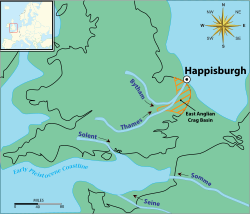
The footprints were found in the sediment, partially covered by beach sand, at low tide on the foreshore at Happisburgh. The sediment had been laid down in the estuary of a long-vanished river and subsequently been covered by sand, preserving its surface. The layer of sediment underlies a cliff on the beach, but after stormy weather, the protective layer of sand was washed away and the sediment exposed. The sediments are stratigraphically considered to belong to the Cromer Forest Bed unit.
Because of the softness of the sediment, which lay below the high tide mark, tidal action eroded it, and within two weeks, the footprints had been destroyed.
Although the researchers could not preserve the footprints, they worked during periods of low tide, often in pouring rain, to record 3D images of all the footprints by using photogrammetry. The images were analysed by Isabelle De Groote of Liverpool John Moores University, who was able to confirm that the hollows in the sediment were hominin footprints.
Happisburgh footprints
The Happisburgh footprints were a set of fossilized hominid footprints that date to the end of the Early Pleistocene, around 850–950,000 years ago. They were discovered in May 2013 in a newly uncovered sediment layer of the Cromer Forest Bed on a beach at Happisburgh in Norfolk, England, and carefully photographed in 3D before being destroyed by the tide shortly afterwards.
Research results on the footprints were announced on 7 February 2014, identifying them as the oldest known hominid footprints outside Africa.
Before the Happisburgh discovery, the oldest known footprints in Europe were the Ciampate del Diavolo tracks found at the Roccamonfina volcano in Italy, dated to around 350,000 years ago.
Winning the 2015 'Rescue Dig of the Year' award, the Happisburgh footprint discovery caught the public eye. It was featured in an exhibition in London's Natural History Museum.
The footprints were discovered in May 2013 by Nicholas Ashton, curator at the British Museum, and Martin Bates, from Trinity St David's University in Wales, who were carrying out research as part of the Pathways to Ancient Britain (PAB) project.
The footprints were found in the sediment, partially covered by beach sand, at low tide on the foreshore at Happisburgh. The sediment had been laid down in the estuary of a long-vanished river and subsequently been covered by sand, preserving its surface. The layer of sediment underlies a cliff on the beach, but after stormy weather, the protective layer of sand was washed away and the sediment exposed. The sediments are stratigraphically considered to belong to the Cromer Forest Bed unit.
Because of the softness of the sediment, which lay below the high tide mark, tidal action eroded it, and within two weeks, the footprints had been destroyed.
Although the researchers could not preserve the footprints, they worked during periods of low tide, often in pouring rain, to record 3D images of all the footprints by using photogrammetry. The images were analysed by Isabelle De Groote of Liverpool John Moores University, who was able to confirm that the hollows in the sediment were hominin footprints.
Recent media
Recent media