
Recent from talks
Hard disk drive failure
Knowledge base stats:
Talk channels stats:
Members stats:
Hard disk drive failure
A hard disk drive failure occurs when a hard disk drive malfunctions and the stored information cannot be accessed with a properly configured computer.
A hard disk failure may occur in the course of normal operation, or due to an external factor such as exposure to fire or water or high magnetic fields, or suffering a sharp impact or environmental contamination, which can lead to a head crash.
The stored information on a hard drive may also be rendered inaccessible as a result of data corruption, disruption or destruction of the hard drive's master boot record, or by malware deliberately destroying the disk's contents.
There are a number of causes for hard drives to fail including: human error, hardware failure, firmware corruption, media damage, heat, water damage, power issues and mishaps. Drive manufacturers typically specify a mean time between failures (MTBF) or an annualized failure rate (AFR) which are population statistics that can't predict the behavior of an individual unit. These are calculated by constantly running samples of the drive for a short period of time, analyzing the resultant wear and tear upon the physical components of the drive, and extrapolating to provide a reasonable estimate of its lifespan. Hard disk drive failures tend to follow the concept of the bathtub curve. Drives typically fail within a short time if there is a defect present from manufacturing. If a drive proves reliable for a period of a few months after installation, the drive has a significantly greater chance of remaining reliable. Therefore, even if a drive is subjected to several years of heavy daily use, it may not show any notable signs of wear unless closely inspected. On the other hand, a drive can fail at any time in many different situations.
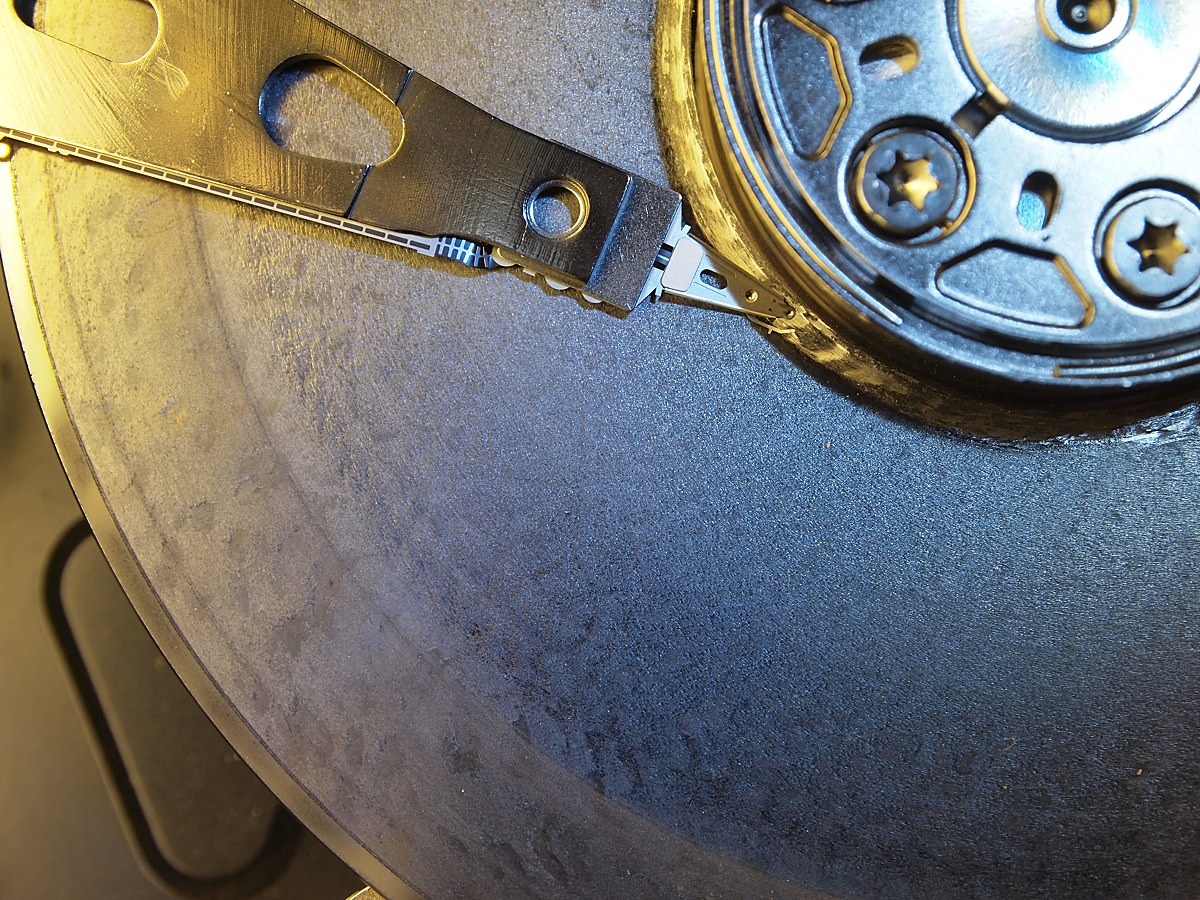
The most notorious cause of drive failure is a head crash, where the internal read-and-write head of the device, usually just hovering above the surface, touches a platter, or scratches the magnetic data-storage surface. A head crash usually incurs severe data loss, and data recovery attempts may cause further damage if not done by a specialist with proper equipment. Drive platters are coated with an extremely thin layer of non-electrostatic lubricant, so that the read-and-write head will likely simply glance off the surface of the platter should a collision occur. However, this head hovers mere nanometers from the platter's surface which makes a collision an acknowledged risk.
Another cause of failure is a faulty air filter. The air filters on today's drives equalize the atmospheric pressure and moisture between the drive enclosure and its outside environment. If the filter fails to capture a dust particle, the particle can land on the platter, causing a head crash if the head happens to sweep over it. After a head crash, particles from the damaged platter and head media can cause one or more bad sectors. These, in addition to platter damage, will quickly render a drive useless.
A drive also includes controller electronics, which occasionally fail. In such cases, it may be possible to recover all data by replacing the controller board.
Failure of a hard disk drive can be catastrophic or gradual. The former typically presents as a drive that can no longer be detected by CMOS setup, or that fails to pass BIOS POST so that the operating system never sees it. Gradual hard-drive failure can be harder to diagnose, because its symptoms, such as corrupted data and slowing down of the PC (caused by gradually failing areas of the hard drive requiring repeated read attempts before successful access), can be caused by many other computer issues, such as malware. A rising number of bad sectors can be a sign of a failing hard drive, but because the hard drive automatically adds them to its own growth defect table, they may not become evident to utilities such as ScanDisk unless the utility can catch them before the hard drive's defect management system does, or the backup sectors held in reserve by the internal hard-drive defect management system run out (by which point the drive is on the point of failing outright). A cyclical repetitive pattern of seek activity such as rapid or slower seek-to-end noises (click of death) can be indicative of hard drive problems.
Hub AI
Hard disk drive failure AI simulator
(@Hard disk drive failure_simulator)
Hard disk drive failure
A hard disk drive failure occurs when a hard disk drive malfunctions and the stored information cannot be accessed with a properly configured computer.
A hard disk failure may occur in the course of normal operation, or due to an external factor such as exposure to fire or water or high magnetic fields, or suffering a sharp impact or environmental contamination, which can lead to a head crash.
The stored information on a hard drive may also be rendered inaccessible as a result of data corruption, disruption or destruction of the hard drive's master boot record, or by malware deliberately destroying the disk's contents.
There are a number of causes for hard drives to fail including: human error, hardware failure, firmware corruption, media damage, heat, water damage, power issues and mishaps. Drive manufacturers typically specify a mean time between failures (MTBF) or an annualized failure rate (AFR) which are population statistics that can't predict the behavior of an individual unit. These are calculated by constantly running samples of the drive for a short period of time, analyzing the resultant wear and tear upon the physical components of the drive, and extrapolating to provide a reasonable estimate of its lifespan. Hard disk drive failures tend to follow the concept of the bathtub curve. Drives typically fail within a short time if there is a defect present from manufacturing. If a drive proves reliable for a period of a few months after installation, the drive has a significantly greater chance of remaining reliable. Therefore, even if a drive is subjected to several years of heavy daily use, it may not show any notable signs of wear unless closely inspected. On the other hand, a drive can fail at any time in many different situations.
The most notorious cause of drive failure is a head crash, where the internal read-and-write head of the device, usually just hovering above the surface, touches a platter, or scratches the magnetic data-storage surface. A head crash usually incurs severe data loss, and data recovery attempts may cause further damage if not done by a specialist with proper equipment. Drive platters are coated with an extremely thin layer of non-electrostatic lubricant, so that the read-and-write head will likely simply glance off the surface of the platter should a collision occur. However, this head hovers mere nanometers from the platter's surface which makes a collision an acknowledged risk.
Another cause of failure is a faulty air filter. The air filters on today's drives equalize the atmospheric pressure and moisture between the drive enclosure and its outside environment. If the filter fails to capture a dust particle, the particle can land on the platter, causing a head crash if the head happens to sweep over it. After a head crash, particles from the damaged platter and head media can cause one or more bad sectors. These, in addition to platter damage, will quickly render a drive useless.
A drive also includes controller electronics, which occasionally fail. In such cases, it may be possible to recover all data by replacing the controller board.
Failure of a hard disk drive can be catastrophic or gradual. The former typically presents as a drive that can no longer be detected by CMOS setup, or that fails to pass BIOS POST so that the operating system never sees it. Gradual hard-drive failure can be harder to diagnose, because its symptoms, such as corrupted data and slowing down of the PC (caused by gradually failing areas of the hard drive requiring repeated read attempts before successful access), can be caused by many other computer issues, such as malware. A rising number of bad sectors can be a sign of a failing hard drive, but because the hard drive automatically adds them to its own growth defect table, they may not become evident to utilities such as ScanDisk unless the utility can catch them before the hard drive's defect management system does, or the backup sectors held in reserve by the internal hard-drive defect management system run out (by which point the drive is on the point of failing outright). A cyclical repetitive pattern of seek activity such as rapid or slower seek-to-end noises (click of death) can be indicative of hard drive problems.
Recent media