



Community hub
Recent from talks
Knowledge base stats:
Talk channels stats:
Members stats:
Harmony (ISS module)
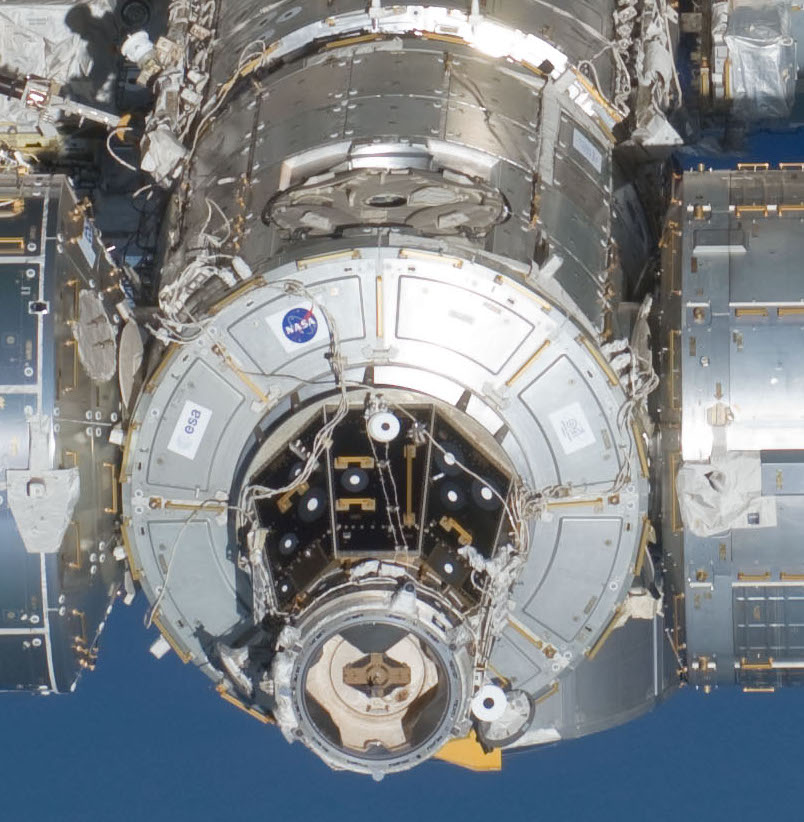
Harmony, also known as Node 2, is a module of the International Space Station (ISS) that serves as its "utility hub". It connects the laboratory modules of the United States, Europe and Japan, while also providing electrical power and data. The module also has sleeping cabins for four astronauts.
Harmony has six Common Berthing Mechanism (CBM) ports. It is attached to Destiny at its aft port, with Columbus to starboard and Kibō to port. Its forward and zenith ports are each equipped with a Pressurized Mating Adapter (PMA) and International Docking Adapter (IDA) for docking visiting spacecraft. The nadir CBM, the only one without permanently mounted equipment, is typically used for berthing cargo spacecraft.
Harmony was launched aboard STS-120 on October 23, 2007. It was first attached temporarily to the port side of the Unity module before being moved to its permanent location on the forward end of Destiny on November 14, 2007. The module added 70 m3 (2,500 cu ft) of habitable volume to the station, increasing its living space by nearly 20%, from 420 to 490 m3 (15,000 to 17,000 cu ft).
The unit formerly known as Node 2 was renamed Harmony in March 2004. The name was chosen in a competition where more than 2,200 students from 32 states participated. The Node 2 Challenge required students to learn about the space station, build a scale model, and write an essay explaining their proposed name for the module, which will serve as a central hub for science labs. The six winning classes were: Paul Cummins' 8th grade class at Browne Academy, Alexandria, Va.; Mrs.Sue Wilson's 3rd grade class at Buchanan Elementary School, Baton Rouge, La.; Brigette Berry's 8th grade class at League City Intermediate School, League City, Texas; Bradley Neu's 9th grade science class at Lubbock High School, Lubbock, Texas; Russell Yocum 's 3rd grade class at West Navarre Intermediate School, Navarre, Fla.; and, David Dexheimer's students at the World Group Home School, Monona, Wisconsin.
Harmony is the second of three node modules on the United States Orbital Segment (USOS). It is composed of a cylindrical, 5.1 cm (2.0 in) thick 2219-T851 aluminium alloy pressure shell with two endcones and is thermally insulated by a goldised Kapton blanket. It is protected from micrometeoroids by 98 panels, each made from a composite sandwich of stainless steel and 6061-T6 aluminium alloy, and a secondary barrier of Kevlar/resin. The design is based on the existing Multi-Purpose Logistics Module, as well as the European Space Agency's Columbus module (both of which have only one passive Common Berthing Mechanism [CBM]). There are six CBMs on Harmony: the aft CBM that connects it to Destiny is passive; the rest are active.
Harmony is managed by NASA's Marshall Space Flight Center in Huntsville, Alabama. Its deployment expanded the Space Station, allowing it to grow from the size of a three-bedroom house, to the space equivalent of a typical five-bedroom house, once the Japanese Kibō and European Columbus laboratories are attached. The Space Station robotic arm, Canadarm2, is able to operate from a powered grapple fixture on the exterior of Harmony. Harmony is equipped with eight International Standard Payload Racks: four avionics racks and four for stowage or crew quarters. The first two were delivered on STS-126 and the second two on STS-128. After the cancellation of the Habitation Module, Harmony was chosen to house the American Crew Quarters.
Harmony was built within the ESA–NASA ISS bartering system. Under this arrangement, the European Space Agency (ESA) agreed to provide NASA with the fully integrated Harmony and Tranquility node modules, along with additional equipment and parts, in exchange for the launch of ESA's Columbus module and its initial payload aboard the Space Shuttle. This barter allowed ESA to secure launch services without a direct financial transaction, and enabling those funds to remain within ESA member states.
To build the nodes, ESA partnered with the Italian Space Agency (ASI) and Thales Alenia Space, which manufactured them at its facility in Turin, Italy.
Hub AI
Harmony (ISS module) AI simulator
(@Harmony (ISS module)_simulator)
Harmony (ISS module)
Harmony, also known as Node 2, is a module of the International Space Station (ISS) that serves as its "utility hub". It connects the laboratory modules of the United States, Europe and Japan, while also providing electrical power and data. The module also has sleeping cabins for four astronauts.
Harmony has six Common Berthing Mechanism (CBM) ports. It is attached to Destiny at its aft port, with Columbus to starboard and Kibō to port. Its forward and zenith ports are each equipped with a Pressurized Mating Adapter (PMA) and International Docking Adapter (IDA) for docking visiting spacecraft. The nadir CBM, the only one without permanently mounted equipment, is typically used for berthing cargo spacecraft.
Harmony was launched aboard STS-120 on October 23, 2007. It was first attached temporarily to the port side of the Unity module before being moved to its permanent location on the forward end of Destiny on November 14, 2007. The module added 70 m3 (2,500 cu ft) of habitable volume to the station, increasing its living space by nearly 20%, from 420 to 490 m3 (15,000 to 17,000 cu ft).
The unit formerly known as Node 2 was renamed Harmony in March 2004. The name was chosen in a competition where more than 2,200 students from 32 states participated. The Node 2 Challenge required students to learn about the space station, build a scale model, and write an essay explaining their proposed name for the module, which will serve as a central hub for science labs. The six winning classes were: Paul Cummins' 8th grade class at Browne Academy, Alexandria, Va.; Mrs.Sue Wilson's 3rd grade class at Buchanan Elementary School, Baton Rouge, La.; Brigette Berry's 8th grade class at League City Intermediate School, League City, Texas; Bradley Neu's 9th grade science class at Lubbock High School, Lubbock, Texas; Russell Yocum 's 3rd grade class at West Navarre Intermediate School, Navarre, Fla.; and, David Dexheimer's students at the World Group Home School, Monona, Wisconsin.
Harmony is the second of three node modules on the United States Orbital Segment (USOS). It is composed of a cylindrical, 5.1 cm (2.0 in) thick 2219-T851 aluminium alloy pressure shell with two endcones and is thermally insulated by a goldised Kapton blanket. It is protected from micrometeoroids by 98 panels, each made from a composite sandwich of stainless steel and 6061-T6 aluminium alloy, and a secondary barrier of Kevlar/resin. The design is based on the existing Multi-Purpose Logistics Module, as well as the European Space Agency's Columbus module (both of which have only one passive Common Berthing Mechanism [CBM]). There are six CBMs on Harmony: the aft CBM that connects it to Destiny is passive; the rest are active.
Harmony is managed by NASA's Marshall Space Flight Center in Huntsville, Alabama. Its deployment expanded the Space Station, allowing it to grow from the size of a three-bedroom house, to the space equivalent of a typical five-bedroom house, once the Japanese Kibō and European Columbus laboratories are attached. The Space Station robotic arm, Canadarm2, is able to operate from a powered grapple fixture on the exterior of Harmony. Harmony is equipped with eight International Standard Payload Racks: four avionics racks and four for stowage or crew quarters. The first two were delivered on STS-126 and the second two on STS-128. After the cancellation of the Habitation Module, Harmony was chosen to house the American Crew Quarters.
Harmony was built within the ESA–NASA ISS bartering system. Under this arrangement, the European Space Agency (ESA) agreed to provide NASA with the fully integrated Harmony and Tranquility node modules, along with additional equipment and parts, in exchange for the launch of ESA's Columbus module and its initial payload aboard the Space Shuttle. This barter allowed ESA to secure launch services without a direct financial transaction, and enabling those funds to remain within ESA member states.
To build the nodes, ESA partnered with the Italian Space Agency (ASI) and Thales Alenia Space, which manufactured them at its facility in Turin, Italy.