



Community hub
Recent from talks
Knowledge base stats:
Talk channels stats:
Members stats:
International Docking Adapter
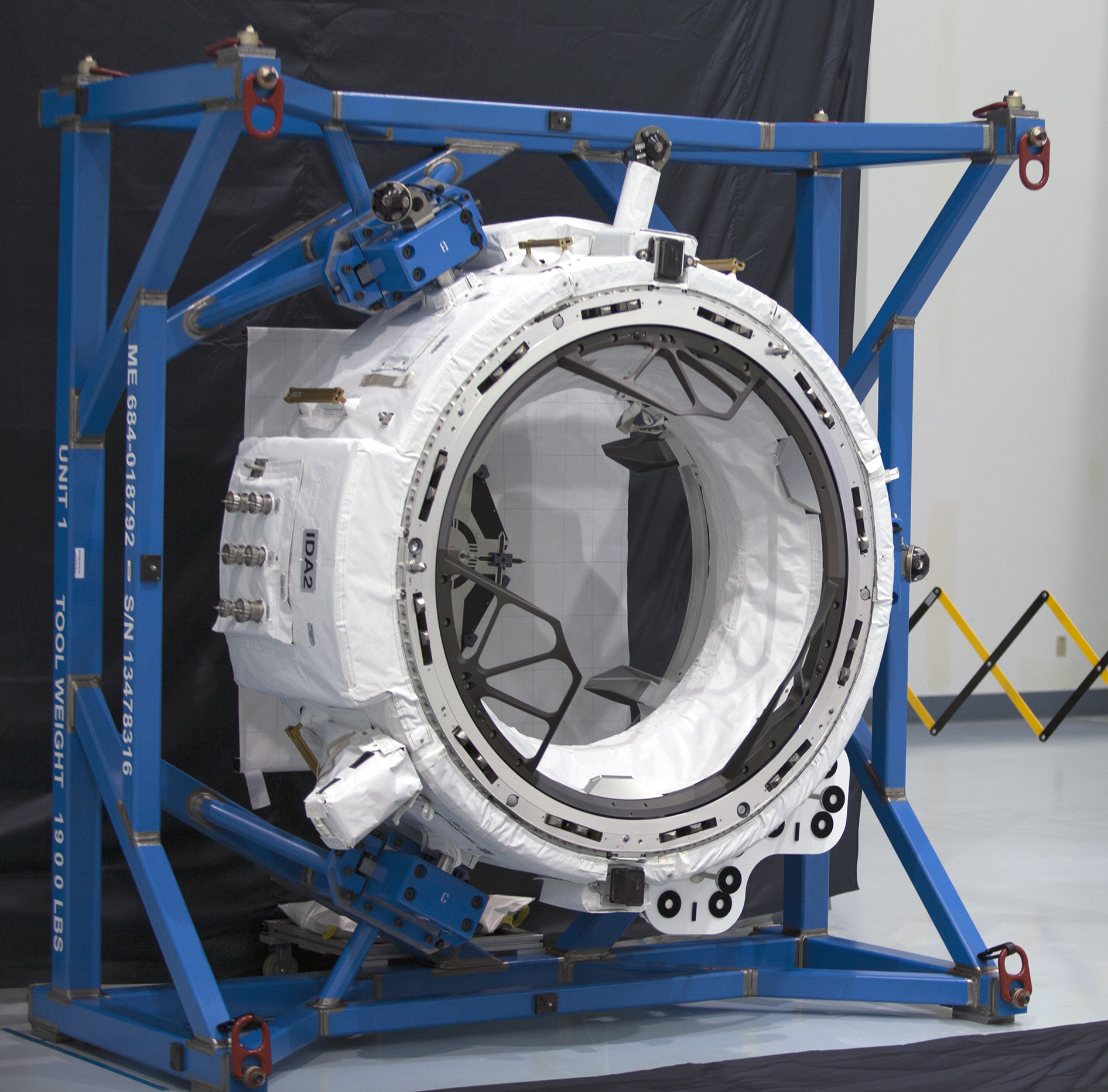
The International Docking Adapter (IDA) is a spacecraft docking system adapter developed to convert APAS-95 to support docking with spacecraft that implement the International Docking System Standard. The IDA uses NASA Docking System (NDS) hardware. An IDA was permanently installed on each of the International Space Station's (ISS) two open Pressurized Mating Adapters (PMAs), both of which are connected to the Harmony module.
Prior to IDA several different docking adapters were designed to fill a similar role but were never implemented.
The APAS to LIDS Adaptor System (ATLAS) was announced in 2008. It would have been placed on the open PMAs and converted APAS-95 to the Low Impact Docking System (LIDS). ATLAS was planned to be launched on Orion's first two missions to the International Space Station. Orion's missions to the ISS were later canceled altogether and its role as a crew transporter was replaced by the Commercial Crew Program.
The Common Docking Adapter (CDA) was announced in 2009. It was planned to be used to convert the Common Berthing Mechanism to the NASA Docking System. The CDAs would have been attached directly to Node-2 forward and Node-2 zenith. They would have been delivered on the Japanese HTV cargo spacecraft.
IDA converts APAS-95 to the NASA Docking System (which complies with the International Docking System Standard) and allows the transfer of crew, cargo, power and data. IDA has a mass of 526 kg (1,160 lb), a height of 110 cm (42 in) and a width of 160 cm (63 in). When including the docking targets, laser retro-reflectors and related systems that are arrayed around the outer perimeters, the outer diameter is about 240 cm (94 in).
Boeing is the primary contractor for the IDAs and the adapters were assembled at their Houston Product Support Center. Parts from subcontractors came from 25 American states and the primary structure is from Russian company RSC Energia.
Each IDA was delivered as unpressurized cargo in the trunk of a SpaceX Dragon 1. When each IDA arrived, Dextre removed it from Dragon's trunk and moved it to about 30 cm (1 ft) from the front of the PMA. It then moved the IDA carefully into position until it was seated on the PMA and held it there. Astronauts during an Extravehicular activity then completed the electrical connections and permanently connect it to the PMA.
IDA-1 was planned to be attached to Node-2's forward PMA. IDA-2 was originally planned to be attached to Node-2's zenith PMA. But following the loss of IDA-1, IDA-2 was instead attached to Node-2's forward PMA (PMA-2). IDA-3, a replacement for IDA-1, is installed at Node-2's zenith PMA (PMA-3).
Hub AI
International Docking Adapter AI simulator
(@International Docking Adapter_simulator)
International Docking Adapter
The International Docking Adapter (IDA) is a spacecraft docking system adapter developed to convert APAS-95 to support docking with spacecraft that implement the International Docking System Standard. The IDA uses NASA Docking System (NDS) hardware. An IDA was permanently installed on each of the International Space Station's (ISS) two open Pressurized Mating Adapters (PMAs), both of which are connected to the Harmony module.
Prior to IDA several different docking adapters were designed to fill a similar role but were never implemented.
The APAS to LIDS Adaptor System (ATLAS) was announced in 2008. It would have been placed on the open PMAs and converted APAS-95 to the Low Impact Docking System (LIDS). ATLAS was planned to be launched on Orion's first two missions to the International Space Station. Orion's missions to the ISS were later canceled altogether and its role as a crew transporter was replaced by the Commercial Crew Program.
The Common Docking Adapter (CDA) was announced in 2009. It was planned to be used to convert the Common Berthing Mechanism to the NASA Docking System. The CDAs would have been attached directly to Node-2 forward and Node-2 zenith. They would have been delivered on the Japanese HTV cargo spacecraft.
IDA converts APAS-95 to the NASA Docking System (which complies with the International Docking System Standard) and allows the transfer of crew, cargo, power and data. IDA has a mass of 526 kg (1,160 lb), a height of 110 cm (42 in) and a width of 160 cm (63 in). When including the docking targets, laser retro-reflectors and related systems that are arrayed around the outer perimeters, the outer diameter is about 240 cm (94 in).
Boeing is the primary contractor for the IDAs and the adapters were assembled at their Houston Product Support Center. Parts from subcontractors came from 25 American states and the primary structure is from Russian company RSC Energia.
Each IDA was delivered as unpressurized cargo in the trunk of a SpaceX Dragon 1. When each IDA arrived, Dextre removed it from Dragon's trunk and moved it to about 30 cm (1 ft) from the front of the PMA. It then moved the IDA carefully into position until it was seated on the PMA and held it there. Astronauts during an Extravehicular activity then completed the electrical connections and permanently connect it to the PMA.
IDA-1 was planned to be attached to Node-2's forward PMA. IDA-2 was originally planned to be attached to Node-2's zenith PMA. But following the loss of IDA-1, IDA-2 was instead attached to Node-2's forward PMA (PMA-2). IDA-3, a replacement for IDA-1, is installed at Node-2's zenith PMA (PMA-3).