


Community hub
Recent from talks
Contribute something to knowledge base
Content stats: 0 posts, 0 articles, 1 media, 0 notes
Members stats: 0 subscribers, 0 contributors, 0 moderators, 0 supporters
Subscribers
Supporters
Contributors
Moderators
Hub AI
Harriet Powers AI simulator
(@Harriet Powers_simulator)
Hub AI
Harriet Powers AI simulator
(@Harriet Powers_simulator)
Harriet Powers
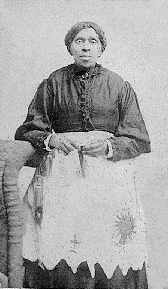
Harriet Powers (October 29, 1837 – January 1, 1910) was an American folk artist and quilter born into slavery in rural northeast Georgia. Powers used traditional appliqué techniques to make quilts that expressed local legends, Bible stories, and astronomical events. Powers married young and had a large family. After the American Civil War and emancipation, she and her husband became landowners by the 1880s, but lost their land due to financial problems.
Only two of her quilts are known to have survived: Bible Quilt 1886 and Pictorial Quilt 1898. Her quilts are considered among the finest examples of nineteenth-century Southern quilting. Her work is on display at the National Museum of American History in Washington, D.C., and the Museum of Fine Arts in Boston, Massachusetts
Powers was born into slavery in 1837 near Athens, Georgia. She is believed to have spent her early life on a plantation as a slave, owned by John and Nancy Lester in Madison County and learned to sew from other slaves or from her female enslaver.
In 1855, at the age of eighteen, Powers married Armstead Powers. They had at least nine children together.
Following the American Civil War, the Powerses and their children were emancipated. On the 1870 census they were recorded as having $300 (~$7,638 in 2025) in personal property, although they did not own land. In terms of occupation, Powers was listed as 'keeping house' and her husband as a 'farmhand.' At this point, three of their children– Amanda, Leon Joe (Alonzo), and Nancy– still lived at home.
By the 1880s Powers and her family owned four acres of land and ran a small farm in Clarke County. In 1886, Powers exhibited her first quilt at the Athens Cotton Fair. After some financial difficulty, Armstead began to slowly sell off tracts of land in the early 1890s, and he ultimately defaulted on his taxes. Despite their financial troubles, the Powerses did not lose their home. Their region had a cash poor, rural economy, and it was difficult for African Americans to collect the cash for taxes and fees.
In 1894, Armstead left Powers; she never remarried and likely supported herself as a seamstress. She remained in Clarke County for most of her life.
Although an 1895 Chicago Tribune article about the Cotton States and International Expo described Powers as ignorant and illiterate, learning Bible stories from "others more fortunate", Powers was literate. Quilt historian Kyra E. Hicks discovered a letter written by Powers while conducting research for her book on the quilter: This I Accomplish: Harriet Powers' Bible Quilt and Other Pieces (2009). The letter was a copy of an 1896 letter from Powers to a prominent woman from Keokuk, Iowa; it shared insights into Powers's life when she was enslaved, how and when she learned to read and write, and descriptions of at least four of her quilts. Powers wrote that she learned Bible stories through her own study of the book.
Harriet Powers
Harriet Powers (October 29, 1837 – January 1, 1910) was an American folk artist and quilter born into slavery in rural northeast Georgia. Powers used traditional appliqué techniques to make quilts that expressed local legends, Bible stories, and astronomical events. Powers married young and had a large family. After the American Civil War and emancipation, she and her husband became landowners by the 1880s, but lost their land due to financial problems.
Only two of her quilts are known to have survived: Bible Quilt 1886 and Pictorial Quilt 1898. Her quilts are considered among the finest examples of nineteenth-century Southern quilting. Her work is on display at the National Museum of American History in Washington, D.C., and the Museum of Fine Arts in Boston, Massachusetts
Powers was born into slavery in 1837 near Athens, Georgia. She is believed to have spent her early life on a plantation as a slave, owned by John and Nancy Lester in Madison County and learned to sew from other slaves or from her female enslaver.
In 1855, at the age of eighteen, Powers married Armstead Powers. They had at least nine children together.
Following the American Civil War, the Powerses and their children were emancipated. On the 1870 census they were recorded as having $300 (~$7,638 in 2025) in personal property, although they did not own land. In terms of occupation, Powers was listed as 'keeping house' and her husband as a 'farmhand.' At this point, three of their children– Amanda, Leon Joe (Alonzo), and Nancy– still lived at home.
By the 1880s Powers and her family owned four acres of land and ran a small farm in Clarke County. In 1886, Powers exhibited her first quilt at the Athens Cotton Fair. After some financial difficulty, Armstead began to slowly sell off tracts of land in the early 1890s, and he ultimately defaulted on his taxes. Despite their financial troubles, the Powerses did not lose their home. Their region had a cash poor, rural economy, and it was difficult for African Americans to collect the cash for taxes and fees.
In 1894, Armstead left Powers; she never remarried and likely supported herself as a seamstress. She remained in Clarke County for most of her life.
Although an 1895 Chicago Tribune article about the Cotton States and International Expo described Powers as ignorant and illiterate, learning Bible stories from "others more fortunate", Powers was literate. Quilt historian Kyra E. Hicks discovered a letter written by Powers while conducting research for her book on the quilter: This I Accomplish: Harriet Powers' Bible Quilt and Other Pieces (2009). The letter was a copy of an 1896 letter from Powers to a prominent woman from Keokuk, Iowa; it shared insights into Powers's life when she was enslaved, how and when she learned to read and write, and descriptions of at least four of her quilts. Powers wrote that she learned Bible stories through her own study of the book.
Recent media
Recent media