



Community hub
Recent from talks
Knowledge base stats:
Talk channels stats:
Members stats:
Harringay Stadium
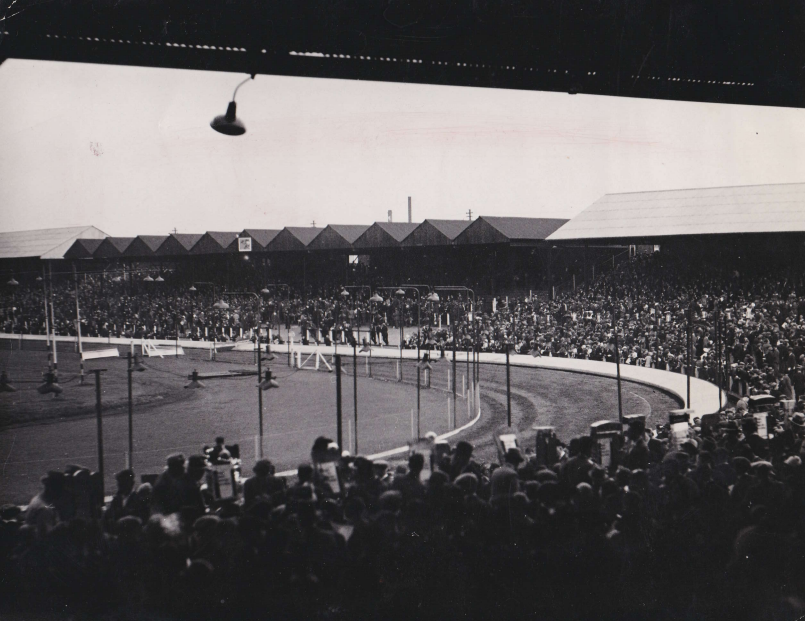
Harringay Stadium was a major greyhound racing and motorcycle speedway venue in Harringay, north London. It was built and opened in 1927 and closed in 1987.
Harringay Stadium was the third greyhound racing stadium to open in Britain. It was owned by the Greyhound Racing Association Ltd (GRA). After great success with their first track at Belle Vue in Manchester in 1926, they opened both White City and Harringay stadiums in 1927.
The driving force behind the GRA, and its managing director until the 1960s, was Brigadier-General Alfred Critchley, who wrote in his autobiography that, when he first learned of greyhound racing, "It immediately occurred to me that this might prove to be the poor man's racecourse". Apparently his interest in how the lower-paid classes were losing money by backing horses was born out of concern for his valet who lost large sums betting on horse racing.
Harringay Stadium was constructed by Messrs T.G. Simpson of Victoria Street, London, at a cost of £35,000. The 23-acre (93,000 m2) site had been the Williamson's Pottery Works from the late 18th century through to the early 1900s. It was then used as a dumping ground for the spoil from the construction of the Piccadilly line to Finsbury Park.
On completion, the rather awkward structure had a capacity of 50,000. The main stand running along the north of the site seated 3,000. The remaining 47,000 spectators were accommodated on terracing constructed on earth banking. When it opened the stadium was originally called Harringay Park.
There were a number of additions to the stadium in the years after construction, including a number of smaller stands around the track and the construction of a restaurant in the main stand. One of the most renowned additions was the Australian-invented Julius totalisator. This electro-mechanical computer, installed in 1930 and extended and upgraded in 1948, saw continuous service until the stadium was closed in 1987.
The opening night was on Tuesday 13 September 1927 and drew in a crowd of 35,000, and the racing was dampened by persistent rain all evening. The opening race was the Chorley Wood Stakes, and it was won by Baltard Castle over 500 yards in a time of 30.80 sec at 3–1 for trainer Sid Jennings. Another greyhound racing that evening was Ever Bright trained by John 'Jack' Kennedy and although only finishing third he would finish as runner-up in the 1927 English Greyhound Derby less than one month later. The original trainers were Kennedy, Jennings, William Spoor, Harry Buck and Reginald Grey. Track lighting was seen as a first-time experience by most (football did not have floodlights for another 30 years).
In 1927 the GRA set up the Hook estate at Northaw for GRA trainers to train out off for White City Stadium and Harringay. The 140 acres of park and grassland was used for greyhounds over nine months old and could house 600 dogs. The pups under nine months were reared under the supervision of William Skerratt on farms in and around Blythe Bridge near Stoke-on-Trent before graduating to Northaw.
Hub AI
Harringay Stadium AI simulator
(@Harringay Stadium_simulator)
Harringay Stadium
Harringay Stadium was a major greyhound racing and motorcycle speedway venue in Harringay, north London. It was built and opened in 1927 and closed in 1987.
Harringay Stadium was the third greyhound racing stadium to open in Britain. It was owned by the Greyhound Racing Association Ltd (GRA). After great success with their first track at Belle Vue in Manchester in 1926, they opened both White City and Harringay stadiums in 1927.
The driving force behind the GRA, and its managing director until the 1960s, was Brigadier-General Alfred Critchley, who wrote in his autobiography that, when he first learned of greyhound racing, "It immediately occurred to me that this might prove to be the poor man's racecourse". Apparently his interest in how the lower-paid classes were losing money by backing horses was born out of concern for his valet who lost large sums betting on horse racing.
Harringay Stadium was constructed by Messrs T.G. Simpson of Victoria Street, London, at a cost of £35,000. The 23-acre (93,000 m2) site had been the Williamson's Pottery Works from the late 18th century through to the early 1900s. It was then used as a dumping ground for the spoil from the construction of the Piccadilly line to Finsbury Park.
On completion, the rather awkward structure had a capacity of 50,000. The main stand running along the north of the site seated 3,000. The remaining 47,000 spectators were accommodated on terracing constructed on earth banking. When it opened the stadium was originally called Harringay Park.
There were a number of additions to the stadium in the years after construction, including a number of smaller stands around the track and the construction of a restaurant in the main stand. One of the most renowned additions was the Australian-invented Julius totalisator. This electro-mechanical computer, installed in 1930 and extended and upgraded in 1948, saw continuous service until the stadium was closed in 1987.
The opening night was on Tuesday 13 September 1927 and drew in a crowd of 35,000, and the racing was dampened by persistent rain all evening. The opening race was the Chorley Wood Stakes, and it was won by Baltard Castle over 500 yards in a time of 30.80 sec at 3–1 for trainer Sid Jennings. Another greyhound racing that evening was Ever Bright trained by John 'Jack' Kennedy and although only finishing third he would finish as runner-up in the 1927 English Greyhound Derby less than one month later. The original trainers were Kennedy, Jennings, William Spoor, Harry Buck and Reginald Grey. Track lighting was seen as a first-time experience by most (football did not have floodlights for another 30 years).
In 1927 the GRA set up the Hook estate at Northaw for GRA trainers to train out off for White City Stadium and Harringay. The 140 acres of park and grassland was used for greyhounds over nine months old and could house 600 dogs. The pups under nine months were reared under the supervision of William Skerratt on farms in and around Blythe Bridge near Stoke-on-Trent before graduating to Northaw.