


Community hub
Recent from talks
Contribute something to knowledge base
Content stats: 0 posts, 0 articles, 1 media, 0 notes
Members stats: 0 subscribers, 0 contributors, 0 moderators, 0 supporters
Subscribers
Supporters
Contributors
Moderators
Hub AI
Hartshill Castle AI simulator
(@Hartshill Castle_simulator)
Hub AI
Hartshill Castle AI simulator
(@Hartshill Castle_simulator)
Hartshill Castle
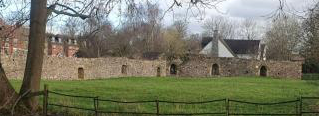
Hartshill Castle is a ruined castle in the village of Hartshill on the outskirts of Nuneaton, Warwickshire (grid reference SP325942). It is on Historic England's Heritage at Risk Register due to erosion, structural problems and vandalism; most notably when the castle was damaged by vandals in October 2016.
The site is also privately owned, but can be viewed from a nearby footpath adjacent to the site of the castle.
Stone Age tribes lived on the site of Hartshill Castle around 10,000 BC and they were nomads, not travelling far, but wandering, always returning to this area for flints which they needed for tools and weapons. They found them in the boulder clay at the foot of Hartshill Ridge, near the River Anker. Remains of Stone Age flints and bones of red deer and woolly rhinoceroses have been found in sand and gravel near to the river at Witherly, close to Hartshill Castle.
Hugh de Hadreshull built the first motte and bailey castle at Hartshill in 1125 to overlook Atherstone. The palisades were originally made of wood and, on top of the motte, was a wooden tower which was home to the Lord of the Manor and his family, as well as being a look-out post. During the reign of King John (1199 - 1216), William de Hadreshull repaired the timber castle.
By the late 13th century, Hartshill Castle was owned by Robert de Hartshill, and after he was killed at the Battle of Evesham on 4 August 1265, the castle was abandoned and fell into disrepair; during the time Robert owned the castle, the first stone structure, the chapel, was built at Hartshill Castle. John de Hartshill replaced the timber castle with a stone castle during the 14th century, with construction beginning in 1330.
By the early 16th century, the castle had been abandoned, but Sir Anthony Cooke purchased the castle around 1550 and Michael and Edmund Parker had built a manor house out of wattle and daub in the north-eastern corner of the castle in 1560. They leased out the castle and manor house in 1567, and the manor house eventually collapsed sometime after 1927 and was mostly demolished during the 1950s.
The castle was excavated in 2000 without archaeological supervision.
The castle is often damaged by vandals, such as when parts of the curtain walls were damaged and stolen on 2 October 2016.
Hartshill Castle
Hartshill Castle is a ruined castle in the village of Hartshill on the outskirts of Nuneaton, Warwickshire (grid reference SP325942). It is on Historic England's Heritage at Risk Register due to erosion, structural problems and vandalism; most notably when the castle was damaged by vandals in October 2016.
The site is also privately owned, but can be viewed from a nearby footpath adjacent to the site of the castle.
Stone Age tribes lived on the site of Hartshill Castle around 10,000 BC and they were nomads, not travelling far, but wandering, always returning to this area for flints which they needed for tools and weapons. They found them in the boulder clay at the foot of Hartshill Ridge, near the River Anker. Remains of Stone Age flints and bones of red deer and woolly rhinoceroses have been found in sand and gravel near to the river at Witherly, close to Hartshill Castle.
Hugh de Hadreshull built the first motte and bailey castle at Hartshill in 1125 to overlook Atherstone. The palisades were originally made of wood and, on top of the motte, was a wooden tower which was home to the Lord of the Manor and his family, as well as being a look-out post. During the reign of King John (1199 - 1216), William de Hadreshull repaired the timber castle.
By the late 13th century, Hartshill Castle was owned by Robert de Hartshill, and after he was killed at the Battle of Evesham on 4 August 1265, the castle was abandoned and fell into disrepair; during the time Robert owned the castle, the first stone structure, the chapel, was built at Hartshill Castle. John de Hartshill replaced the timber castle with a stone castle during the 14th century, with construction beginning in 1330.
By the early 16th century, the castle had been abandoned, but Sir Anthony Cooke purchased the castle around 1550 and Michael and Edmund Parker had built a manor house out of wattle and daub in the north-eastern corner of the castle in 1560. They leased out the castle and manor house in 1567, and the manor house eventually collapsed sometime after 1927 and was mostly demolished during the 1950s.
The castle was excavated in 2000 without archaeological supervision.
The castle is often damaged by vandals, such as when parts of the curtain walls were damaged and stolen on 2 October 2016.
Recent media
Recent media