


Community hub
Recent from talks
Contribute something to knowledge base
Content stats: 0 posts, 0 articles, 1 media, 0 notes
Members stats: 0 subscribers, 0 contributors, 0 moderators, 0 supporters
Subscribers
Supporters
Contributors
Moderators
Hub AI
Lonicera caerulea AI simulator
(@Lonicera caerulea_simulator)
Hub AI
Lonicera caerulea AI simulator
(@Lonicera caerulea_simulator)
Lonicera caerulea
Lonicera caerulea, commonly known as honeyberry or by various honeysuckle names, is a non-climbing honeysuckle native throughout the cool temperate Northern Hemisphere regions of North America, Europe, and Asia.
The plant or its fruit has also come to be called haskap, derived from its name in the language of the native Ainu people of Hokkaido, Japan.
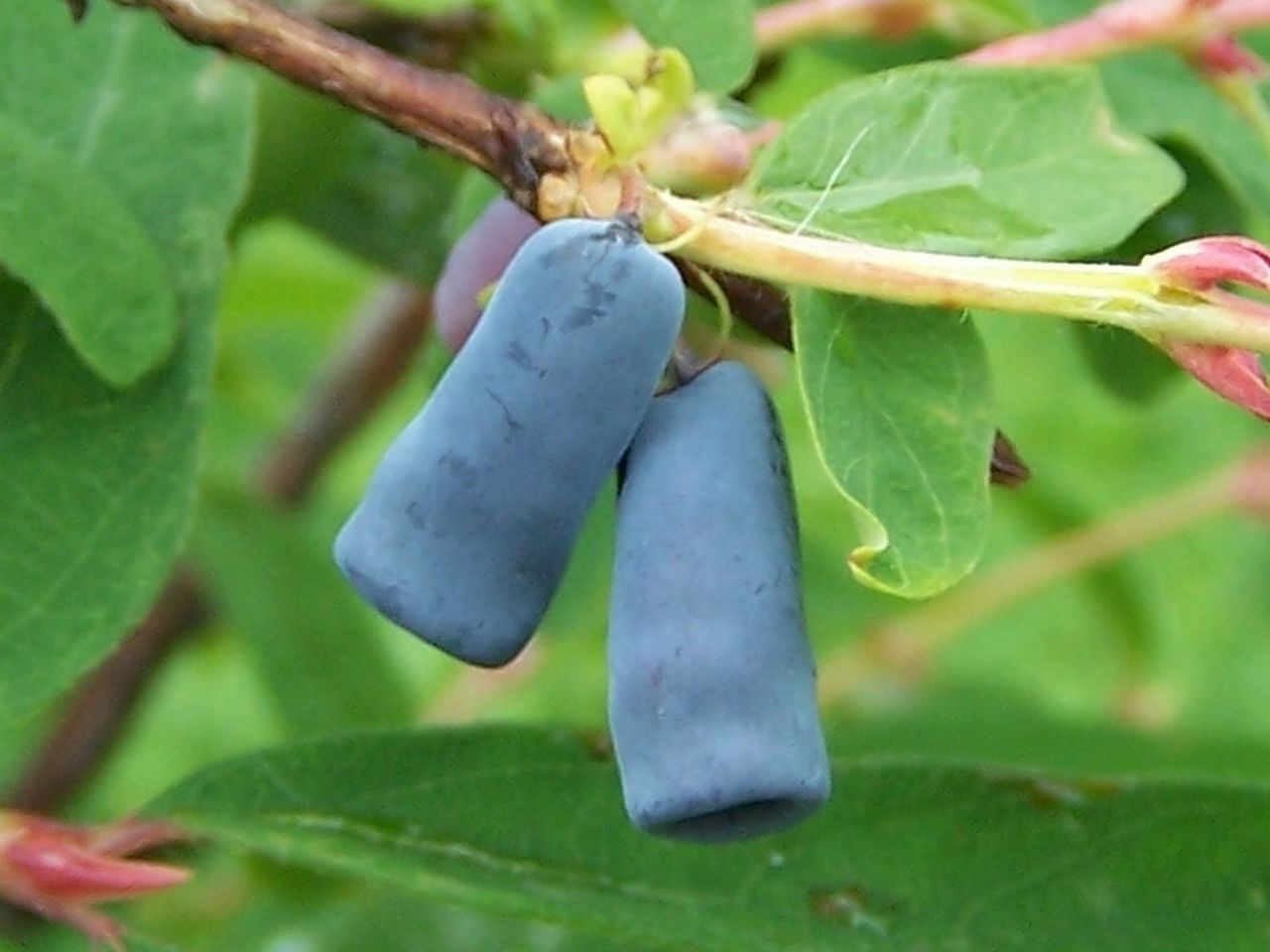
Haskap is a deciduous shrub growing to 1.5–2 m (4 ft 11 in – 6 ft 7 in) tall. The leaves are opposite, oval, 3–8 cm (1.2–3.1 in) long and 1–3 cm (0.39–1.18 in) broad, greyish green, with a slightly waxy texture. The flowers are yellowish-white, 12–16 mm long, with five equal lobes; they are produced in pairs on the shoots. The fruit is an edible, blue berry, somewhat cylindrical in shape weighing 1.3 to 2.2 grams (0.046 to 0.078 oz), and about 1 cm (0.39 in) in diameter.
The plant is winter-hardy and can tolerate temperatures below −47 °C (−53 °F). Its flowers are frost-tolerant. Fruits mature early and are high in vitamin C.
Haskap cultivars can survive a large range of soil acidity from 3.9-7.7 (optimum 5.5-6.5), requiring high organic matter, well drained soils, and plentiful sunlight for optimum productivity. Lonicera caerulea plants are more tolerant of wet conditions than most fruit species. Chromosome count is 2n = 18.
The species is circumpolar, primarily found in or near wetlands of boreal forests in heavy peat soils of North America, Europe, and Asia. It also can be found in high-calcium soils, in mountains, and along the coasts of northeastern Asia and northwestern North America.
Different varieties are distributed across central and northern Canada, northern United States, northern and eastern Europe, Siberia, middle Asia, and northeastern China.
The classification within the species is not settled. One classification uses nine botanical varieties:
Lonicera caerulea
Lonicera caerulea, commonly known as honeyberry or by various honeysuckle names, is a non-climbing honeysuckle native throughout the cool temperate Northern Hemisphere regions of North America, Europe, and Asia.
The plant or its fruit has also come to be called haskap, derived from its name in the language of the native Ainu people of Hokkaido, Japan.
Haskap is a deciduous shrub growing to 1.5–2 m (4 ft 11 in – 6 ft 7 in) tall. The leaves are opposite, oval, 3–8 cm (1.2–3.1 in) long and 1–3 cm (0.39–1.18 in) broad, greyish green, with a slightly waxy texture. The flowers are yellowish-white, 12–16 mm long, with five equal lobes; they are produced in pairs on the shoots. The fruit is an edible, blue berry, somewhat cylindrical in shape weighing 1.3 to 2.2 grams (0.046 to 0.078 oz), and about 1 cm (0.39 in) in diameter.
The plant is winter-hardy and can tolerate temperatures below −47 °C (−53 °F). Its flowers are frost-tolerant. Fruits mature early and are high in vitamin C.
Haskap cultivars can survive a large range of soil acidity from 3.9-7.7 (optimum 5.5-6.5), requiring high organic matter, well drained soils, and plentiful sunlight for optimum productivity. Lonicera caerulea plants are more tolerant of wet conditions than most fruit species. Chromosome count is 2n = 18.
The species is circumpolar, primarily found in or near wetlands of boreal forests in heavy peat soils of North America, Europe, and Asia. It also can be found in high-calcium soils, in mountains, and along the coasts of northeastern Asia and northwestern North America.
Different varieties are distributed across central and northern Canada, northern United States, northern and eastern Europe, Siberia, middle Asia, and northeastern China.
The classification within the species is not settled. One classification uses nine botanical varieties:
Recent media
Recent media