Hubbry Logo
ShrubShrubMain
Open search
Shrub
Community hub
Shrub
logo
8 pages, 0 posts
0 subscribers
Be the first to start a discussion here.
Contribute something
Shrub
Shrub
from Wikipedia
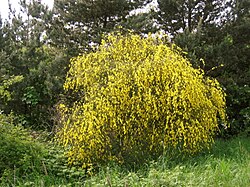
A broom shrub in flower
A rhododendron shrubbery in Sheringham Park

A shrub or bush is a small to medium-sized perennial woody plant. Unlike herbaceous plants, shrubs have persistent woody stems above the ground. Shrubs can be either deciduous or evergreen. They are distinguished from trees by their multiple stems and shorter height, less than 6–10 m (20–33 ft) tall.[1][2] Small shrubs, less than 2 metres (6.6 feet) tall are sometimes termed as subshrubs. Many botanical groups have species that are shrubs, and others that are trees and herbaceous plants instead.

Some define a shrub as less than 6 m (20 ft) and a tree as over 6 m. Others use 10 m (33 ft) as the cutoff point for classification.[2] Many trees do not reach this mature height because of hostile, less than ideal growing conditions, and resemble shrub-sized plants. Others in such species have the potential to grow taller in ideal conditions. For longevity, most shrubs are classified between perennials and trees. Some only last about five years in good conditions. Others, usually larger and more woody, live beyond 70. On average, they die after eight years.[3]

Shrubland is the natural landscape dominated by various shrubs; there are many distinct types around the world, including fynbos, maquis, shrub-steppe, shrub swamp and moorland. In gardens and parks, an area largely dedicated to shrubs (now somewhat less fashionable than a century ago) is called a shrubbery, shrub border or shrub garden. There are many garden cultivars of shrubs, bred for flowering, for example rhododendrons, and sometimes even leaf colour or shape.

Compared to trees and herbaceous plants, a small number of shrubs have culinary usage.[citation needed] Apart from the several berry-bearing species (using the culinary rather than botanical definition), few are eaten directly, and they are generally too small for much timber use unlike trees. Those that are used include several perfumed species such as lavender and rose, and a wide range of plants with medicinal uses. Tea and coffee are on the tree-shrub boundary;[4] they are normally harvested from shrub-sized plants, but these would be large enough to become small trees if left to grow instead.

Definition

[edit]

Shrubs are perennial woody plants, and therefore have persistent woody stems above ground (compare with succulent stems of herbaceous plants).[2] Usually, shrubs are distinguished from trees by their height and multiple stems. Some shrubs are deciduous (e.g. hawthorn) and others evergreen (e.g. holly).[2] Ancient Greek philosopher Theophrastus divided the plant world into trees, shrubs and herbs.[5] Small, low shrubs, generally less than 2 m (6.6 ft) tall, such as lavender, periwinkle and most small garden varieties of rose, are often termed as subshrubs.[6][7]

Most definitions characterize shrubs as possessing multiple stems with no main trunk below.[2] This is because the stems have branched below ground level. There are exceptions to this, with some shrubs having main trunks, but these tend to be very short and divide into multiple stems close to ground level without a reasonable length beforehand. Many trees can grow in multiple stemmed forms also while being tall enough to be trees, such as oak or ash.[2]

Evolution and adaptive value of growth form

[edit]

Ecologists and evolutionary biologists have paid little attention to why there are two major growth forms of woody plants; shrubs and trees, both occurring on large land area, and often together. While the time when the first shrubs appeared on the Earth is difficult to establish, hypotheses explaining the adaptive value of having multiple stems, compared to a single one in trees, exist. One model is based on the advantages of having many stems, with larger total stem area for photosynthesis (on, and under bark), larger area of cambium and phloem, and larger area for sprouting from stems, compared to a (small) tree with same initial woody volume.[8]This model could successfully predict faster shrub growh than tree growth at early stages. Other advantages for shrubs (compared to trees) include for instance extra stems in case one die, and faster seed production. It is not surprising that at least angiosperm trees, if cut or broken, revert to shrub growth form for fast growth (due to their capacity of sprouting at the base, and thus becoming shrub-like for some time).

Many shrubs, such as Salix species, have good dispersal ability (seeds disperse by air) and many shrubs are also able to grow in more extreme habitats, such as alpine areas, where trees are less common. The last decades have seen 'shrubification' in the arctic, with marked increase of shrublands. One reason is increased temperature, with consequences for plant community structure and carbon balance.[9]

Use in gardens and parks

[edit]

An area of cultivated shrubs in a park or a garden is known as a shrubbery.[10] When clipped as topiary, suitable species or varieties of shrubs develop dense foliage and many small leafy branches growing close together.[11] Many shrubs respond well to renewal pruning, in which hard cutting back to a "stool", removes everything but vital parts of the plant, resulting in long new stems known as "canes".[12] Other shrubs respond better to selective pruning to dead or unhealthy, or otherwise unattractive parts to reveal their structure and character.[13]

Shrubs in common garden practice are generally considered broad-leaved plants, though some smaller conifers such as mountain pine and common juniper are also shrubby in structure. Species that grow into a shrubby habit may be either deciduous or evergreen.[14]

Botanical structure

[edit]
Shrub vegetation (with some cactus) in Webb County, Texas.
Blackthorn shrub (Prunus spinosa) in the Vogelsberg
Hydrangea macrophylla
Winter-flowering Witch-hazel (Hamamelis)
Senecio angulatus, a scrambling shrub by the sea (yellow-flowered).

In botany and ecology, a shrub is more specifically used to describe the particular physical canopy structure or plant life-form of woody plants which are less than 8 metres (26 ft) high and usually multiple stems arising at or near the surface of the ground. For example, a descriptive system widely adopted in Australia is based on structural characteristics based on life-form, plus the height and amount of foliage cover of the tallest layer or dominant species.[15]

For shrubs that are 2–8 metres (6.6–26.2 ft) high, the following structural forms are categorized:

  • dense foliage cover (70–100%) — closed-shrubs
  • mid-dense foliage cover (30–70%) — open-shrubs
  • sparse foliage cover (10–30%) — tall shrubland
  • very sparse foliage cover (<10%) — tall open shrubland

For shrubs less than 2 metres (6.6 ft) high, the following structural forms are categorized:

  • dense foliage cover (70–100%) — closed-heath or closed low shrubland—(North America)
  • mid-dense foliage cover (30–70%) — open-heath or mid-dense low shrubland—(North America)
  • sparse foliage cover (10–30%) — low shrubland
  • very sparse foliage cover (<10%) — low open shrubland

List

[edit]

Those marked with * can also develop into tree form if in ideal conditions.

A
B
C
D
E
F
G
H
I
J
K
L
M
N
O
P
Q
R
S
T
U
V
W
X
Y
Z

References

[edit]
Revisions and contributorsEdit on WikipediaRead on Wikipedia
from Grokipedia
A shrub is a distinguished from trees by its multiple stems arising close to or directly from the ground, typically reaching heights of less than 6 meters (20 feet), though some may exceed this in favorable conditions. Unlike trees, which develop a single dominant trunk, shrubs often form a bushy or rounded structure with branching that begins low on the plant, enabling them to thrive in diverse environments from arid deserts to temperate forests. Shrubs encompass both , which retain foliage year-round, and types that shed leaves seasonally. In ecological systems, shrubs play a vital role by providing , sources such as berries and , and for including birds, , and small mammals, thereby supporting across ecosystems. They contribute to , preventing on slopes and in disturbed areas, and enhance nutrient cycling through leaf litter . In forests, shrubs form critical components of communities, influencing succession patterns after disturbances like and responding to environmental factors such as . Horticulturally, shrubs are valued for due to their ornamental flowers, fruits, and foliage, with selections like providing seasonal color and structure in gardens.

Definition and Characteristics

Definition

A shrub is defined in as a that typically grows to a of less than 6 to 10 meters (20 to 33 feet), characterized by multiple stems or trunks arising directly from the base near the ground rather than a single central trunk. This distinguishes shrubs from trees, which develop a dominant trunk, while positioning shrubs intermediate between herbaceous and taller woody species in the spectrum of vascular , though the distinction is not always absolute as some can exhibit both growth forms depending on environmental conditions. Shrubs encompass a wide variety of forms, including both that shed their leaves seasonally and that retain foliage year-round. Within , shrubs are classified under the broader category of woody perennials in the division Magnoliophyta (flowering plants) and other relevant groups, serving as a key growth form in ecosystems worldwide. The term "shrub" derives from "shrubbe," which traces back to "scrybb," meaning brushwood or undergrowth, with roots in Proto-Germanic words akin to Scandinavian terms for low, bushy vegetation. In common botanical usage, shrubs are differentiated from subshrubs, which are semi-woody plants that are only partially lignified, typically woody at the base with herbaceous upper stems, and often shorter in stature. Similarly, shrubs differ from lianas, which are woody climbing vines that use other structures for support rather than self-supporting erect growth. These distinctions highlight the self-supporting, multi-stemmed central to the shrub form.

Distinguishing Features

Shrubs are distinguished from primarily by their height and growth form, typically reaching a maximum of around 6 meters (20 feet) with multiple stems arising from or near the ground, creating a bushy, rounded rather than a single dominant trunk topped by a canopy. This multi-stemmed structure contrasts with the singular, upright bole of trees, which often exceed 6 meters and develop a clear central axis for height competition in forests. For instance, while a like an grows to form a single trunk supporting elevated branches, shrubs such as the American plum () maintain several low-originating stems that spread laterally. The lignification of shrubs involves persistent woody stems that provide year-round , yet without the vertical elongation seen in trees, allowing shrubs to allocate resources to lateral expansion rather than height. These stems, often rigid and , enable shrubs to maintain form across seasons, differing from the herbaceous, non-woody stems of annuals or the towering, self-supporting trunks of trees. Branching in shrubs is characteristically dense and lateral, originating close to the soil surface, which frequently results in the formation of thickets—compact clusters of interconnected that enhance stability in exposed environments. This pattern, evident in species like black chokeberry (), promotes a low-center-of-gravity suited to open or disturbed areas. Leaf traits in shrubs vary between persistent () and seasonal () foliage, with many species featuring simple, undivided leaves that optimize capture in or edge habitats; examples include the oval, simple leaves of (Forsythia spp.) in deciduous forms or the leathery, persistent leaves of (Rhododendron spp.) in evergreens. Reproductive structures, including flowers and fruits, are adapted to diverse methods, such as insect-attracting tubular blooms in azaleas or wind-dispersed berry-like fruits in viburnums, facilitating effective spread without reliance on tall stature. These traits underscore shrubs' versatility in compared to the often elevated, gravity-dependent fruiting of trees. Shrubs exhibit notable environmental resilience, particularly through basal meristems that enable regrowth after , by herbivores, or disturbance, allowing stems to resprout from the base rather than solely from apical tips. This capacity for renewal, as seen in rejuvenation of species like potentilla (Potentilla spp.), contrasts with trees' vulnerability to top damage and supports shrubs' persistence in dynamic landscapes. In fire-prone areas, this basal sprouting mechanism aids rapid recovery, maintaining community structure in shrub-dominated ecosystems.

Botanical Structure

Growth Habit

Shrubs exhibit a life cycle marked by repeated annual growth cycles, with species entering a period of seasonal during colder months to minimize energy expenditure and protect against environmental stress. This dormancy involves cessation of active growth, leaf drop, and metabolic slowdown, allowing resumption of vegetative expansion in favorable spring conditions. The lifespan of individual shrubs varies widely, typically 10-30 years for many under cultivation, though some wild can live for centuries, influenced by , , and management, enabling them to persist as foundational elements in diverse ecosystems. Stem development in shrubs is characterized by the production of multiple primary stems originating from basal buds close to the soil surface, resulting in a bushy, multi-trunked without a single dominant central leader as seen in trees. This form arises early in from adventitious buds on the root crown or lower stem, promoting lateral expansion over vertical elongation and contributing to the plant's overall rounded or spreading silhouette. Shrubs respond to environmental cues such as , , and nutrients through hormonal , particularly auxins, which promote cell elongation and , though shrubs exhibit weaker than trees, allowing for multiple stems and a more compact stature. In response to disturbance or resource availability, many shrubs employ suckering—emergence of new shoots from —or natural layering, where flexible stems root upon contact with , facilitating clonal spread and colony formation without reliance on . During maturity phases, shrubs progress from a juvenile stage featuring dense, bushy growth with prolific branching and high shoot density to a mature phase where the form becomes more compact, with reduced branching vigor and increased lignification stabilizing the structure. Age-related changes often lead to denser wood formation and altered branching patterns, enhancing resilience but potentially limiting new shoot production, as observed in like ( spp.) where initial upright growth yields to rounded maturity.

Anatomy and Physiology

Shrubs exhibit secondary growth through the activity of the , a lateral that produces secondary inward and secondary outward, resulting in the thickening of stems and the formation of and bark. The secondary consists of lignified cells, including vessels and tracheids, that provide structural support and facilitate efficient water transport from to shoots via and pressure gradients. Bark, derived from secondary and , protects the inner tissues and includes layers such as phelloderm, phellogen, and phellem, which contribute to and environmental resistance. Root systems in shrubs are typically either fibrous, forming a dense network of shallow, branching roots for enhanced soil anchorage and nutrient absorption, particularly in shallow or erosion-prone soils, or taproot systems, which develop a primary root penetrating deeper into the soil for access to water and nutrients in deeper, more stable soils. Many shrub species form symbiotic mycorrhizal associations with soil fungi, where fungal hyphae extend the root surface area, improving uptake of phosphorus and other nutrients in exchange for plant-derived carbohydrates. Leaf physiology in shrubs supports efficient primarily through mesophyll cells in the and spongy layers, where chloroplasts capture light and fix into sugars via the . In dense shrub canopies, overlapping leaves optimize light interception while minimizing water loss, contributing to higher photosynthetic rates per unit area compared to sparse arrangements. Arid-adapted shrubs often possess sclerophyllous leaves, characterized by thick, leathery cuticles and reduced surface area, which lower rates and enhance , though this can limit mesophyll conductance and maximum photosynthetic capacity. Reproductive physiology in shrubs involves specialized flower structures arranged in inflorescences such as racemes or panicles, which facilitate by attracting pollinators through or visual cues, leading to fertilization and development. mechanisms include ballistic ejection, animal-mediated transport via fruits, or wind dispersal through lightweight samaras, ensuring propagation across suitable habitats. Hormonal regulation, particularly by promoting dormancy and breaking it, controls viability and timing in response to environmental cues like and . Water and dynamics in shrubs rely on transport, driven by the cohesion-tension mechanism where from leaves creates negative pressure, pulling upward through continuous columns held by cohesive forces between molecules and forces to vessel walls. Nutrients, absorbed via and loaded into sap, move passively with this flow, with rates influenced by availability and demand, ensuring balanced distribution to support growth and metabolism.

Ecology and Distribution

Habitats and Adaptations

Shrubs exhibit a broad global distribution, thriving in diverse biomes such as temperate forests, Mediterranean scrublands, , and deserts. They are particularly prevalent in coastal regions between 30° and 40° latitude north and south, including areas surrounding the , , , southwestern , and southwest Africa. In , chaparral shrublands dominate California's coastal ranges, while xeric shrublands extend across arid interiors worldwide, often bordering deserts and grasslands. In colder regions, shrubs form extensive covers in and alpine zones, from the to high-elevation montane areas. Adaptations to climatic extremes enable shrubs to persist in these varied environments. In drought-prone deserts and Mediterranean climates, many species develop deep root systems to tap into subsurface reserves, reducing reliance on surface . Reduced area, often through small, needle-like, or thick, waxy leaves, minimizes water loss via while reflecting excess . For cold resistance in alpine and habitats, shrubs evolve low-growing, prostrate forms that hug the ground, forming dense mats or cushions to shield against desiccation winds and retain heat beneath cover. These compact growth habits, supported by their woody structure, enhance resilience to freezing temperatures and short growing seasons. Shrubs demonstrate notable soil preferences, often colonizing nutrient-poor, rocky, or sandy substrates where taller struggles. Certain shrub , including those in the family like (), form symbiotic relationships with bacteria in root nodules to fix atmospheric nitrogen and improve in barren areas. Other shrubs, such as Russian olive () in the family, associate with bacteria for the same purpose. In response to disturbances, shrubs frequently employ resprouting mechanisms for rapid recovery. Following fires, many possess —swollen, woody basal structures storing carbohydrates and dormant buds—that facilitate vegetative regeneration, as seen in species like . This adaptation is evolutionarily linked to frequent regimes in shrublands, with lignotuber formation evolving as a proxy for shifting fire intensities over millennia. resistance arises from tough, fibrous leaves and stems, allowing persistence in herbivore-pressured landscapes. Shrublands themselves trace an evolutionary history tied to post-glacial warming, expanding from refugia during the Pleistocene as ice sheets retreated, fostering diverse assemblages in newly exposed terrains. Shrubs contribute significantly to in transitional habitats, serving as key components in ecotones like forest edges and . In these zones, they bridge distinct communities, enhancing by providing structural diversity and microhabitats that support plants and pollinators. For instance, riparian shrub thickets along wetland margins act as buffers, stabilizing soils and fostering high faunal diversity amid shifting environmental gradients.

Ecological Roles

Shrubs play a vital in supporting within ecosystems by providing essential food sources such as berries, , and foliage, as well as and nesting sites for birds, , , and small mammals. These structures, including dense foliage and branching habits, create microhabitats that enhance complexity, fostering diverse communities and promoting activity through floral resources. For instance, -rich shrubs attract that serve as prey for birds, while fruit-bearing varieties support by frugivorous animals, thereby maintaining in plant populations. In terms of , shrubs contribute significantly to through their extensive root networks, which anchor particles and prevent loss during heavy rainfall or events. These roots also facilitate by storing carbon in woody biomass and , enhancing carbon stocks over time. Additionally, shrubs help regulate nutrient cycling by preventing degradation, which supports long-term and reduces the risk of landslides in sloped terrains. Shrubs are key participants in dynamics, often acting as in disturbed habitats such as post-fire or cleared areas, where they rapidly colonize bare ground and stabilize the environment for subsequent establishment. In primary succession, shrubs follow initial herbaceous colonizers, providing shade and that improve conditions and facilitate the transition to forested communities; conversely, in , they maintain stable, fire-adapted states that resist further succession. This role underscores their importance in ecosystem recovery, as they bridge early and late successional stages. Shrubs engage in various biotic interactions, including mutualisms with organisms like mycorrhizal fungi, which enhance uptake through symbiotic associations, and , which defend against herbivores in exchange for or shelter. However, competitive interactions arise when shrubs vie for light, water, and with neighboring , potentially altering composition. Invasive shrub can exacerbate these dynamics by outcompeting native , disrupting mutualistic networks, and reducing overall through resource monopolization. Shrubs contribute to climate regulation by moderating microclimates through shading, which reduces and air temperatures, and , which cools surrounding areas and influences local . Their woody tissues serve as carbon sinks, sequestering atmospheric CO2 and mitigating accumulation. In response to global warming, shrubs are expanding in regions like the Arctic tundra, altering effects and amplifying regional warming through increased vegetation cover. This expansion, driven by warmer temperatures, enhances carbon storage but may feedback positively on by reducing surface reflectivity.

Human Uses

Ornamental and Landscaping

Shrubs play a central role in garden design, often serving as hedges to provide and define boundaries, foundation plantings to soften building edges, and massed groups to create vibrant color displays throughout the seasons. In formal garden layouts, shrubs have been integral since the in , where they were meticulously clipped into geometric patterns to form parterres and allées, emphasizing symmetry and human control over nature. These structured plantings complemented architectural elements, enhancing the grandeur of estates like those in Italian and French gardens that influenced broader European traditions. Aesthetic appeal drives the selection of various shrub types for ornamental purposes, with flowering varieties such as hydrangeas (Hydrangea spp.) prized for their large, showy blooms in shades of blue, pink, and white that add seasonal drama to borders and woodland edges. Evergreen shrubs, including boxwood (Buxus spp.) and yew (Taxus spp.), provide year-round structural definition and foliage density, acting as reliable backdrops or accents in mixed plantings. For autumn interest, deciduous shrubs like fothergilla (Fothergilla gardenii) and oakleaf hydrangea (Hydrangea quercifolia) deliver striking foliage displays in hues of red, orange, and purple, extending visual appeal beyond summer. In urban settings, shrubs contribute to resilient landscaping through applications like green roofs, where low-growing, drought-tolerant species help mitigate stormwater runoff and absorb airborne pollutants such as particulate matter. Street plantings often feature compact shrubs selected for their mature size, low maintenance needs, and ability to tolerate pollution, forming barriers that improve air quality and reduce urban heat islands. Criteria for urban shrub selection emphasize adaptability to confined spaces, minimal pruning requirements, and resistance to traffic-related stresses to ensure long-term viability. From a perspective, incorporating shrubs enhances in residential and public yards by providing and sources for pollinators and birds. Sustainable practices prioritize native shrubs, which require significantly less supplemental compared to non-natives while supporting local ecosystems and reducing demands in water-scarce regions. Shrubs hold cultural significance in landscaping traditions, symbolizing order and artistry, as seen in the English garden practice of , where evergreens like boxwood are sculpted into elaborate shapes to evoke classical motifs and whimsy, a technique revived from Roman origins during the and perfected in 17th- and 18th-century estates. This tradition underscores shrubs' role in blending natural forms with human creativity, influencing global garden aesthetics.

Medicinal and Practical Applications

Shrubs have been utilized for medicinal purposes across various cultures, with species like willow (Salix spp.) providing bark rich in salicin, a compound that the body converts to salicylic acid, serving as a natural analgesic for pain relief and inflammation, and acting as the key precursor to synthetic aspirin. Elderberry (Sambucus nigra), a common deciduous shrub, yields fruits and flowers with potent antiviral properties, particularly against influenza viruses, due to bioactive compounds that inhibit viral replication and boost immune response. In practical applications, shrub wood from species such as hazel (Corylus spp.) and dogwood (Cornus spp.) has historically served as a durable material for crafting tools, handles, and fuel, owing to its straight grain and slow-burning qualities. Bark extracts from oak shrubs (Quercus spp.), high in tannins, are employed in vegetable tanning processes to convert animal hides into leather, providing a natural preservative that enhances durability without synthetic chemicals. Additionally, certain shrub barks, like that of black oak (Quercus velutina), yield dyes for coloring textiles and leather through extraction of phenolic compounds. Many shrubs contribute to food and forage systems, with fruits from ( spp.) and currant ( spp.) bushes offering nutrient-dense berries rich in antioxidants, vitamins, and fiber for human consumption. Leaves and twigs from shrubs like and (Alnus spp.) provide browse for in pastoral , supporting animal in arid or forested environments where grasses are scarce. Industrial uses of shrubs include the production of essential oils from lavender (Lavandula spp.), a shrub whose flowers are steam-distilled to yield oils with and calming properties, widely applied in perfumery, , and pharmaceuticals. Fibers extracted from the inner bark of shrubs such as are twisted into cordage for ropes and , leveraging their tensile strength in traditional and sustainable practices. Historically, indigenous communities have integrated shrubs into , with Native American groups using willow bark teas for fever and pain relief long before European contact, reflecting a deep ethnobotanical knowledge passed through generations. In modern research as of 2025, phytochemicals from shrubs—such as and polyphenols—are being studied for their roles in preventing chronic diseases like cancer and cardiovascular conditions, with clinical trials validating their and efficacy in .

Cultivation and Propagation

Growing Conditions

Shrubs thrive in a wide range of USDA Plant Hardiness Zones, typically from 3 to 10, depending on the , with many common varieties suited to zones 5 through 9 based on annual minimum winter temperatures. Selection should prioritize zone compatibility to ensure survival, as rated for warmer zones may suffer winter damage in colder areas, while those from colder zones can adapt to milder conditions. Light requirements vary by shrub type, with most preferring full sun (at least 6 hours of direct daily) for optimal growth and flowering, though many tolerate partial shade (2-4 hours) or even full shade in settings. conditions are critical, favoring well-drained loamy or sandy loams amended with to enhance and nutrient retention; heavy clay soils should be improved with to prevent waterlogging and . pH levels influence suitability, as acid-loving shrubs like rhododendrons require acidic soils (pH 4.5-5.5) for nutrient uptake, while others perform best in neutral to slightly alkaline conditions ( 6.0-7.5). Water needs differ between species, with drought-tolerant shrubs such as junipers requiring infrequent deep watering once established to encourage root depth, whereas moisture-loving types like azaleas demand consistent without saturation to avoid fungal issues. Proper drainage is essential across all types, achieved by planting on mounds in poorly drained sites or incorporating in planting holes to mitigate from excess moisture. strategies should focus on slow, thorough applications during dry spells, adjusting for local rainfall to maintain even . Site selection emphasizes adequate spacing based on mature size—typically 3-6 feet apart for medium shrubs—to promote air circulation and reduce humidity-related diseases. Protection from harsh winds and frost pockets is advisable, especially for tender evergreens, by siting near windbreaks or sheltered walls to minimize desiccation and cold injury. Common challenges include pest vulnerabilities like aphids, which suck sap and weaken growth, and diseases such as powdery mildew, often exacerbated by poor air flow or overhead watering; prevention involves monitoring, cultural practices like pruning for ventilation, and avoiding stressed conditions. As of 2025, climate change effects, including northward shifts in hardiness zones by up to one zone in many U.S. regions due to warming temperatures, are altering shrub suitability, increasing risks from extreme weather, prolonged droughts, and emerging pests adapted to milder winters. For low-maintenance gardening, match shrub species to local climate, soil pH, and light exposure through soil testing and zone mapping, favoring resilient, native-adapted varieties that require minimal intervention once established. Diverse plantings further enhance resilience against pests and environmental shifts.

Reproduction Methods

Shrubs reproduce through both sexual and asexual methods, each offering distinct advantages in propagation and genetic variation. Sexual reproduction primarily occurs via seed propagation, where pollen fertilizes the ovum to form seeds containing genetic material from two parent plants. This method promotes genetic diversity but often requires overcoming seed dormancy, particularly physiological dormancy influenced by environmental cues like temperature and moisture. To break dormancy, stratification is commonly employed, involving the exposure of seeds to moist, cold conditions (typically 0–5°C for 30–90 days) to mimic winter, enhancing germination rates in species such as Rhododendron and Viburnum. Hybridization, a controlled form of sexual reproduction, has been used to develop new cultivars by cross-pollinating compatible shrub species, resulting in offspring with combined desirable traits like improved flowering or hardiness. Asexual reproduction allows for the of shrubs, producing genetically identical offspring that preserve specific traits. Common techniques include cuttings, where stem segments are severed and induced to ; cuttings from new growth (spring/summer) faster in humid environments with rooting hormones, achieving success rates of 70–90% in species like , while hardwood cuttings from dormant stems (winter) suit tougher shrubs such as with lower but reliable rates around 50%. Layering involves bending a low stem to the ground to encourage formation while still attached to the parent, a method effective for sprawling shrubs like with rooting success up to 80% after 6–12 months. Division separates established clumps into sections, ideal for multi-stemmed shrubs such as , yielding multiple plants with high viability (near 100% if healthy divisions are replanted promptly). Grafting and provide advanced asexual options for shrubs, particularly for propagating rare or difficult varieties. unites a scion (desired upper part) with a compatible to confer traits like resistance or vigor, commonly used in fruiting shrubs such as where whip-and-tongue grafts achieve 85–95% success under controlled conditions. , or , cultures explants (small tissue pieces) in nutrient media under sterile conditions to mass-produce clones, especially for woody shrubs recalcitrant to cuttings, with rates exceeding 10-fold per cycle in genera like . Modern biotechnological approaches, including CRISPR-based gene editing since 2020, have enabled targeted modifications for enhanced resistance in plants, though applications in shrubs remain emerging and focus on editing susceptibility genes to bolster traits like fungal tolerance. The breeding of hybrid shrubs traces back to 19th-century European nurseries, where selective hybridization created popular cultivars; for instance, × intermedia emerged in 1878 from crosses between F. suspensa and F. viridissima in , revolutionizing ornamental gardening with its vibrant spring blooms. These efforts, driven by plant collectors like , introduced Asian to Western cultivation and spurred commercial breeding for aesthetic and adaptive improvements. Propagation challenges include germination inhibitors in shrub seeds, such as that enforces to prevent untimely sprouting, necessitating pretreatment like or leaching for species in the family. Asexual methods, while efficient for uniformity, trade off by producing clones vulnerable to uniform threats like pests, contrasting with sexual reproduction's role in fostering adaptive variation essential for long-term population resilience.

Notable Examples

Common Species

Shrubs represent a diverse group within the woody , with common often prized for their ornamental qualities, resilience, and distinctive morphological traits such as multi-stemmed growth, persistent or foliage, and compact forms typically under 6 meters in height. Identification of common genera generally relies on features like arrangement (alternate or opposite), stem texture (smooth or thorny), and reproductive structures (flowers, berries, or cones), which vary by family but help distinguish them from trees or herbaceous . Globally, shrubs contribute significantly to , though exact counts are challenging due to overlapping definitions with small trees; notable concerns include like Japanese barberry (), native to but widely naturalized and problematic in North American forests for altering habitats and harboring ticks. Temperate examples include , a of flowering shrubs primarily native to eastern Asia and parts of , valued for their large inflorescences in shades of blue, pink, or white that cluster on rounded or conical heads. Species like exhibit smooth, opposite leaves and thrive in moist, shaded understories, reaching heights of 1-3 meters. Another key temperate shrub is , with many species originating from , such as , known for producing clusters of small white flowers followed by colorful berries that attract ; these shrubs feature opposite, toothed leaves and grow 2-4 meters tall in woodland edges. Evergreen types are exemplified by (Ilex), a genus with species native to , , and , featuring glossy, spiny-margined leaves and bright red berries that persist through winter for ornamental appeal. Ilex opaca, the American holly, is a slow-growing shrub or small tree up to 15 meters, with dioecious flowers requiring both male and female for fruit production. Similarly, Boxwood (Buxus) originates from the Mediterranean region, including and southwest , and is renowned for its dense, small-leaved foliage ideal for hedging; Buxus sempervirens forms compact, rounded shrubs 1-3 meters high with , opposite leaves that resist clipping. Aromatic or utility shrubs include Lavender (Lavandula), native to the Mediterranean basin, characterized by narrow, gray-green leaves and spikes of purple flowers with a strong fragrance used historically in perfumery and medicine. , the English lavender, grows as a semi-woody shrub to 1 meter, preferring dry, sunny conditions. Lilac (), originating from southeastern and parts of , offers fragrant blooms in panicles; , the common lilac, is a shrub reaching 3-5 meters with heart-shaped leaves and lilac-colored flowers in spring.

Regional Varieties

Shrubs exhibit remarkable diversity across geographic regions, with many species evolving unique adaptations that tie them to specific ecosystems and cultural contexts. In North America, manzanita species in the genus Arctostaphylos are emblematic of fire-prone chaparral habitats in California, where they thrive in the Mediterranean climate of the state's coastal ranges and Sierra Nevada foothills. These evergreen shrubs, such as common manzanita (Arctostaphylos manzanita), are highly fire-adapted, resprouting from basal burls after intense burns that clear competing vegetation and trigger seed germination. Similarly, serviceberry (Amelanchier spp.), including downy serviceberry (A. arborea), is a deciduous shrub native to eastern North American forests, from the Appalachians to the Great Lakes region, producing edible purple pomes that ripen in early summer and serve as a vital food source for wildlife and indigenous communities. In and , regional shrubs often dominate nutrient-poor, acidic landscapes. Heather (Calluna vulgaris), known as ling, forms vast carpets on the UK's upland moors and peatlands, tolerating low-nutrient, acidic soils with pH levels below 5.5 and supporting in these oligotrophic environments. In , azaleas—deciduous and subsets of the , such as R. indicum—originate from temperate and subtropical zones, with early cultivation records dating to the 15th century in , where they are prized for their vibrant spring blooms in ornamental gardens and tea ceremonies. Tropical and subtropical regions host shrubs suited to humid, coastal margins. Hibiscus species, like H. rosa-sinensis, are widely used as hedging plants in the Pacific islands, including and , where their glossy leaves and large, showy flowers provide year-round screening in tropical gardens and coastal settlements. In Australia, bottlebrush shrubs (Callistemon spp.), such as crimson bottlebrush (C. citrinus), are endemic to wetland edges and riparian zones along eastern waterways, adapting to periodic flooding with their cylindrical, nectar-rich flower spikes that attract pollinators in eucalypt woodlands. Many regional endemic shrubs face threats from habitat loss due to , , and , with over 58% of endemics classified as threatened or extinct globally as of 2025 assessments. In , like pallid manzanita (Arctostaphylos pallida) are endangered, with populations restricted to fragmented maritime chaparral habitats vulnerable to development and altered fire regimes. Conservation efforts, including protected areas and restoration planting, have stabilized some populations, such as the federally threatened Alameda manzanita, though ongoing habitat degradation persists. Cultural significance further underscores the local importance of these shrubs. In , blackthorn (), a thorny hedgerow shrub, yields sloe berries harvested for , a traditional infused with the fruit's tart flavor, featured in as a symbol of winter resilience and rural cuisine across the and continental hedgerows.

References

Add your contribution
Related Hubs
Contribute something
User Avatar
No comments yet.