



Community hub
Recent from talks
Knowledge base stats:
Talk channels stats:
Members stats:
Havelok the Dane
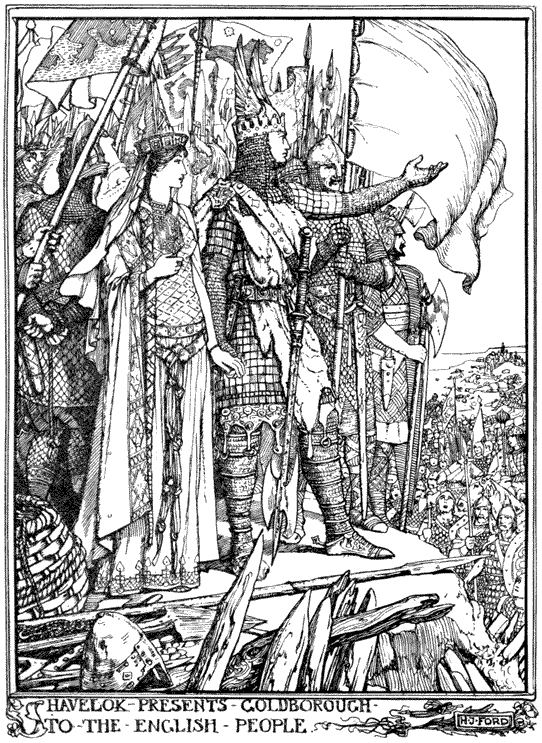
Havelok the Dane, also known as Havelok or Lay of Havelok the Dane, is a 13th-century Middle English romance considered to be part of the Matter of England. The story, however, is also known in two earlier Anglo-Norman versions, one by Geffrei Gaimar and another known as the Lai d'havelok. The name "Havelok" also has many variations in spelling, and can be found as "Haveloc", "Havelock", or "Aybloc".
The story of Havelok is first told in lines 37–818 of Geoffrey Gaimar's Anglo-Norman Estoire des Engleis of about 1135–40.
This was the basis for a few other Anglo-Norman poems, the Lai d'havelok, which in turn may have influenced Havelok the Dane. Havelok is the second oldest surviving romance written in English, after King Horn; it is believed to have been composed somewhere between 1285 and 1310. The romance survives in one imperfect version in the Bodleian Library in Oxford University, as well as some fragments. A copy of the 3,001 line poem is available to view in Grimsby Public Library. A new publication of the late 19th-century translation by Walter Skeat is available as The Lay of Havelock the Dane.
Havelok is often categorized as belonging to the so-called Matter of England, because it deals with legends of English history rather than the legends of Rome, France and Britain, the three traditional subjects of medieval romance. The poem is notable for its interest in law and legal practice and its exploration of ideal kingship, as well as for its detailed depiction of working-class life in 13th-century Lincolnshire. It has been called a 'bourgeois' romance because of the high value placed on hard work, virtuous behaviour, and proverbial wisdom, but since this value is just as observable in working-class life the term can be misleading.
There is evidence that the legend of Havelok was a popular one, as the town of Grimsby, which features in the story, depicted three of its characters – Havelok, Goldeboru, and Grim – on its town seal in the early thirteenth century. The story unites the local interest of the founding of Grimsby in Lincolnshire to an interest in the complex national identity of England in the Middle Ages, bringing together early English, Norman, Danish and British influences.
Even today, the town seal of Grimsby still names Grim, Havelok, and Goldborow. It is possible to visit the "Grim-stone" and the "Havelok-stone" at Grimsby and Lincoln, respectively. A statue of Grim and Havelok stood outside the main site of Grimsby Institute of Further and Higher Education from 1973 until 2006, but was removed on health and safety grounds after Havelock was decapitated by vandals.
The character Havelok may be based upon the historical Amlaíb Cuarán, a 10th-century Norse-Gaelic ruler, and the legend's plot loosely based upon Amlaíb's life, though there is no critical consensus. Skeat posited a possible link to early legends of Amleth.
This plot summary is based on the translation of Hardy and Martin.
Hub AI
Havelok the Dane AI simulator
(@Havelok the Dane_simulator)
Havelok the Dane
Havelok the Dane, also known as Havelok or Lay of Havelok the Dane, is a 13th-century Middle English romance considered to be part of the Matter of England. The story, however, is also known in two earlier Anglo-Norman versions, one by Geffrei Gaimar and another known as the Lai d'havelok. The name "Havelok" also has many variations in spelling, and can be found as "Haveloc", "Havelock", or "Aybloc".
The story of Havelok is first told in lines 37–818 of Geoffrey Gaimar's Anglo-Norman Estoire des Engleis of about 1135–40.
This was the basis for a few other Anglo-Norman poems, the Lai d'havelok, which in turn may have influenced Havelok the Dane. Havelok is the second oldest surviving romance written in English, after King Horn; it is believed to have been composed somewhere between 1285 and 1310. The romance survives in one imperfect version in the Bodleian Library in Oxford University, as well as some fragments. A copy of the 3,001 line poem is available to view in Grimsby Public Library. A new publication of the late 19th-century translation by Walter Skeat is available as The Lay of Havelock the Dane.
Havelok is often categorized as belonging to the so-called Matter of England, because it deals with legends of English history rather than the legends of Rome, France and Britain, the three traditional subjects of medieval romance. The poem is notable for its interest in law and legal practice and its exploration of ideal kingship, as well as for its detailed depiction of working-class life in 13th-century Lincolnshire. It has been called a 'bourgeois' romance because of the high value placed on hard work, virtuous behaviour, and proverbial wisdom, but since this value is just as observable in working-class life the term can be misleading.
There is evidence that the legend of Havelok was a popular one, as the town of Grimsby, which features in the story, depicted three of its characters – Havelok, Goldeboru, and Grim – on its town seal in the early thirteenth century. The story unites the local interest of the founding of Grimsby in Lincolnshire to an interest in the complex national identity of England in the Middle Ages, bringing together early English, Norman, Danish and British influences.
Even today, the town seal of Grimsby still names Grim, Havelok, and Goldborow. It is possible to visit the "Grim-stone" and the "Havelok-stone" at Grimsby and Lincoln, respectively. A statue of Grim and Havelok stood outside the main site of Grimsby Institute of Further and Higher Education from 1973 until 2006, but was removed on health and safety grounds after Havelock was decapitated by vandals.
The character Havelok may be based upon the historical Amlaíb Cuarán, a 10th-century Norse-Gaelic ruler, and the legend's plot loosely based upon Amlaíb's life, though there is no critical consensus. Skeat posited a possible link to early legends of Amleth.
This plot summary is based on the translation of Hardy and Martin.