



Community hub
Recent from talks
Knowledge base stats:
Talk channels stats:
Members stats:
Health literacy
Health literacy is the ability to obtain, read, understand, and use healthcare information in order to make appropriate health decisions and follow instructions for treatment. There are multiple definitions of health literacy, in part because health literacy involves both the context (or setting) in which health literacy demands are made (e.g., health care, media, internet or fitness facility) and the skills that people bring to that situation.
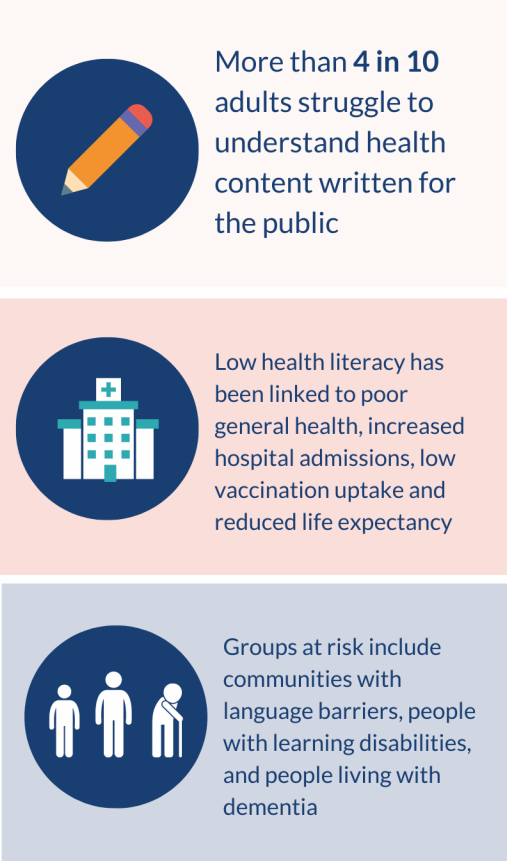
Since health literacy is a primary contributing factor to health disparities, it is a continued and increasing concern for health professionals. The 2003 National Assessment of Adult Literacy (NAAL) conducted by the US Department of Education found that 36% of participants scored as either "basic" or "below basic" in terms of their health literacy and concluded that approximately 80 million Americans have limited health literacy. These individuals have difficulty with common health tasks including reading the label of a prescribed drug. Several factors may influence health literacy. However, the following factors have been shown to strongly increase this risk: age (especially patients 65 years and older), limited English language proficiency or English as a second language, chronic conditions, less education, and lower socioeconomic status. Patients with low health literacy understand less about their medical conditions and treatments and overall report worse health status. Patients who struggle with substantial health literacy challenges often forego important health care such as vaccinations or annual screenings, and are more likely to miss appointments, misuse medication, prepare improperly for procedures, and even die prematurely.
Various interventions, such as simplifying information and illustrations, avoiding jargon, using "teach-back" methods, and encouraging patients' questions, have improved health behaviors in persons with low health literacy. The proportion of adults aged 18 and over in the U.S., in the year 2010, who reported that their health care providers always explained things so they could understand them was about 60.6%. This number increased 1% from 2007 to 2010. The Healthy People 2020 initiative of the United States Department of Health and Human Services (HHS) has included health literacy as a pressing new topic, with objectives for improving it in the decade to come.
In planning for Healthy People 2030 (the fifth edition of Healthy People), HHS issued a "Solicitation for Written Comments on an Updated Health Literacy Definition for Healthy People". Several proposals address the fact that "health literacy is multidimensional", being the result of a concerted effort that involves the individual seeking care or information, providers and caregivers, the complexity and demands of the system, and the use of plain language for communication.
The National Library of Medicine defined health literacy as:
"The degree to which individuals have the capacity to obtain, process, and understand basic health literacy information and services needed to make appropriate health decisions."
Health literacy encompasses a wide range of skills, and competencies that people develop over their lifetimes to seek out, comprehend, evaluate, and use health information and concepts to make informed choices, reduce health risks, and increase quality of life.
Another view of health literacy includes the ability to understand scientific concepts, content, and health research; skills in spoken, written, and online communication; critical interpretation of mass media messages; navigating systems of health care and governance; knowledge and use of community capital and resources; and using cultural and indigenous knowledge in health decision making. This view sees health literacy as one of the social determinants of health which can reduce inequities in health.
Hub AI
Health literacy AI simulator
(@Health literacy_simulator)
Health literacy
Health literacy is the ability to obtain, read, understand, and use healthcare information in order to make appropriate health decisions and follow instructions for treatment. There are multiple definitions of health literacy, in part because health literacy involves both the context (or setting) in which health literacy demands are made (e.g., health care, media, internet or fitness facility) and the skills that people bring to that situation.
Since health literacy is a primary contributing factor to health disparities, it is a continued and increasing concern for health professionals. The 2003 National Assessment of Adult Literacy (NAAL) conducted by the US Department of Education found that 36% of participants scored as either "basic" or "below basic" in terms of their health literacy and concluded that approximately 80 million Americans have limited health literacy. These individuals have difficulty with common health tasks including reading the label of a prescribed drug. Several factors may influence health literacy. However, the following factors have been shown to strongly increase this risk: age (especially patients 65 years and older), limited English language proficiency or English as a second language, chronic conditions, less education, and lower socioeconomic status. Patients with low health literacy understand less about their medical conditions and treatments and overall report worse health status. Patients who struggle with substantial health literacy challenges often forego important health care such as vaccinations or annual screenings, and are more likely to miss appointments, misuse medication, prepare improperly for procedures, and even die prematurely.
Various interventions, such as simplifying information and illustrations, avoiding jargon, using "teach-back" methods, and encouraging patients' questions, have improved health behaviors in persons with low health literacy. The proportion of adults aged 18 and over in the U.S., in the year 2010, who reported that their health care providers always explained things so they could understand them was about 60.6%. This number increased 1% from 2007 to 2010. The Healthy People 2020 initiative of the United States Department of Health and Human Services (HHS) has included health literacy as a pressing new topic, with objectives for improving it in the decade to come.
In planning for Healthy People 2030 (the fifth edition of Healthy People), HHS issued a "Solicitation for Written Comments on an Updated Health Literacy Definition for Healthy People". Several proposals address the fact that "health literacy is multidimensional", being the result of a concerted effort that involves the individual seeking care or information, providers and caregivers, the complexity and demands of the system, and the use of plain language for communication.
The National Library of Medicine defined health literacy as:
"The degree to which individuals have the capacity to obtain, process, and understand basic health literacy information and services needed to make appropriate health decisions."
Health literacy encompasses a wide range of skills, and competencies that people develop over their lifetimes to seek out, comprehend, evaluate, and use health information and concepts to make informed choices, reduce health risks, and increase quality of life.
Another view of health literacy includes the ability to understand scientific concepts, content, and health research; skills in spoken, written, and online communication; critical interpretation of mass media messages; navigating systems of health care and governance; knowledge and use of community capital and resources; and using cultural and indigenous knowledge in health decision making. This view sees health literacy as one of the social determinants of health which can reduce inequities in health.