
Recent from talks
Heart (novel)
Knowledge base stats:
Talk channels stats:
Members stats:
Heart (novel)
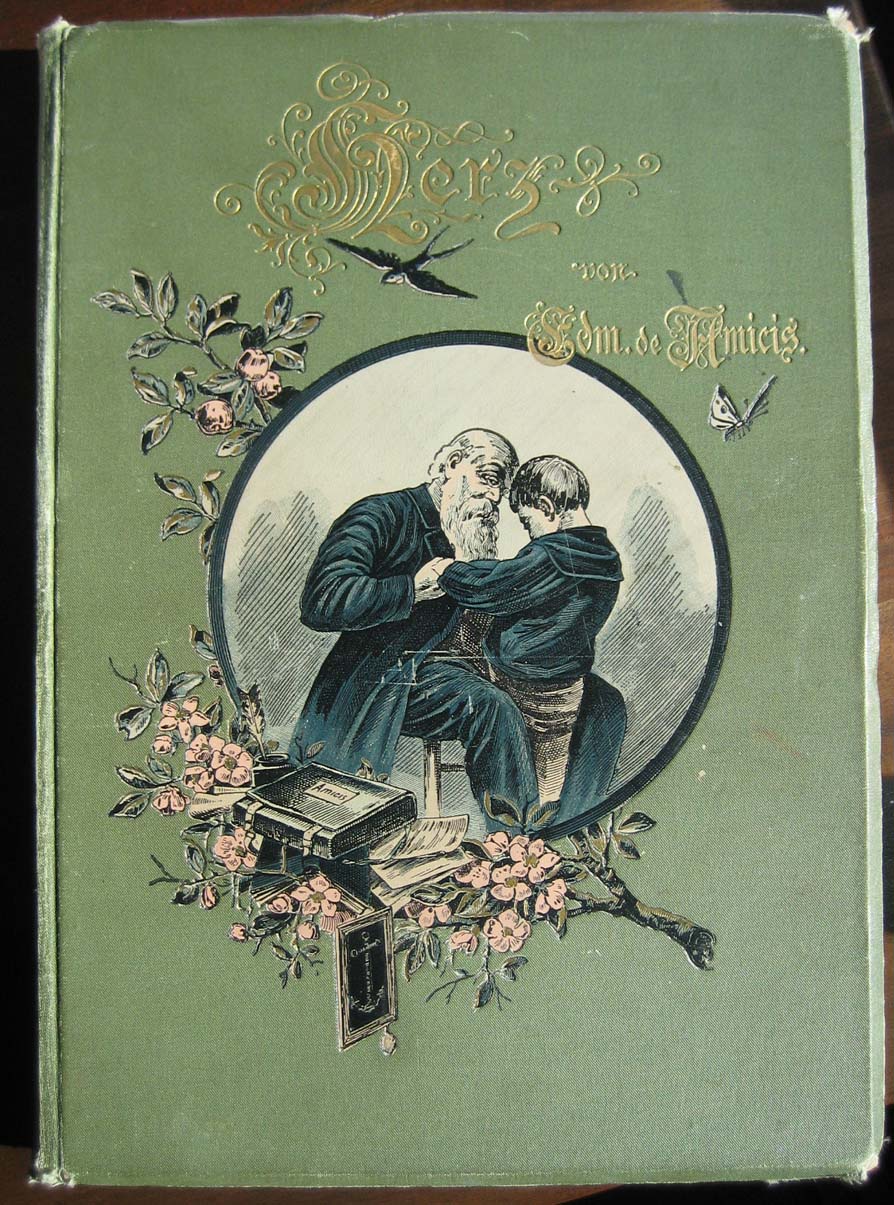
Heart (Italian: Cuore [ˈkwɔːre]) is a children's novel by the Italian author Edmondo De Amicis who was a novelist, journalist, short story writer, and poet. The novel is his best known work to this day, having been inspired by his own children Furio and Ugo who had been schoolboys at the time. It is set during the Italian unification, and includes several patriotic themes. It was issued in Milan by Treves on October 18, 1886, the first day of school in Italy, and rose to immediate success. In 1892, Treves published the first illustrated edition, with illustrations by Arnaldo Ferraguti, Enrico Nardi, and Giulio Aristide Sartorio.
Through its investigation of social issues such as poverty, Heart shows the influence of left-wing ideologies on De Amicis' work (he later joined the Italian Socialist Party). Because of this, the book remained influential (and the staple of many textbooks) in countries of the Eastern Bloc. On the other hand, the book's strong evocation of Italian nationalism and patriotism also made it welcome in Fascist Italy.
The novel is written in a diary form as told by Enrico Bottini, an 11-year-old primary school student in Turin with an upper class background who is surrounded by classmates of working class origin. The entire chronological setting corresponds to the third-grade season of 1881-82 (Enrico says it has been four years since the death of Victor Emmanuel II, king of Italy, and the succession by Umberto I, and also tells about the death of Giuseppe Garibaldi, which happened in 1882).
Enrico's parents and older sister Silvia interact with him as written in his diary, as well as his teacher who assigns him with homework that deals with several different stories of children throughout the Italian states who should be seen as role models – these stories are then given in the book as Enrico comes upon reading them. Every story revolves around a different moral value, the most prominent of which are helping those in need, having great love and respect for family and friends, and patriotism. These are called 'The Monthly Stories' and appear at the end of every school month.
The novel was translated into Chinese in the early 20th century (with the title "愛的教育" – literally The Education of Love) and became quite well known in East Asia. It was translated into Spanish with the title, Corazón: Diario de un niño meaning Heart: Diary of a Child. The book was popular in Latin countries, such as Mexico, among young boys and girls in the 1960s and 1970s.[citation needed]
The novel was also extremely popular and influential in 1950s Israel, the Hebrew translation going through no less than seventeen printings up to 1963. Its strong evocation of patriotism and its basking in the great recent achievement of Italian Unification were well in tune with the new-born Israel of the 1950s, created in cataclysmic wars and struggles, and the book's Socialist undertones were in tune with the values of Labor Zionism, then dominant in Israel. At present however it is considered rather old-fashioned and no longer well known to the current generation of young Israelis.[citation needed]
In 1887, a sequel, called Testa (Head), was written by neurologist Paolo Mantegazza, Amicis' friend, which narrates the life of Enrico in his teens.
In 1962, Umberto Eco published Elogio di Franti (In Praise of Franti) viewing Franti, the "bad boy" of the novel, as a figure of resistance against militarist and nationalist ideology.
Hub AI
Heart (novel) AI simulator
(@Heart (novel)_simulator)
Heart (novel)
Heart (Italian: Cuore [ˈkwɔːre]) is a children's novel by the Italian author Edmondo De Amicis who was a novelist, journalist, short story writer, and poet. The novel is his best known work to this day, having been inspired by his own children Furio and Ugo who had been schoolboys at the time. It is set during the Italian unification, and includes several patriotic themes. It was issued in Milan by Treves on October 18, 1886, the first day of school in Italy, and rose to immediate success. In 1892, Treves published the first illustrated edition, with illustrations by Arnaldo Ferraguti, Enrico Nardi, and Giulio Aristide Sartorio.
Through its investigation of social issues such as poverty, Heart shows the influence of left-wing ideologies on De Amicis' work (he later joined the Italian Socialist Party). Because of this, the book remained influential (and the staple of many textbooks) in countries of the Eastern Bloc. On the other hand, the book's strong evocation of Italian nationalism and patriotism also made it welcome in Fascist Italy.
The novel is written in a diary form as told by Enrico Bottini, an 11-year-old primary school student in Turin with an upper class background who is surrounded by classmates of working class origin. The entire chronological setting corresponds to the third-grade season of 1881-82 (Enrico says it has been four years since the death of Victor Emmanuel II, king of Italy, and the succession by Umberto I, and also tells about the death of Giuseppe Garibaldi, which happened in 1882).
Enrico's parents and older sister Silvia interact with him as written in his diary, as well as his teacher who assigns him with homework that deals with several different stories of children throughout the Italian states who should be seen as role models – these stories are then given in the book as Enrico comes upon reading them. Every story revolves around a different moral value, the most prominent of which are helping those in need, having great love and respect for family and friends, and patriotism. These are called 'The Monthly Stories' and appear at the end of every school month.
The novel was translated into Chinese in the early 20th century (with the title "愛的教育" – literally The Education of Love) and became quite well known in East Asia. It was translated into Spanish with the title, Corazón: Diario de un niño meaning Heart: Diary of a Child. The book was popular in Latin countries, such as Mexico, among young boys and girls in the 1960s and 1970s.[citation needed]
The novel was also extremely popular and influential in 1950s Israel, the Hebrew translation going through no less than seventeen printings up to 1963. Its strong evocation of patriotism and its basking in the great recent achievement of Italian Unification were well in tune with the new-born Israel of the 1950s, created in cataclysmic wars and struggles, and the book's Socialist undertones were in tune with the values of Labor Zionism, then dominant in Israel. At present however it is considered rather old-fashioned and no longer well known to the current generation of young Israelis.[citation needed]
In 1887, a sequel, called Testa (Head), was written by neurologist Paolo Mantegazza, Amicis' friend, which narrates the life of Enrico in his teens.
In 1962, Umberto Eco published Elogio di Franti (In Praise of Franti) viewing Franti, the "bad boy" of the novel, as a figure of resistance against militarist and nationalist ideology.
Recent media