Recent from talks
Main milestones
Financial Struggles
Personal Life and Relationships
Invention of Frequency-Hopping Spread Spectrum (1940-1942)
Frequency-Hopping Spread Spectrum: Development and Recognition (1942-1997)
Early Life and Education (1914-1933)
Hollywood Career (1938-1958)
Marriage to Fritz Mandl (1933-1937)
Nothing was collected or created yet.
Hedy Lamarr
View on Wikipedia
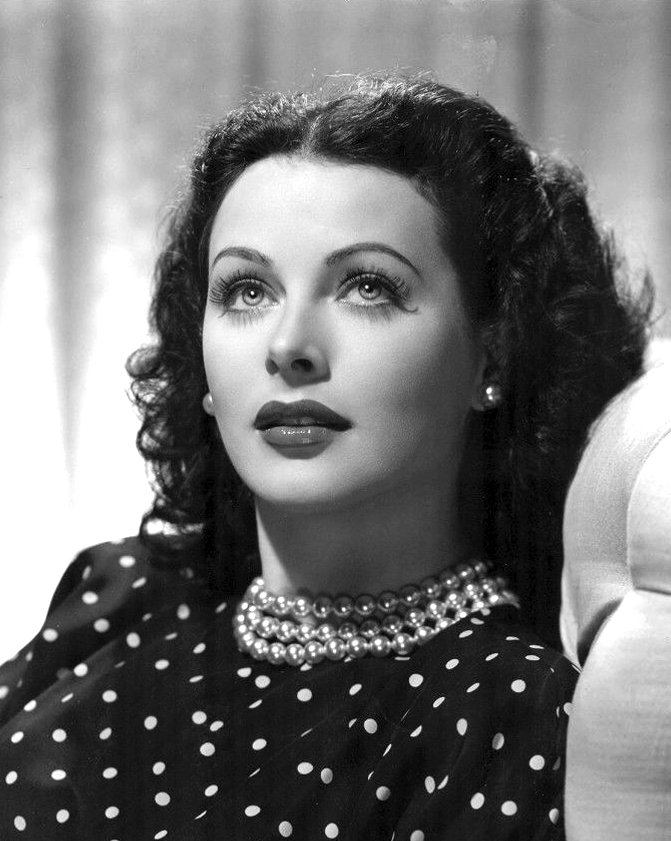
Hedy Lamarr (/ˈhɛdi/; born Hedwig Eva Maria Kiesler; November 9, 1914[a] – January 19, 2000) was an Austrian and American actress and inventor. After a brief early film career in Czechoslovakia, including the controversial erotic romantic drama Ecstasy (1933), she fled from her first husband, Friedrich Mandl, and secretly moved to Paris. Traveling to London, she met Louis B. Mayer, who offered her a film contract in Hollywood. Lamarr became a film star with her performance in the romantic drama Algiers (1938).[2] She achieved further success with the Western Boom Town (1940) and the drama White Cargo (1942). Lamarr's most successful film was the religious epic Samson and Delilah (1949).[3] She also acted on television before the release of her final film in 1958. She was honored with a star on the Hollywood Walk of Fame in 1960.
Key Information
At the beginning of World War II, along with George Antheil, Lamarr co-invented a radio guidance system for Allied torpedoes that used spread spectrum and frequency hopping technology to defeat the threat of radio jamming by the Axis powers. This approach, conceptualized as a "Secret Communication System," was intended to provide secure, jam-resistant communication for weapon guidance by spreading the signal across multiple frequencies, a method now recognized as the foundation of spread spectrum technology.[4][5][6][7] However, the technology was used in operational systems only beginning in 1962,[8] which was well after World War II and three years after the expiry of the Lamarr-Antheil patent.[9] Frequency hopping became a foundational technology for spread spectrum communications. Its principles directly influenced the development of secure wireless networking, including Bluetooth and early versions of Wi-Fi, which use variants of spread spectrum to protect data from interception and interference.[10][11][12]
Early life
[edit]Lamarr was born Hedwig Eva Maria Kiesler in 1914 in Vienna,[13] the only child of Gertrud "Trude" Kiesler (née Lichtwitz) and Emil Kiesler.
Her father was born to a Galician-Jewish family in Lemberg in the Kingdom of Galicia and Lodomeria, part of Austria-Hungary (now Lviv in Ukraine) and was, in the 1920s, deputy director of Wiener Bankverein,[14][15] and at the end of his life a director at the united Creditanstalt-Bankverein.[16][17] Her mother, a pianist and a native of Budapest, in the Kingdom of Hungary, had come from an upper-class Hungarian-Jewish family. She had converted to Catholicism and was described as a "practicing Christian" who raised her daughter as a Christian, although Hedy was not baptized at the time.[16]: 8
As a child, Lamarr showed an interest in acting and was fascinated by theater and film. At the age of 12, she won a beauty contest in Vienna.[18] She also began to learn about technological inventions with her father, who would take her out on walks, explaining how devices functioned.[19][20]
European film career
[edit]Early work
[edit]Lamarr was taking acting classes in Vienna when one day, she forged a note from her mother and went to Sascha-Film and was able to have herself hired as a script girl. While there, she had a role as an extra in the romantic comedy Money on the Street (1930), and then a small speaking part in the comedy Storm in a Water Glass (1931). Producer Max Reinhardt then cast her in a play entitled The Weaker Sex, which was performed at the Theater in der Josefstadt. Reinhardt was so impressed with her that he brought her with him back to Berlin.[21]
However, she never actually trained with Reinhardt or appeared in any of his Berlin productions. Instead, she met the Russian theatre producer Alexis Granowsky, who cast her in his film directorial debut, The Trunks of Mr. O.F. (1931), starring Walter Abel and Peter Lorre.[22] Granowsky soon moved to Paris, but Lamarr stayed in Berlin and was given the lead role in No Money Needed (1932), a comedy directed by Carl Boese.[23] Lamarr then starred in the film which made her internationally famous.
Ecstasy
[edit]
In early 1933, at age 18, Lamarr was given the lead in Gustav Machatý's film Ecstasy (Ekstase in German, Extase in Czech). She played the neglected young wife of an indifferent older man.
The film became both celebrated and notorious for showing Lamarr's face in the throes of orgasm as well as close-up and brief scenes of nudity. Lamarr claimed she was "duped" by the director and producer, who used high-power telephoto lenses, although the director contested her claims.[24][b][25]
Although she was dismayed and now disillusioned about taking other roles, the film gained world recognition after winning an award at the Venice Film Festival.[26] Throughout Europe, it was regarded as an artistic work. In America, it was considered overly sexual and received negative publicity, especially among women's groups.[24] It was banned there and in Germany.[27]
Withdrawal
[edit]
Lamarr played a number of stage roles, including a starring one in Sissy, a play about Empress Elisabeth of Austria produced in Vienna. It won accolades from critics. Admirers sent roses to her dressing room and tried to get backstage to meet her. She sent most of them away, including a man who was more insistent, Friedrich Mandl.[24] He became obsessed with getting to know her.[28]
Mandl was an Austrian military arms merchant[29] and munitions manufacturer who was reputedly the third-richest man in Austria. She fell for his charming and fascinating personality, partly due to his immense financial wealth.[27] Her parents, both of Jewish descent, did not approve due to Mandl's ties to Italian fascist leader Benito Mussolini and, later, German Führer Adolf Hitler, but they could not stop the headstrong Lamarr.[24]
On August 10, 1933, Lamarr married Mandl at the Karlskirche. She was 18 years old and he was 33. In Lamarr's ghostwritten[30] autobiography, Ecstasy and Me, Mandl is described as an extremely controlling husband who strongly objected to her simulated orgasm scene in Ecstasy and prevented her from pursuing her acting career. She claimed she was kept a virtual prisoner in their castle home, Schloss Schwarzenau.[27]

Mandl had close social and business ties to the Italian government, selling munitions to the country,[16] and had ties to the Nazi regime of Germany as well, even though his own father was Jewish, as was Hedy's. Lamarr wrote that the dictators of both countries attended lavish parties at the Mandl home. Lamarr accompanied Mandl to business meetings, where he conferred with scientists and other professionals involved in military technology. These conferences were her introduction to the field of applied science and nurtured her latent talent in science.[31]
Lamarr's marriage to Mandl eventually became unbearable and she decided to separate herself from both her husband and country in 1937. In her autobiography, she wrote that she disguised herself as her maid and fled to Paris, but according to other accounts she persuaded Mandl to let her wear all of her jewelry for a dinner party and then disappeared afterward.[32] She wrote about her marriage:
I knew very soon that I could never be an actress while I was his wife. ... He was the absolute monarch in his marriage. ... I was like a doll. I was like a thing, some object of art which had to be guarded—and imprisoned—having no mind, no life of its own.[33]
Hollywood career
[edit]Louis B. Mayer and MGM
[edit]
After arriving in London[34] in 1937, she met Louis B. Mayer, head of MGM, who was scouting for talent in Europe.[35] She initially turned down the offer he made her (of $125 a week), but then booked herself onto the same New York–bound liner as him, and she managed to impress him enough to secure a $500-a-week contract. Mayer persuaded her to change her name to Hedy Lamarr (to distance herself from her real identity and "the Ecstasy lady" reputation associated with it),[32] choosing the surname in homage to the beautiful silent film star Barbara La Marr, on the suggestion of his wife, who admired La Marr. He brought her to Hollywood in 1938 and began promoting her as the "world's most beautiful woman".[36]
Mayer loaned Lamarr to producer Walter Wanger, who was making Algiers (1938), an American version of the French film Pépé le Moko (1937). Lamarr was cast in the lead opposite Charles Boyer. The film created a "national sensation", says Shearer.[16]: 77 She was billed as an unknown but well-publicized Austrian actress, which created anticipation in audiences. Mayer hoped she would become another Greta Garbo or Marlene Dietrich.[16]: 77 According to one viewer, when her face first appeared on the screen, "everyone gasped ... Lamarr's beauty literally took one's breath away."[16]: 2

In future Hollywood films, she was invariably typecast as the archetypal glamorous seductress of exotic origin. Her second American film was to be I Take This Woman, co-starring with Spencer Tracy under the direction of regular Dietrich collaborator Josef von Sternberg. Von Sternberg was fired during the shoot, replaced by Frank Borzage. The film was put on hold, and Lamarr was put into Lady of the Tropics (1939), where she played a mixed-race seductress in Saigon opposite Robert Taylor. She returned to I Take This Woman, re-shot by W. S. Van Dyke. The resulting film was a flop.

Far more popular was Boom Town (1940) with Clark Gable, Claudette Colbert and Spencer Tracy; it made $5 million.[37] MGM promptly reteamed Lamarr and Gable in Comrade X (1940), a comedy film in the vein of Ninotchka (1939), which was another hit.
Lamarr was teamed with James Stewart in Come Live with Me (1941), playing a Viennese refugee. Stewart was also in Ziegfeld Girl (1941), where Lamarr, Judy Garland and Lana Turner played aspiring showgirls – a big success.[37]
Lamarr was top-billed in H. M. Pulham, Esq. (1941), although the film's protagonist was the title role played by Robert Young. She made a third film with Tracy, Tortilla Flat (1942). It was successful at the box office, as was Crossroads (1942) with William Powell.
Lamarr played the exotic Arab seductress[38] Tondelayo in White Cargo (1942), top billed over Walter Pidgeon. It was a huge hit. White Cargo contains arguably her most memorable film quote, delivered with provocative invitation: "I am Tondelayo. I make tiffin for you?" This line typifies many of Lamarr's roles, which emphasized her beauty and sensuality while giving her relatively few lines. The lack of acting challenges bored Lamarr. She reportedly took up inventing to relieve her boredom.[39]
She was reunited with Powell in a comedy The Heavenly Body (1944), then was borrowed by Warner Bros for The Conspirators (1944). This was an attempt to repeat the success of Casablanca (1943), and RKO borrowed her for a melodrama Experiment Perilous (1944).
Back at MGM Lamarr was teamed with Robert Walker in the romantic comedy Her Highness and the Bellboy (1945), playing a princess who falls in love with a New Yorker. It was very popular, but would be the last film she made under her MGM contract.[40]
Her off-screen life and personality during those years was quite different from her screen image. She spent much of her time feeling lonely and homesick. She might swim at her agent's pool, but shunned the beaches and staring crowds. When asked for an autograph, she wondered why anyone would want it. Writer Howard Sharpe interviewed her and gave his impression:
Hedy has the most incredible personal sophistication. She knows the peculiarly European art of being womanly; she knows what men want in a beautiful woman, what attracts them, and she forces herself to be these things. She has magnetism with warmth, something that neither Dietrich nor Garbo has managed to achieve.[24]
Author Richard Rhodes describes her assimilation into American culture:
Of all the European émigrés who escaped Nazi Germany and Nazi Austria, she was one of the very few who succeeded in moving to another culture and becoming a full-fledged star herself. There were so very few who could make the transition linguistically or culturally. She really was a resourceful human being–I think because of her father's strong influence on her as a child.[41]
Lamarr also had a penchant for speaking about herself in the third person.[42]
Wartime fundraiser
[edit]Lamarr wanted to join the National Inventors Council, but was reportedly told by NIC member Charles F. Kettering and others that she could better help the war effort by using her celebrity status to sell war bonds.[43][44]
She participated in a war-bond-selling campaign with a sailor named Eddie Rhodes. Rhodes was in the crowd at each Lamarr appearance, and she would call him up on stage. She would briefly flirt with him before asking the audience if she should give him a kiss. The crowd would say yes, to which Hedy would reply that she would if enough people bought war bonds. After enough bonds were purchased, she would kiss Rhodes and he would head back into the audience. Then they would head off to the next war bond rally.[45]
Producer
[edit]
After leaving MGM in 1945, Lamarr formed a production company with Jack Chertok and made the thriller The Strange Woman (1946). It went over budget and only made minor profits.[46]
She and Chertok then made Dishonored Lady (1947), another thriller starring Lamarr, which also went over budget – but was not a commercial success. She tried a comedy with Robert Cummings, Let's Live a Little (1948).
Later films
[edit]Lamarr enjoyed her biggest success playing Delilah against Victor Mature as the Biblical strongman in Cecil B. DeMille's Samson and Delilah, the highest-grossing film of 1950. The film won two Oscars.[27]
Lamarr returned to MGM for a film noir with John Hodiak, A Lady Without Passport (1950), which flopped. More popular were two pictures she made at Paramount, a Western with Ray Milland, Copper Canyon (1950), and a Bob Hope spy spoof, My Favorite Spy (1951).
Her career went into decline. She went to Italy to play multiple roles in Loves of Three Queens (1954), which she also produced. However she lacked the experience necessary to make a success of such an epic production, and lost millions of dollars when she was unable to secure distribution of the picture.
She played Joan of Arc in Irwin Allen's critically panned epic, The Story of Mankind (1957) and did episodes of Zane Grey Theatre ("Proud Woman") and Shower of Stars ("Cloak and Dagger"). Her last film was a thriller The Female Animal (1958).
Lamarr was signed to act in the 1966 film Picture Mommy Dead,[47] but was let go when she collapsed during filming from nervous exhaustion.[48] She was replaced in the role of Jessica Flagmore Shelley by Zsa Zsa Gabor.
Inventing career
[edit]Although Lamarr had no formal training and was primarily self-taught, she invested her spare time, including on set between takes, in designing and drafting inventions,[49] which included an improved traffic stoplight and a tablet that would dissolve in water to create a flavored carbonated drink.[39]

During the late 1930s, Lamarr attended arms deals with her then-husband, arms dealer Fritz Mandl, "possibly to improve his chances of making a sale".[50] From the meetings, she learned that navies needed "a way to guide a torpedo as it raced through the water." Radio control had been proposed. However, an enemy might be able to jam such a torpedo's guidance system and set it off course.[51]
When later discussing this with a new friend, composer and pianist George Antheil, her idea to prevent jamming by frequency hopping met Antheil's previous work in music. In that earlier work, Antheil attempted synchronizing note-hopping in the avant-garde piece written as a score for the film Ballet Mécanique (1923–24) that involved multiple synchronized player pianos. Antheil's idea in the piece was to synchronize the start time of four player pianos with matching player piano rolls, so the pianos would play in time with one another. Together, they realized that radio frequencies could be changed similarly, using the same kind of mechanism, but miniaturized.[9][50]
Based on the strength of the initial submission of their ideas to the National Inventors Council (NIC) in late December 1940, in early 1941 the NIC introduced Antheil to Samuel Stuart Mackeown, Professor of Electrical Engineering at Caltech, to consult on the electrical systems.[52][49] Lamarr hired the legal firm of Lyon & Lyon to draft the application for the patent[53][54] which was granted as U.S. patent 2,292,387 on August 11, 1942, under her legal name Hedy Kiesler Markey.[55] The invention was proposed to the Navy, who rejected it on the basis that it would be too large to fit in a torpedo,[56] and Lamarr and Antheil, shunned by the Navy, pursued their invention no further. It was suggested that Lamarr invest her time and attention to selling war bonds since she was a celebrity.[57]
Later years
[edit]Lamarr became a naturalized citizen of the United States at age 38 on April 10, 1953. Her autobiography, Ecstasy and Me, was published in 1966. She said on TV that it was not written by her, and much of it was fictional.[58] Lamarr later sued the publisher, saying that many details were fabricated by its ghost writer, Leo Guild.[59][60] Lamarr, in turn, was sued by Gene Ringgold, who asserted that the book plagiarized material from an article he had written in 1965 for Screen Facts magazine.[61]
In the late 1950s, along with former husband W. Howard Lee, Lamarr designed and developed the Villa LaMarr ski resort in Aspen, Colorado.[62][63]
In 1966, Lamarr was arrested in Los Angeles for shoplifting. The charges were eventually dropped. In 1991, she was arrested on the same charge in Orlando, Florida, this time for stealing $21.48 worth of laxatives and eye drops.[64][65] She pleaded no contest to avoid a court appearance, and the charges were dropped in return for her promise to refrain from breaking any laws for a year.[66]
Seclusion
[edit]The 1970s was a decade of increasing seclusion for Lamarr. She was offered several scripts, television commercials, and stage projects, but none piqued her interest. In 1974, she filed a $10 million lawsuit against Warner Bros., claiming that the running parody of her name ("Hedley Lamarr") in the Mel Brooks comedy Blazing Saddles infringed her right to privacy. Brooks said he was flattered. The studio settled out of court for an undisclosed nominal sum and an apology to Lamarr for "almost using her name". Brooks said that Lamarr "never got the joke".[67][68] In 1981, with her eyesight failing, Lamarr retreated from public life and settled in Miami Beach, Florida.[16]
A large Corel-drawn image of Lamarr won CorelDRAW's yearly software suite cover design contest in 1996. For several years, beginning in 1997, it was featured on boxes of the software suite. Lamarr sued the company for using her image without her permission. Corel countered that she did not own rights to the image. The parties reached an undisclosed settlement in 1998.[69][70]
For her contribution to the motion picture industry, Lamarr has a star on the Hollywood Walk of Fame at 6247 Hollywood Boulevard[71][72] adjacent to Vine Street where the walk is centered.
Lamarr became estranged from her older son, James Lamarr Loder, when he was 12 years old. Their relationship ended abruptly, and he moved in with another family. They did not speak again for almost 50 years. Lamarr left James Loder out of her will, and he sued for control of the US$3.3 million estate left by Lamarr in 2000.[73] He eventually settled for US$50,000.[74]
In her later years, Lamarr lived in Altamonte Springs, Florida, before moving to Casselberry, Florida, in the final months of her life.[75] She communicated with family and friends almost exclusively by telephone.[76] However, after moving to Casselberry, two friends who lived nearby would visit her at home to check on her a few times a week.[75]
Death
[edit]
On January 19, 2000, Lamarr was found dead at her home in Casselberry at the age of 85; the cause of death was heart disease.[16][75] Her son Anthony Loder spread part of her ashes in Austria's Vienna Woods in accordance with her last wishes.[77]
In 2014, a memorial to Lamarr was unveiled in Vienna's Central Cemetery.[78] The remainder of her ashes were buried there.[79][80]
Awards, honors, and tributes
[edit]On January 7, 1939, Hedy Lamarr was selected the "most promising new actress" of 1938 in a poll of Philadelphia film fans conducted by Elsie Finn, the Philadelphia Record film critic.[81]
On January 26, 1939, Lamar was chosen the "ideal type" of woman in a poll of both male and female students conducted by the Pomona College newspaper.[82]
On May 9, 1939, Lamarr was named the "most beautiful actress" in "a secret poll of 30 Hollywood correspondents" conducted by the American magazine Look.[83]
On August 30, 1940, Lamarr won "top honors for facial features" in a poll of 400 members of the California Models Association.[84]
In December 1943, makeup expert Max Factor, Jr. included Lamarr among the ten glamorous Hollywood actresses with the most appealing voices.[85]
In 1951, British moviegoers voted Lamarr the year's 10th best actress, for her performance in Samson and Delilah.[86]
In 1960, Lamarr was honored with a star on the Hollywood Walk of Fame for her contributions to the motion picture industry.[87]
In 1997, Lamarr and George Antheil were jointly honored with the Electronic Frontier Foundation's Pioneer Award[88] and Lamarr also was the first woman to receive the Invention Convention's BULBIE Gnass Spirit of Achievement Award, known as the "Oscars of inventing".[89][90][91] given to individuals whose creative lifetime achievements in the arts, sciences, business, or invention fields have significantly contributed to society.[92] The following year, Lamarr's native Austria awarded her the Viktor Kaplan Medal of the Austrian Association of Patent Holders and Inventors.[93]
In 2006, the Hedy-Lamarr-Weg was founded in Vienna Meidling (12th District), named after the actress.
In 2013, the IQOQI installed a quantum telescope on the roof of the University of Vienna, which they named after her in 2014.[94]
In 2014, Lamarr was posthumously inducted into the National Inventors Hall of Fame for frequency-hopping spread spectrum technology.[95] The same year, Anthony Loder's request that the remaining ashes of his mother should be buried in an honorary grave of the city of Vienna was realized. On November 7, her urn was buried at the Vienna Central Cemetery in Group 33 G, Tomb No. 80, not far from the centrally located presidential tomb.[79][80]
On November 9, 2015, Google honored her on the 101st anniversary of her birth, and on her 109th on November 9, 2023, with a doodle.[96]
On August 27, 2019, an asteroid was named after her: 32730 Lamarr.[97][98]
On August 6, 2023 Star Trek: Prodigy showrunners Dan and Kevin Hageman debuted the first five minutes of footage from season two, showing the new Lamarr-class USS Voyager-A, in tribute to her.[99]
Marriages and children
[edit]Lamarr was married and divorced six times and had three children:
- Friedrich Mandl (married 1933–1937), chairman of the Hirtenberger Patronen-Fabrik[100]
- Gene Markey (married 1939–1941), screenwriter and producer. She adopted a boy (however this was later contested by the child, see below) during her marriage with Markey. Lamarr became estranged from the boy when he was 12 years old, their relationship ended abruptly, they did not speak again for almost 50 years, and Lamarr left him out of her will.[73] Lamarr and Markey lived at 2727 Benedict Canyon Drive in Beverly Hills, California during their marriage, at a place called Hedgerow Farm. The home still exists.[101]
- John Loder (married 1943–1947), actor. The two had a daughter, Denise, who married Larry Colton, a writer and former baseball player, and a son, Anthony, who worked for illustrator James McMullan.[102] Anthony Loder was featured in the 2004 documentary film Calling Hedy Lamarr.[77]
- Ernest "Teddy" Stauffer (married 1951–1952), nightclub owner, restaurateur, and former bandleader
- W. Howard Lee (married 1953–1960), a Texas oilman (who later married film actress Gene Tierney)
- Lewis J. Boies (married 1963–1965), Lamarr's divorce lawyer
Following her sixth and final divorce in 1965, Lamarr remained unmarried for the last 35 years of her life.
Throughout her life, Lamarr claimed that her first son, James Lamarr Loder, was not biologically related to her and was adopted during her marriage to Gene Markey.[103][104] Years later, her son found documentation that he was the out-of-wedlock son of Lamarr and actor John Loder, whom she later married as her third husband.[105] However, a later DNA test proved him not to be biologically related to either, as documented in Bombshell: The Hedy Lamarr Story.[106][107][108]
Filmography
[edit]Source: Hedy Lamarr at the TCM Movie Database
| Year | Title | Role | Notes |
|---|---|---|---|
| 1930 | Money on the Street | Young Girl | Original title: Geld auf der Straße |
| 1931 | Storm in a Water Glass | Secretary | Original title: Sturm im Wasserglas |
| The Trunks of Mr. O.F. | Helene | Original title: Die Koffer des Herrn O.F. | |
| 1932 | No Money Needed | Käthe Brandt | Original title: Man braucht kein Geld |
| 1933 | Ecstasy | Eva Hermann | Original title: Ekstase |
| 1938 | Algiers | Gaby | |
| 1939 | Lady of the Tropics | Manon deVargnes Carey | |
| 1940 | I Take This Woman | Georgi Gragore Decker | |
| Boom Town | Karen Vanmeer | ||
| Comrade X | Golubka/ Theodore Yahupitz/ Lizvanetchka "Lizzie" | ||
| 1941 | Come Live with Me | Johnny Jones | |
| Ziegfeld Girl | Sandra Kolter | ||
| H. M. Pulham, Esq. | Marvin Myles Ransome | ||
| 1942 | Tortilla Flat | Dolores Ramirez | |
| Crossroads | Lucienne Talbot | ||
| White Cargo | Tondelayo | ||
| 1944 | The Heavenly Body | Vicky Whitley | |
| The Conspirators | Irene Von Mohr | ||
| Experiment Perilous | Allida Bederaux | ||
| 1945 | Her Highness and the Bellboy | Princess Veronica | |
| 1946 | The Strange Woman | Jenny Hager | Also executive producer |
| 1947 | Dishonored Lady | Madeleine Damien | |
| 1948 | Let's Live a Little | Dr. J.O. Loring | |
| 1949 | Samson and Delilah | Delilah | Her first film in Technicolor |
| 1950 | A Lady Without Passport | Marianne Lorress | |
| Copper Canyon | Lisa Roselle | ||
| 1951 | My Favorite Spy | Lily Dalbray | |
| 1954 | Loves of Three Queens | Helen of Troy, Joséphine de Beauharnais, Genevieve of Brabant |
Original title: L'amante di Paride |
| 1957 | The Story of Mankind | Joan of Arc | |
| 1958 | The Female Animal | Vanessa Windsor |
Radio appearances
[edit]| Broadcast date | Series | Episode |
|---|---|---|
| July 7, 1941 | Lux Radio Theatre | Algiers[109] |
| December 29, 1941 | Lux Radio Theatre | The Bride Came C.O.D.[109] |
| May 14, 1942 | Command Performance (radio series) | Edward G Robinson Hedy Lamarr Glenn Miller[110] |
| October 5, 1942 | Lux Radio Theatre | Love Crazy[109] |
| August 2, 1943 | The Screen Guild Theatre | Come Live with Me[111] |
| September 26, 1942 | The Chase and Sanborn Hour | Hedy Lamarr[112] |
| October 26, 1943 | Burns and Allen | Hedy Lamarr[113] |
| January 24, 1944 | Lux Radio Theatre | Casablanca[109] |
| February 4, 1945 | The Radio Hall of Fame | Experiment Perilous[114] |
| November 19, 1951 | Lux Radio Theatre | Samson and Delilah[109] |
In popular culture
[edit]In the 1952 Pulitzer Prize-winning novel The Caine Mutiny by Herman Wouk, Hedy Lamarr is mentioned by name in Chapter 37 when defense attorney Lieutenant Barney Greenwald confronts Lieutenant Tom Keefer at a party after Lieutenant Stephen Maryk's court-martial acquittal in the Caine mutiny.[c] – [115]
The Mel Brooks 1974 western parody Blazing Saddles features a villain, played by Harvey Korman, named "Hedley Lamarr". As a running gag, various characters mistakenly refer to him as "Hedy Lamarr" prompting him to testily reply "That's Hedley."
In the 1982 off-Broadway musical Little Shop of Horrors and subsequent film adaptation (1986), Audrey II says to Seymour in the song "Feed Me", that he can get Seymour anything he wants including "A date with Hedy Lamarr."[116]
In the 2004 video game Half-Life 2, Dr. Kleiner's pet headcrab, Lamarr, is named after Hedy Lamarr.[117]
Her son, Anthony Loder, was featured in the 2004 documentary film Calling Hedy Lamarr, in which he played excerpts from tapes of her many telephone calls.
In 2008, an off-Broadway play, Frequency Hopping, features the lives of Lamarr and Antheil. The play was written and staged by Elyse Singer, and the script won a prize for best new play about science and technology from STAGE.[16][118]
In the 2009 mockumentary The Chronoscope,[119] written and directed by Andrew Legge, the fictional Irish scientist Charlotte Keppel is likely modeled after Hedy Lamarr. The film satirizes the extreme politics of the 1930s and tells the story of a fictionalized fascist group that steals a device invented by Keppel. This chronoscope can see the past and is used by the group to create propaganda films of their heroes from the past.
In 2010, Lamarr was selected out of 150 IT people to be featured in a short film launched by the British Computer Society on May 20.[120]
Also during 2010, the New York Public Library exhibit Thirty Years of Photography at the New York Public Library included a photo of a topless Lamarr (c. 1930) by Austrian-born American photographer Trude Fleischmann.[121]
In 2011, the story of Lamarr's frequency-hopping spread spectrum invention was explored in an episode of the Science Channel show Dark Matters: Twisted But True, a series that explores the darker side of scientific discovery and experimentation, which premiered on September 7.[122] Her work in improving wireless security was part of the premiere episode of the Discovery Channel show How We Invented the World.[123]
Also during 2011, Anne Hathaway revealed that she had learned that the original Catwoman was based on Lamarr, so she studied all of Lamarr's films and incorporated some of her breathing techniques into her portrayal of Catwoman in the 2012 film The Dark Knight Rises.[124]
In 2015, on November 9, the 101st anniversary of Lamarr's birth, Google paid tribute to Hedy Lamarr's work in film and her contributions to scientific advancement with an animated Google Doodle.[125]
In 2016, Lamarr was depicted in an off-Broadway play, HEDY! The Life and Inventions of Hedy Lamarr, a one-woman show written and performed by Heather Massie.[126][127]
Also in 2016, the off-Broadway, one-actor show Stand Still and Look Stupid: The Life Story of Hedy Lamarr, starring Emily Ebertz and written by Mike Broemmel, went into production.[128][129]
Also during 2016, Whitney Frost, a character in the TV show Agent Carter was inspired by Hedy Lamarr and Lauren Bacall.[130]
In 2017, actress Celia Massingham portrayed Lamarr on The CW television series Legends of Tomorrow in the sixth episode of the third season, titled "Helen Hunt". The episode is set in 1937 Hollywoodland. The episode aired on November 14, 2017.[131]
Also during 2017, a documentary about Lamarr's career as an actress and later as an inventor, Bombshell: The Hedy Lamarr Story, premiered at the 2017 Tribeca Film Festival. The documentary was written and directed by Alexandra Dean and produced by Susan Sarandon;[132][41] it was released in theaters on November 24, 2017, and aired on PBS American Masters in May 2018.
In 2018, actress Alyssa Sutherland portrayed Lamarr on the NBC television series Timeless in the third episode of the second season, titled "Hollywoodland". The episode aired March 25, 2018.[133]
In 2019, actor and musician Johnny Depp composed a song called "This Is a Song for Miss Hedy Lamarr" with Tommy Henriksen. It was included on Depp and Jeff Beck's 2022 album 18.[134]
Also in 2019, The Only Woman in the Room, a novel based on Hedy Lamarr's life by Marie Benedict, was published by Sourcebooks Landmark. The book is a New York Times and USA Today bestseller and Barnes & Noble Book Club Pick.[135] In 2019, it received a space in Library Reads's Hall of Fame.[136]
In 2021, Lamarr was mentioned in the first episode of the Marvel's What If...?.[137] The episode aired on August 11, 2021.
In May 2023, a dance production called Hedy Lamarr: An American Muse was made in her honor by Linze Rickles McRae. She was accompanied by her daughter, Azalea McRae, with whom she performed it, alongside her students at her dancing school, Downtown Dance Conservatory in Gadsden, AL.[138]
In July 2024, the principal setting of the second season of the Netflix/Nickelodeon/Paramount television series Star Trek Prodigy is the science vessel USS Voyager, NCC-74656-A, a Starship of the Lamarr class, classified in honor of Lamarr's scientific contributions.[139]
See also
[edit]- Inventors' Day
- List of Austrians
- Whitney Frost A character in the Marvel Cinematic Universe is loosely based on Ms Lamarr, her character having been both an actress and a physicist.
Explanatory notes
[edit]- ^ According to Lamarr biographer Stephen Michael Shearer (pp. 8, 339), she was born in 1914, not 1913.
- ^ When Lamarr applied for the role, she had little experience nor understood the planned filming. Anxious for the job, she signed the contract without reading it. When, during an outdoor scene, the director told her to disrobe, she protested and threatened to quit, but he said that if she refused, she would have to pay for the cost of all the scenes already filmed. To calm her, he said they were using "long shots" in any case, and no intimate details would be visible. At the preview in Prague, sitting next to the director, when she saw the numerous close-ups produced with telephoto lenses, she screamed at him for tricking her. She left the theater in tears, worried about her parents' reaction and that it might have ruined her budding career. However, the cinematographer of the film claimed that she was aware during filming that there would be nude scenes and did not raise concerns during filming.[24]
- ^ "You’ll retire old and full of fat fitness reports. You’ll publish your novel proving that the Navy stinks, and you’ll make a million dollars and marry Hedy Lamarr. No letter of reprimand for you, just royalties on your novel."
References
[edit]- ^ Lawrence, Snezana (April 12, 2021). "Historical Notes: The Fantastic Lives of Hedy Lamarr".
- ^ Severo, Richard (January 20, 2000). "Hedy Lamarr, Sultry Star Who Reigned in Hollywood of 30s and 40s, Dies at 86". The New York Times. Retrieved December 24, 2018.
- ^ Haskell, Molly (December 10, 2010). "European Exotic". The New York Times. Archived from the original on September 8, 2018. Retrieved July 26, 2012.
- ^ "Hedy Lamarr │ The National Inventors Hall of Fame". www.invent.org. August 3, 2025. Retrieved August 4, 2025.
- ^ Kristy (October 23, 2024). "2024 Hedy Lamarr". Wireless History Foundation. Retrieved August 4, 2025.
- ^ "Biography: Hedy Lamarr". National Women's History Museum. Retrieved August 4, 2025.
- ^ "Hedy Lamarr's WWII Invention Helped Shape Modern Tech". The National WWII Museum | New Orleans. April 23, 2025. Retrieved August 4, 2025.
- ^ Fleming, Meeks (May 14, 1990). "I Guess They Just Take and Forget About a Person". Forbes. 145 (10): 136–138.
- ^ a b Rothman, Tony (January–February 2019). "Random Paths to Frequency Hopping". American Scientist. Vol. 107, no. 1. p. 46. doi:10.1511/2019.107.1.46. Retrieved March 27, 2024.
- ^ O'Brien, Elle (November 8, 2020). "Hedy Lamarr: actress, inventor, wartime code maker". Massive Science. Retrieved August 4, 2025.
- ^ "Hedy Lamarr and Frequency Hopping Technology - News - SparkFun Electronics". news.sparkfun.com. Retrieved August 4, 2025.
- ^ samainstage (June 23, 2023). "Actress/Inventor Hedy Lamarr – and How Far Wireless Communication Has Come". IEEE Standards Association. Retrieved August 4, 2025.
- ^ Sterling, Christopher H. (2008). Military Communications: From Ancient Times to the 21st Century. Bloomsbury Academic. ISBN 9781851097326.
- ^ Quackenbush, James L.; O'Brien, John P. (1920). "The City of New York against Bridge Operating Company". Supreme Court, Appellate Division- First Department. New York City: The Hecla Press. p. 17.
- ^ Winklbauer, Andrea (September 21, 2020). "Zinshaus, Villa und Palais – Eine Tour zu Hedy Lamarrs Wiener Lebensorten". Jüdisches Museum Wien (in German).
- ^ a b c d e f g h i Shearer, Stephen Michael (2010). Beautiful: The Life of Hedy Lamarr. Thomas Dunne Books. ISBN 978-0-312-55098-1. OCLC 471817029.
- ^ Loacker, Armin (2001). Ekstase (in German). Filmarchiv Austria. ISBN 978-3-901932-10-6.
- ^ Barton 2010, pp. 12–13.
- ^ Alexandra Dean (film director), Hedy Lamarr, Jennifer Hom, Mel Brooks (November 24, 2017). Bombshell: The Hedy Lamarr Story (Biographical documentary film). Zeitgeist Films; Kanopy. Event occurs between 07:05-08.00. OCLC 1101944158.
- ^ "Role Model in Science & Engineering Achievement". 2014. Archived from the original on February 4, 2017. Retrieved November 15, 2021.
- ^ Barton 2010, pp. 16–19.
- ^ Barton 2010, pp. 21–22.
- ^ Barton 2010, p. 25.
- ^ a b c d e f "A Candid Portrait of Hedy Lamarr", Liberty magazine, December 1938, pp. 18–19
- ^ "Czech Film Series 2009–2010 – Gustav Machatý:Ecstasy" (PDF). Russian & East European Institute, Indiana University. September 2, 2009. Archived from the original (PDF) on September 11, 2009. Retrieved November 9, 2013.
- ^ Morandini, Laura; Morandini, Luisa; Morandini, Morando (2009). Il Morandini 2010: dizionario dei film [The Morandini 2010 Dictionary of Films] (in Italian). Bologna: Zanichelli. p. 493. ISBN 978-88-08-20183-6. OCLC 475597884.
- ^ a b c d Extraordinary Women: Hedy Lamarr, documentary, 2011
- ^ "A Movie Star, Some Player Pianos, and Torpedoes" Archived April 19, 2017, at the Wayback Machine, Lemelson Center, November 12, 2015.
- ^ "Hedy Lamarr: Inventor of more than the 1st theatrical-film orgasm". Los Angeles Times. November 28, 2010. Archived from the original on January 17, 2013. Retrieved July 26, 2012.
- ^ "Ghostwritten books of the past, and a poll: Who's being ghosted now?". Los Angeles Times. October 27, 2009. Retrieved June 11, 2025.
- ^ "Happy 100th birthday, Hedy Lamarr, movie star who paved way for Wi-Fi". CNET. Archived from the original on May 11, 2015. Retrieved May 26, 2015.
- ^ a b Friedrich, Otto (1997). City of Nets: A Portrait of Hollywood in the 1940s (reprint ed.). Berkeley and Los Angeles: University of California Press. pp. 12–13. ISBN 0-520-20949-4.
- ^ Rhodes 2012, pp. 28–29.
- ^ "Hedy Lamarr's Great Escape". KnowledgeNuts. September 7, 2015. Archived from the original on April 4, 2018. Retrieved May 17, 2018.
- ^ Donnelley, Paul. Fade to Black: 1500 Movie Obituaries, Omnibus Press (2010), p. 639.
- ^ Katz, Ephraim. The Film Encyclopedia, 3rd ed. HarperPerennial (1998), p. 780.
- ^ a b The Eddie Mannix Ledger, Los Angeles: Margaret Herrick Library, Center for Motion Picture Study.
- ^ "Susan Sarandon: "Hedy Lamarr was so strong, as well as brilliant"". March 8, 2018.
- ^ a b "'Most Beautiful Woman' By Day, Inventor By Night". NPR. November 22, 2011. Archived from the original on April 29, 2015. Retrieved May 26, 2015.
- ^ Hedy Lamarr, TCM Full Filmography
- ^ a b "Bombshell: Interview with Richard Rhodes on Hedy Lamarr" Archived April 19, 2017, at the Wayback Machine, Sloan Science and Film, April 18, 2017.
- ^ Barton 2010, p. 97.
- ^ Scholtz, Robert A. (May 1982). "The Origins of Spread-Spectrum Communications". IEEE Transactions on Communications. 30 (5): 822. Bibcode:1982ITCom..30..822S. doi:10.1109/tcom.1982.1095547.
- ^ Price, Robert (January 1983). "Further Notes and Anecdotes on Spread-Spectrum Origins". IEEE Transactions on Communications. 31 (1): 85. doi:10.1109/tcom.1983.1095725.
- ^ Wayne, Robert L. "Moses" Speaks to His Grandchildren, Dog Ear Publishing (2014); ISBN 978-1-4575-3321-1, pg. 19.
- ^ Balio, Tino (2009). United Artists: The Company Built by the Stars. University of Wisconsin Press. ISBN 978-0-299-23004-3. p203
- ^ Duo Slated for 5 Pictures Martin, Betty. Los Angeles Times (1923–Current File) [Los Angeles, Calif] Jan 21, 1966: c6.
- ^ Hedy Lamarr Fired From Comeback Film: HEDY LAMARR Berman, Art. Los Angeles Times (1923–Current File) [Los Angeles, Calif] Feb 4, 1966: 3.
- ^ a b "A Beautiful Mind". Segulamag.com. Retrieved July 18, 2022.
- ^ "Hedy Lamarr – actor, inventor, amateur engineer" (MP3). The Science Show. July 5, 2014. 7 minutes in. Radio National. Archived from the original on July 5, 2014.
- ^ Rhodes 2012, p. 169.
- ^ ABC news. Hedy Lamarr: Actress and inventor. 4 minutes
- ^ "Hedy Lamarr: Movie star, inventor of WiFi". CBS News. April 20, 2012. Archived from the original on April 9, 2016. Retrieved April 9, 2016.
- ^ USPTO. "Patent 2,292,387 Full Text". United States Patent and Trademark Office. USPTO. Archived from the original on January 10, 2020. Retrieved May 11, 2016.
- ^ Hans-Joachim Braun, "Hedy Lamarr, Radio-Controlled Torpedo", Invention and Technology, Winter 2020, Volume 26, Issue 1. Retrieved 26 March 2024.
- ^ Blackburn, Renée (December 22, 2017). "The secret life of Hedy Lamarr Bombshell: The Hedy Lamarr Story Alexandra Dean, director Reframed Pictures, 2017". Science. 358 (6370): 1546. doi:10.1126/science.aar4304. ISSN 0036-8075. S2CID 44138813.
- ^ Hedy Lamarr, 1969 TV Interview. Archived from the original on July 24, 2024 – via YouTube; Merv Griffin Entertainment; Reelin' in the Years Productions, LLC. on The Merv Griffin Show with Woody Allen, 1969
- ^ "Hedy Lamarr Loses Fight to Stop Autobiography". The Tuscaloosa News. September 27, 1966. p. 12 – via Google Newspapers.
- ^ "Hedy Lamarr Loses Suit to Halt Book", The New York Times, September 27, 1966, p. 74.
- ^ "Lamarr Autobiography Prompts Plagiarism Suit", The New York Times, February 7, 1967, p. 18.
- ^ Hedy Lamarr in 1950s Aspen Archived March 5, 2023, at the Wayback Machine, The Aspen Times Weekly (March 22, 2012)
- ^ Hedy Lamarr: The Most Beautiful Woman in Film (2010), pg. 194
- ^ "Google Doodle of the day: Who is Hedy Lamarr?" Archived April 19, 2017, at the Wayback Machine, Palm Beach Post, November 9, 2015.
- ^ Hedy Lamarr accused of shoplifting from Orlando drugstore, UPI, Aug. 2, 1991
- ^ Salamone, Debbie (October 24, 1991). "Hedy Lamarr Won't Face Theft Charges If She Stays In Line". Orlando Sentinel. Archived from the original on March 24, 2012. Retrieved June 10, 2010.
- ^ Interview: Mel Brooks. Blazing Saddles (DVD). Burbank, California: Warner Brothers Pictures/Warner Home Video, 2004; ISBN 0-7907-5735-4.
- ^ Barton 2010, p. 220.
- ^ "Hedy Lamarr Sues Corel". April 7, 1998. Archived from the original on July 6, 2011.
- ^ Sprenger, Polly (November 30, 1998). "Corel Caves to Actress Hedy Lamarr". Wired News. Archived from the original on June 15, 2013.
- ^ "Hedy Lamarr". Hollywood Chamber of Commerce. Archived from the original on November 11, 2013. Retrieved November 9, 2013.
- ^ "Hedy Lamarr". Los Angeles Times Hollywood Star Project. Archived from the original on November 15, 2013. Retrieved November 9, 2013.
- ^ a b "Court To Weigh Plea of Lamarr's Estranged Son". Orlando Sentinel. October 30, 2000. Archived from the original on February 17, 2016. Retrieved May 26, 2015.
- ^ "Hedy Lamarr's Adopted Son Trades Claim To Estate For $50,000". January 26, 2001. Archived from the original on November 13, 2016. Retrieved April 13, 2017.
- ^ a b c Moore, Roger (January 20, 2000). "Hedy Lamar: 1913–2000". Orlando Sentinel. Archived from the original on November 15, 2017. Retrieved April 27, 2018.
- ^ "Hedy Lamarr: The Hollywood starlet who helped invent WiFi". Sky HISTORY TV channel. Retrieved November 22, 2024.
- ^ a b "Calling Hedy Lamarr". Mischief Films. Archived from the original on December 5, 2007. Retrieved December 20, 2007.
- ^ "Memorial to Hollywood pin-up". thelocal.at. November 7, 2014. Archived from the original on July 21, 2015. Retrieved May 26, 2015.
- ^ a b Presse-Service (November 7, 2014). "Archivmeldung: Hedy Lamarr erhält Ehrengrab der Stadt Wien". Presseservice der Stadt Wien (in German). Archived from the original on March 5, 2023. Retrieved November 15, 2021.
- ^ a b "Verstorbenensuche Detail – Friedhöfe Wien – Friedhöfe Wien". friedhoefewien.at (in German). Retrieved November 15, 2021.
- ^ "Philly's Best". Boxoffice: 30-C. January 7, 1939.
- ^ "Hedy Lamarr Chosen". The Pittsburgh Press. January 26, 1939. p. 15. Retrieved February 1, 2025.
- ^ "Bette Davis and Clark Gable Best Liked by Writers". Victoria Daily Advocate. May 9, 1939. p. 3. Retrieved February 1, 2025.
- ^ "Models Find Lack of Perfect Girls". Spokane Daily Chronicle. August 30, 1940. p. 12. Retrieved February 1, 2025.
- ^ Johnson, Erskine (December 26, 1943). "Who'll Win Oscars This Year? All Hollywood Is Speculating!". The Pittsburgh Press. p. 28. Retrieved February 1, 2025.
- ^ "Anna Neagle's Film Award". The Mercury. No. May 10, 1951. Retrieved February 24, 2018.
- ^ "Hedy Lamarr". Hollywood Walk of Fame. October 25, 2019. Retrieved November 15, 2021.
- ^ "Movie Legend Hedy Lamarr to be Given Special Award at EFF's Sixth Annual Pioneer Awards" (Press release). Electronic Frontier Foundation. March 11, 1997. Archived from the original on October 16, 2007. Retrieved February 1, 2014.
- ^ "1940's Film Goddess Hedy Lamarr Responsible For Pioneering Spread Spectrum". Invention Convention. Archived from the original on June 25, 2018. Retrieved May 23, 2018.
- ^ "Hedy Lamarr: Invention of Spread Spectrum Technology". women-inventors.com. Archived from the original on November 12, 2015. Retrieved May 23, 2018.
- ^ Dolor, Danny. "The other side of Hedy Lamarr". Philstar.com. Retrieved March 16, 2022.
- ^ "Honorary grave for Hollywood pin-up". November 7, 2014. Archived from the original on November 10, 2014. Retrieved November 11, 2014.
- ^ Peterson, Barbara Bennett (April 2001), "Lamarr, Hedy", American National Biography
- ^ "Auf den Spuren einer Hollywood-Diva" [In the footsteps of a Hollywood diva] (in German). Retrieved November 15, 2021 – via PressReader.
- ^ "Inductee Detail | National Inventors Hall of Fame". National Inventors Hall of Fame. Archived from the original on July 1, 2025. Retrieved July 10, 2025.
- ^ "Hedy Lamarr: Ein Kino-Orgasmus, eine bahnbrechende Erfindung, 101. Geburtstag". GIGA (in German). November 9, 2015. Retrieved November 15, 2021.
- ^ "IAU Minor Planet Center". minorplanetcenter.net. Retrieved November 15, 2021.
- ^ "Small-Body Database Lookup". ssd.jpl.nasa.gov. Retrieved November 15, 2021.
- ^ "First Look Star Trek: Prodigy - Season 2, Episode 1". startrek.com. Retrieved April 7, 2024.
- ^ Ivanis, Daniel J. "The stars come out: Recruiting ad featuring Hedy Lamarr creates 'buzz't". Boeing Frontiers. Archived from the original on October 29, 2012. Retrieved February 16, 2013.
- ^ 1940 US Census via Ancestry.com
- ^ To Tell The Truth – Hedy Lamarr + Anthony Loder + Denise Loder Deluca. Archived from the original on June 6, 2014. Retrieved May 30, 2014 – via YouTube.
- ^ "Hedy Lamarr Adopts Baby Boy", nytimes.com; accessed June 3, 2017.
- ^ "Hedy Lamarr Biography". Archived from the original on December 30, 2011.
- ^ "HEDY NEWS: LAMARR'S SON NOT ADOPTED". New York Post. February 5, 2001. Archived from the original on June 12, 2018. Retrieved June 9, 2018.
- ^ "Bombshell: The Hedy Lamarr Story Unveils a Scientific Innovator and Feminist Ahead of Her Time". Phoenix Magazine. March 2017. Retrieved March 7, 2024.
- ^ Harvey, Dennis (November 30, 2017). "Film Review: 'Bombshell: The Hedy Lamarr Story'". Variety. Retrieved August 11, 2025.
- ^ Mather, Chris (January 8, 2018). "About Hedy Lamarr Documentary". Bombshell: The Hedy Lamarr Story | American Masters | PBS. Retrieved August 11, 2025.
- ^ a b c d e List of Lux Radio Theatre episodes
- ^ "Vintage Radio Shows". Vintageradioshows.com. Archived from the original on November 11, 2021. Retrieved November 11, 2021.
- ^ Archived at Ghostarchive and the Wayback Machine: "Hedy Lamarr 'Come Live with Me" Live Radio Performance". June 9, 2009 – via YouTube.
- ^ "The Internet Archive". Archive.org.
- ^ "Jerry Haendiges Vintage Radio Logs". Otrsite.com.
- ^ "Vintage Radio Shows". Vintageradioshows.com. Archived from the original on November 11, 2021. Retrieved November 11, 2021.
- ^ Wouk, Herman (1951). The Caine Mutiny. Doubleday. p. 464. Retrieved November 11, 2020 – via Internet Archive. ISBN 9780761543640
- ^ Alan Menken (Ft. Lee Wilkof & Ron Taylor) – Sudden Changes/ Feed Me (Git it), archived from the original on October 31, 2018, retrieved October 30, 2018
- ^ Hodgson, David (November 23, 2004). Half-Life 2: Raising the bar. Prima Games. p. 124. ISBN 978-0761543640. Retrieved November 11, 2020 – via Google Books.
- ^ "Frequency Hopping". Hourglass Group. Archived from the original on May 21, 2015. Retrieved June 2, 2015.
- ^ Legge, Andrew (2009). "The Chronoscope". Fastnet Films. Retrieved November 10, 2022.
- ^ "BCS launches celebrity film campaign to raise profile of the IT industry". BCS. Archived from the original on October 19, 2014. Retrieved October 14, 2014.
- ^ "Trude Fleischmann (American, 1895–1990): "Hedy Lamarr"". Recollection: Thirty Years of Photography at the New York Public Library. New York Public Library. Archived from the original on November 19, 2015. Retrieved November 18, 2015.
- ^ "Positively Poisonous, Medusa's Heroin, Beauty and Brains". Dark Matters: Twisted But True. Season 2. Episode 5. September 7, 2011. Science Channel. Archived from the original on November 14, 2013. Retrieved November 9, 2013.
- ^ Genzlinger, Neil (March 18, 2013). "On the Origins of Gadgets". The New York Times. Archived from the original on November 29, 2016. Retrieved December 30, 2015.
- ^ "'Dark Knight Rises' star Anne Hathaway: 'Gotham City is full of grace'". Los Angeles Times. December 29, 2011. Archived from the original on July 6, 2012. Retrieved June 23, 2012.
- ^ "Hedy Lamarr's 101st birthday". Archived from the original on June 10, 2017. Retrieved June 3, 2017.
- ^ 'HEDY! The Life & Inventions of Hedy Lamarr' Extended by Popular Demand Archived January 31, 2017, at the Wayback Machine, broadwayworld.com, October 28, 2016.
- ^ C. E. Gerber, "HEDY! : The Life and Inventions of Hedy Lamarr Review – Simple and Effective" Archived February 2, 2017, at the Wayback Machine, lasplash.com, November 14, 2016.
- ^ "Stand Still & look Stupid – A play in three acts". The Life Story of Hedy Lamarr. Archived from the original on March 14, 2018. Retrieved April 27, 2018.
- ^ Varnum, Janet (March 5, 2018). "STAND STILL AND LOOK STUPID". The Ark Magazine. Archived from the original on January 27, 2020. Retrieved April 27, 2018.
- ^ Topel, Fred (August 6, 2015). "Exclusive: 'Marvel's Agent Carter' Producers on Season Two Villain, Hollywood Setting, and Action". /Film. Archived from the original on August 8, 2015. Retrieved August 7, 2015.
- ^ ""DC's Legends of Tomorrow" Helen Hunt (TV Episode 2017) – IMDb". IMDb. November 14, 2017. Archived from the original on June 16, 2018. Retrieved July 1, 2018.
- ^ Thorpe, Vanessa (November 12, 2017). "Film tells how Hollywood star Hedy Lamarr helped to invent wifi". The Guardian. Archived from the original on November 12, 2017. Retrieved November 12, 2017.
- ^ ""Timeless" Hollywoodland (TV Episode 2018) – IMDb". IMDb. March 25, 2018. Archived from the original on April 2, 2018. Retrieved July 1, 2018.
- ^ Colothan, Scott (May 30, 2022). "Johnny Depp performs four songs with Jeff Beck at Sheffield concert – watch". Planet Rock. Retrieved June 1, 2022.
- ^ "The Only Woman in the Room|Paperback". Barnes & Noble. Retrieved May 30, 2022.
- ^ "Marie Benedict". LibraryReads. Archived from the original on October 19, 2022. Retrieved May 30, 2022.
- ^ "What If...?" What If... Captain Carter Were the First Avenger? (TV Episode 2021) – IMDb, retrieved November 21, 2021
- ^ "Downtown Dance Pays Tribute to Hedy Lamarr". May 10, 2023.
- ^ "Voyager-A: Every Change Confirmed To Star Trek's Original". Screen Rant. August 7, 2023.
Further reading
[edit]- Barton, Ruth (2010). Hedy Lamarr: The Most Beautiful Woman in Film. Lexington: University of Kentucky Press. ISBN 978-0-8131-3654-7.
- Benedict, Marie (2019). The Only Woman in the Room. Source Books Landmark. ISBN 978-1492666899.
- Lamarr, Hedy (1966). Ecstasy and Me: My Life as a Woman. New York: Bartholomew House. ASIN B0007DMMN8.
- Rhodes, Richard (2012). Hedy's Folly: The Life and Breakthrough Inventions of Hedy Lamarr. New York: Doubleday. ISBN 978-0-307-74295-7.
- Shearer, Stephen Michael (2010). Beautiful: The Life of Hedy Lamarr. New York: St. Martin's Press. ISBN 978-0-312-55098-1.
- Young, Christopher (1979). The Films of Hedy Lamarr. New York: Citadel Press. ISBN 978-0-8065-0579-4.
- Busch-Vishniac, Ilene; Busch, Lauren; Tietjen, Jill (2024). "Chapter 14. Hedy Lamarr". Women in the National Inventors Hall of Fame: The First 50 Years. Springer Nature. ISBN 9783031755255.
External links
[edit]- Official website
- Hedy Lamarr discography at Discogs
- Hedy Lamarr at IMDb
- Hedy Lamarr at the TCM Movie Database
- Hedy Lamarr at Reel Classics
Hedy Lamarr
View on GrokipediaEarly Life
Family Background and Vienna Upbringing
Hedwig Eva Maria Kiesler was born on November 9, 1914, in Vienna, Austria-Hungary, as the only child of Emil Kiesler and Gertrud "Trude" Kiesler (née Lichtwitz).[1][5] Her father, born on December 27, 1876, in Lemberg (now Lviv, Ukraine), to a Galician-Jewish family, had become a successful banker and director at the Bank of Vienna, providing the family with considerable financial security.[6][7] Her mother, originating from an upper-class Hungarian-Jewish family in Budapest, was a trained concert pianist whose performances exposed the household to classical music.[8] The Kieslers maintained an affluent, assimilated Jewish household in Vienna's 19th district of Döbling, where secularism prevailed despite their Jewish heritage, reflecting the cultural integration common among upper-middle-class Viennese Jews in the interwar period.[9][10] Emil Kiesler's professional success and intellectual pursuits fostered an environment emphasizing education and scientific curiosity; he routinely explained the mechanics of everyday technologies to his daughter, cultivating her early interest in how devices functioned.[11] Gertrud's musical background complemented this, with family life including private tutors and servants who affectionately referred to the young Hedwig as "Princess Hedy."[11] Vienna's vibrant interwar cultural milieu, including theaters and opera houses, further shaped her formative years through familial attendance at performances tied to her mother's career, blending artistic exposure with the city's intellectual ferment without overt religious observance.[8] This upbringing in a stable, resource-rich setting prioritized rational inquiry and cultural refinement over traditional piety, laying groundwork for her later pursuits amid the era's underlying social tensions for assimilated Jews.[9]Education and Early Interests
Hedy Lamarr, born Hedwig Eva Maria Kiesler on November 9, 1914, in Vienna, Austria, received her early education in the city's private schools, where the curriculum emphasized languages such as German, French, and Italian alongside humanities and introductory sciences.[12] Her governess provided additional tutoring in these languages, fostering multilingual proficiency that later aided her acting career.[12] From a young age, Lamarr displayed an aptitude for mechanics and mathematics, influenced heavily by her father, Emil Kiesler, a bank director with a keen interest in technology. He took her on walks around Vienna, disassembling concepts of everyday machinery like streetcars and telephones to explain their inner workings, which ignited her curiosity for engineering principles.[3] [13] This hands-on exposure led her to tinker with household devices, honing skills in understanding causal mechanisms through direct manipulation rather than abstract theory alone.[14] At age 16 in 1930, Lamarr left formal schooling to train as an actress at Max Reinhardt's seminary in Vienna, prioritizing performance over continued academic study.[14] Despite this shift, her self-directed learning in technology persisted, drawing from her father's guidance to explore wireless devices and basic electronics independently, laying foundational interests distinct from her emerging artistic pursuits.[3]Pre-Hollywood Career in Europe
Initial Film Roles
Lamarr entered the European film industry at age 16 with a bit part in the 1930 German comedy Geld auf der Straße (Money on the Street), directed by Georg Jacoby, where she portrayed a minor character amid a storyline involving an aviator's pursuit of wealth.[15][16] This debut role, secured shortly after her training under theater director Max Reinhardt, emphasized basic on-screen mechanics such as posture and expression, capitalizing on her photogenic features in an era transitioning from silent to sound production.[2] In 1931, she transitioned to Czech-language productions, appearing in Die Frau von Lindenau (also released as Die Blumenfrau von Lindenau or tied to the German Sturm im Wasserglas, Storm in a Water Glass), a comedy directed by Georg Jacoby featuring a flower seller's tax troubles and political satire.[17] Her small supporting role in this multilingual adaptation showcased rudimentary dramatic timing, with her natural poise aiding delivery in non-native dialogue, as Central European studios like those in Prague expanded sound filming to reach broader markets.[18] The film's modest box-office reception, typical of early talkies with ratings around 6.8/10 from limited contemporary reviews, highlighted Lamarr's appeal as a visually compelling novice rather than a lead reliant on script complexity.[18] These initial roles reflected the professional demands of the continental industry, where rapid casting favored versatile performers amid technical innovations like synchronized audio, yet constrained depth by formulaic narratives focused on light comedy and social tropes. Lamarr's quick progression from extras to credited parts stemmed empirically from her multilingual proficiency—German, Czech, and French—and striking aesthetics, securing contracts in under a year despite scripts offering little beyond decorative presence.[19] By late 1931, such mechanics positioned her for escalating visibility in Vienna and Berlin studios, underscoring a merit-based ascent in a competitive pre-depression market.[20]The Ecstasy Film and Associated Scandals
In 1933, Hedy Kiesler (later Lamarr) starred as Eva, a newlywed dissatisfied with her impotent husband, in the Czech-produced film Ecstasy (Extase), directed by Gustav Machatý. The narrative follows Eva's pursuit of passion with a young engineer, incorporating pioneering cinematic elements such as a nude swim in a lake captured via zoom lens and a close-up simulation of female orgasm achieved through facial expressions and subtle editing rather than explicit action.[21][22] These sequences marked the first depiction of nudity and orgasmic response in a non-pornographic feature film, drawing on Machatý's intent to portray eroticism as a natural, psychological force unbound by conventional morality.[22] Kiesler later recounted in interviews that the director had assured her a body double would handle any undressed footage, but employed telephoto lenses to film her partially nude without prior consent, omitting such details from the script; Machatý defended the approach as essential for authentic emotional intensity, though no contemporaneous documentation confirms the extent of deception.[23] The film's premiere at the 1934 Venice Film Festival ignited immediate backlash, with bootlegged copies circulating despite official suppressions, amplifying Kiesler's visibility across Europe as an emblem of liberated sensuality.[24] Ecstasy provoked bans and condemnations reflecting era-specific cultural thresholds: Nazi Germany prohibited it explicitly due to Kiesler's Jewish ancestry, the Vatican denounced it as morally corrupting in its newspaper L'Osservatore Romano, and the U.S. Customs Service seized imports as "dangerously indecent" under obscenity laws, delaying public screenings until a 1938 court ruling on edited versions.[25][26] The Catholic Legion of Decency similarly branded it sinful, citing its disruption of traditional sexual norms without redeeming artistic merit in their view. This notoriety, while generating underground demand and cementing Kiesler's reputation for beauty intertwined with erotic allure, constrained her subsequent European opportunities by prioritizing her physical image over dramatic range, as evidenced by typecasting in sensual roles amid persistent scandal echoes.[25][26]Marriage to Fritz Mandl and Flight from Europe
On August 10, 1933, at the age of 18, Hedwig Kiesler (later known as Hedy Lamarr) married Friedrich "Fritz" Mandl, a prominent Austrian industrialist and chairman of the Hirtenberger Patronen-Fabrik arms manufacturing company.[27] Mandl, who had converted to Catholicism and held fascist sympathies, supplied munitions to regimes including Mussolini's Italy during its invasion of Abyssinia in 1935–1936.[28] The marriage, which lasted until 1937, effectively paused Lamarr's acting career as Mandl, driven by jealousy over her previous film roles, restricted her public appearances and involvement in the entertainment industry.[29] During the union, Lamarr accompanied Mandl to business dinners and meetings with engineers and military figures, where discussions often centered on advanced weaponry, including radio-controlled guidance systems for torpedoes and aircraft.[4] These exposures provided her with informal insights into technical challenges like signal jamming, though she held no formal role in Mandl's operations.[30] The relationship grew increasingly strained amid Mandl's controlling nature and his pro-Axis business alignments, which coincided with escalating antisemitism in Austria following the 1934 assassination of Chancellor Engelbert Dollfuss and the rising influence of Nazi Germany.[31] In late summer 1937, after reportedly two failed attempts, Lamarr fled Mandl's estate, disguising herself as her maid to evade detection, and traveled via Paris to London.[32] She financed her passage by selling jewelry acquired during the marriage, marking her departure from Vienna's elite circles and her Jewish-Austrian heritage amid political turmoil.[29] Mandl later sought annulment of the marriage in 1938, citing racial grounds related to Lamarr's Jewish ancestry.[5]Hollywood Transition and Acting Career
Arrival in the United States and MGM Contract
In 1937, after escaping her controlling marriage to Austrian arms manufacturer Fritz Mandl amid Austria's annexation by Nazi Germany, Hedy Lamarr fled to London, where she met Louis B. Mayer, co-founder and head of Metro-Goldwyn-Mayer (MGM) studios, during his European talent scouting amid the exodus of artists and intellectuals from fascist-threatened regions.[2] [5] Mayer, impressed by her striking beauty and notoriety from the 1933 film Ecstasy, offered her an initial seven-year MGM contract at $125 per week, positioning her as a glamorous import to rival established stars like Marlene Dietrich.[3] [33] Lamarr, leveraging her self-perceived market value from European fame and prior theatrical training under Max Reinhardt, rejected the lowball figure and negotiated aggressively en route to New York on the RMS Normandie, securing $500 per week—reflecting her pragmatic agency in Hollywood's cutthroat deal-making rather than passive allure.[34] [35] Upon docking in New York in late 1937 and proceeding to California, Lamarr formalized the MGM agreement as one of 14 European émigrés signed by Mayer to capitalize on the influx of continental talent fleeing political turmoil.[36] To mitigate associations with her scandalous Ecstasy role and original surname Kiesler—which evoked her Viennese munitions ties—Mayer insisted on a stage name change to Hedy Lamarr, proposed by his wife Margaret as a homage to silent-era actress Barbara La Marr, aiding her rebranding as Hollywood's "most beautiful woman" archetype.[37] [33] This contract, emphasizing long-term exclusivity, delayed her debut films as MGM prioritized image refinement to align her Eastern European sophistication with American audience tastes, underscoring the studio's strategic calculus in an era of imported stardom.[5][38]Peak Hollywood Roles and Public Image
Lamarr achieved her Hollywood breakthrough with the role of Gaby in Algiers (1938), a romantic drama remake of the French film Pépé le Moko, co-starring Charles Boyer, which showcased her as an enigmatic love interest and established her as a leading lady.[39] The film capitalized on her exotic allure, drawing audiences to theaters and marking a shift from her European sensuality to polished American glamour. This success led to a lucrative MGM contract, negotiated to $500 per week despite initial lowball offers, reflecting her market value as a beauty draw.[40] Subsequent roles reinforced typecasting in romantic leads, such as Betsy Bartlett in Boom Town (1940) opposite Clark Gable and Golubka/Theo in Comrade X (1940), also with Gable, where her characters blended seductive charm with subtle wit, aligning with studio formulas prioritizing visual appeal over narrative depth.[41] These pictures contributed to her films' strong commercial performance, with Lamarr's output from 1940 onward generating significant adjusted domestic grosses in the billions collectively, underscoring her draw despite repetitive scripting.[42] Publicly, she cultivated an image of "brains and beauty" in 1940s interviews and profiles, emphasizing intellectual pursuits alongside her looks to counter superficial perceptions, though Hollywood's beauty-centric system causally limited roles to glamour vehicles.[43] Critics and observers noted that such typecasting underutilized her dramatic range evident from European films, confining her to exotic seductresses and romantic foils rather than complex characters, a direct outcome of industry bias favoring her physical attributes for box-office reliability over versatile acting.[44][45] By the mid-1940s, films like The Heavenly Body (1944) perpetuated this pattern, yielding financial returns but highlighting the studios' reluctance to deviate from profitable formulas, even as Lamarr expressed frustration with unchallenging parts.[46]World War II Fundraising and Patriotic Efforts
Lamarr actively supported the U.S. war effort following America's entry into World War II in December 1941, leveraging her celebrity status for fundraising amid her longstanding opposition to Nazism rooted in her Jewish ancestry and experiences in Europe.[47] Her motivations stemmed from having witnessed fascist sympathies firsthand during her 1933–1937 marriage to Austrian arms manufacturer Fritz Mandl, whose business dealings included associations with Mussolini's regime and Nazi officials, prompting her disguise and flight to London in 1937.[29] [48] In 1942, Lamarr conducted a nationwide tour of rallies, selling $25 million in war bonds—equivalent to a significant portion of a battleship's construction cost at the time, aiding procurement of naval assets.[2] Military and aviation pioneer Charles Kettering reportedly advised her that her public image could amplify such drives more effectively than technical pursuits, a view echoed by naval officials who prioritized her promotional role.[50] Contemporary coverage, including in outlets like Screenland magazine, highlighted Lamarr's allure in these events—such as staged kisses for bond buyers—often framing her participation through a lens of glamour rather than strategic impact, despite the tangible fiscal outcomes that bolstered Allied logistics.[51] She further engaged in morale-boosting activities, including volunteer appearances at canteens frequented by servicemen, though these drew similar media emphasis on her persona over the voluntary labor involved.[52]Post-War Films and Career Decline
Following the end of her seven-year contract with Metro-Goldwyn-Mayer in 1945, Lamarr transitioned to freelance roles and independent productions. Her post-war output included The Strange Woman (1946), a film noir she also produced, followed by Dishonored Lady (1947) and the comedy Let's Live a Little (1948).[53] These films received mixed reviews and modest box-office returns, reflecting a shift from MGM's high-profile vehicles to smaller-scale projects amid her disputes over compensation and creative control during the war years.[35] A notable exception was Cecil B. DeMille's biblical epic Samson and Delilah (1949), in which Lamarr portrayed the titular temptress opposite Victor Mature. Released on October 28, 1949, the film grossed approximately $28.8 million domestically, making it the highest-grossing film of that year and the third highest-grossing of its era up to that point.[54] This success capitalized on post-war appetite for Technicolor spectacles but marked her final major box-office triumph, as subsequent roles in Westerns like Copper Canyon (1950) and spy comedies such as My Favorite Spy (1951) failed to replicate the draw.[55] By the mid-1950s, Lamarr's career waned due to a confluence of factors: her advancing age (nearing 40), the rise of television eroding theatrical attendance, and persistent typecasting as an exotic beauty ill-suited to evolving dramatic demands.[5] She rejected offers perceived as undervaluing her, including potential loan-outs during her MGM tenure, which limited opportunities and accelerated her fade from leading roles to character parts in low-budget fare like A Lady Without Passport (1950).[56] Independent ventures abroad, such as the Italian production Loves of Three Queens (1954) where she played multiple historical figures, underscored her quest for greater autonomy but yielded negligible impact.[57] In her 1966 memoir Ecstasy and Me, Lamarr expressed frustration with Hollywood's superficial assignments, lamenting roles that prioritized her appearance over substance and her stalled ambitions to produce and direct for deeper creative input.[58] This dissatisfaction manifested in her cameo as Joan of Arc in the anthology film The Story of Mankind (1957), a critical and commercial flop she hoped might pivot her toward production oversight, though it instead highlighted her diminished star power.[59] Her screen career concluded with The Female Animal (1958), after which she retired from acting, having appeared in over 20 films since 1946 with diminishing returns in audience engagement and industry regard.[60]Inventive Contributions
Origins of the Frequency-Hopping Idea
Lamarr's conception of frequency hopping stemmed from her awareness of the vulnerabilities in radio-guided torpedoes during the early years of World War II, particularly the ease with which Axis forces, including German U-boats, could jam Allied control signals transmitted on fixed frequencies. This problem became acutely evident around 1940, as demonstrated by incidents like the September 17, 1940, sinking of the SS City of Benares, which underscored the limitations of single-frequency guidance systems prone to interference and disruption.[2] Motivated by these wartime challenges and her desire to contribute to the Allied effort, Lamarr identified jamming as a core causal weakness: prolonged signals on predictable channels allowed enemies to detect and overwhelm transmissions, rendering torpedoes ineffective. Her technical insights drew partly from earlier exposure during her 1933–1937 marriage to Austrian arms manufacturer Fritz Mandl, whose business dealings involved munitions and weaponry; at his hosted dinners with engineers and military figures, Lamarr quietly observed discussions on guidance technologies, including torpedoes, fostering an intuitive grasp of radio and synchronization principles without formal training.[2] Supplementing this with self-directed study in Hollywood—using engineering texts and a personal drafting table—she reasoned from first principles that rapid, coordinated frequency shifts between transmitter and receiver could mimic resilient, non-interruptible sequences, thereby preserving signal integrity amid interference. The core mechanism envisioned synchronized devices hopping across multiple frequencies in a pre-set pattern, akin to the unjammable operation of player piano rolls that coordinate perforations for precise, sequential playback without external disruption. This approach effectively distributed the signal over a spectrum, diluting any jammer's ability to target a static point and ensuring torpedo guidance remained operational— a direct counter to empirical jamming tactics observed in 1940 naval engagements.[2] Lamarr sketched these concepts independently circa 1940, prioritizing torpedo-specific anti-jamming resilience over broader communication applications.Collaboration, Patent Process, and Technical Details
In 1940, Hedy Lamarr met composer George Antheil through Hollywood social circles, including a dinner party hosted by mutual acquaintances at MGM Studios.[1] [61] Lamarr, drawing from her pre-war exposure to radio-guided torpedo systems during her marriage to arms manufacturer Fritz Mandl, proposed the core concept of rapidly switching radio frequencies—known as frequency hopping—to prevent enemy jamming of Allied control signals for aerial torpedoes.[30] [2] Antheil contributed a synchronization mechanism inspired by his 1924 composition Ballet Mécanique, which required coordinating multiple player pianos; he adapted the 88-key piano roll principle to sequence hops across 88 discrete radio channels, ensuring transmitter and receiver remained locked via identical perforated tapes or films.[30] [62] The collaborators refined prototypes using punched paper tapes to generate pseudo-random hopping patterns, with the system designed for compact implementation in torpedoes or aircraft via matched mechanical or electrical drives.[63] [64] However, early models proved bulky due to the mechanical synchronization components, limiting immediate practicality for wartime aerial deployment.[30] On June 10, 1941, Lamarr (under her married name Hedy Kiesler Markey) and Antheil filed U.S. Patent Application Serial No. 397,120 for their "Secret Communication System," which detailed a transmitter modulating a carrier wave across frequencies in a pre-shared sequence, while the receiver demodulated by mirroring the hops to extract the signal amid interference.[63] [30] The patent, US 2,292,387, was granted on August 11, 1942, assigning equal inventorship and emphasizing the jamming-resistant spread-spectrum technique without electronic computers, relying instead on physical media for code distribution.[63] [65]Wartime Reception by Military Authorities
Lamarr and composer George Antheil submitted their frequency-hopping invention to the U.S. Navy's National Inventors Council in late 1941, following the patent application's filing on June 10, 1941.[66] The proposal aimed to enable secure radio guidance for torpedoes by rapidly switching frequencies to evade jamming, using synchronized piano-roll mechanisms for transmitter and receiver coordination.[67] U.S. Navy authorities rejected the system as impractical for wartime deployment, primarily due to the mechanical components—miniaturized clocks and perforated rolls derived from player piano technology—being too bulky and unreliable to fit within a torpedo's limited space.[68] [30] Officials favored simpler, established radio-control methods amid the urgency of World War II, where rapid production and reliability of proven technologies superseded experimental designs from non-military sources.[69] Contemporary records reflect patronizing attitudes toward Lamarr as a Hollywood actress, with some evaluators questioning her technical credibility based on her profession rather than the proposal's inherent anti-jamming merits, which addressed a real vulnerability in Allied torpedo guidance.[51] Despite these flaws in execution, the concept demonstrated foresight in countering signal interference, though wartime priorities precluded its adoption.[67] The Navy classified the August 11, 1942, patent but implemented no aspects of the Lamarr-Antheil method during the conflict.[68]Invention Legacy and Controversies
Post-War Applications and Technological Influence
The Lamarr-Antheil patent (U.S. Patent No. 2,292,387), issued on August 11, 1942, expired after 17 years in 1959, entering the public domain and enabling unrestricted adaptation of its frequency-hopping principles for broader applications.[70][71] This timing coincided with accelerating Cold War demands for jam-resistant communications, where pseudo-random frequency shifts proved effective against electronic interference and eavesdropping, though implementations often built upon parallel military research rather than direct replication of the torpedo-guidance synchronization mechanism.[3] Post-war military adoption included frequency-hopping spread-spectrum (FHSS) in U.S. Navy systems for secure radio links during the 1960s, enhancing resistance to jamming in submarine and aerial operations amid escalating conflicts like Vietnam, where adversaries deployed rudimentary electronic warfare.[2] By the 1970s, evolved FHSS variants appeared in tactical radios such as the HAVE QUICK system, which hopped frequencies up to 200 times per second across VHF bands to protect aeronautical voice traffic from interception. These systems prioritized short-hop durations and synchronization via pre-shared codes, echoing the patent's core logic of distributing signal energy over multiple channels to dilute jamming power, thereby achieving processing gains of 10-20 dB in empirical tests against narrowband interference.[64] In civilian domains, the public-domain FHSS concept indirectly informed anti-jamming features in technologies like early IEEE 802.11 wireless standards (1997), which optional FHSS modes employed for unlicensed spectrum use, hopping across 75-79 channels in the 2.4 GHz band at rates up to 2.5 hops per second to mitigate interference from co-located devices.[71] Similarly, Bluetooth protocols adopted FHSS with 1,600 hops per second over 79 channels, enabling robust personal area networks, though these drew from cumulative spread-spectrum evolutions rather than Lamarr's specific piano-roll synchronization for guided munitions.[64] GPS signals, while primarily using direct-sequence spread-spectrum for code-division ranging, incorporated spreading gains analogous to FHSS for anti-jam resilience, processing signals below noise floors by factors of thousands in military receivers.[3] Such applications validated the patent's causal premise—that rapid, coordinated channel shifts preserve link integrity under adversarial conditions—but quantified impacts, per IEEE analyses, stem from integrated engineering advances, not isolated attribution to the 1942 filing.[72]Historical Precedents and Attribution Debates
Frequency-hopping techniques for secure radio communication emerged in the interwar period, predating Hedy Lamarr and George Antheil's 1942 patent application. In 1929, Dutch inventor Willem Broertjes filed a patent describing a system that rapidly switched transmission frequencies to evade interference, enabling synchronized hopping between transmitter and receiver for confidentiality.[64] That same year, German firm Telefunken developed methods to conceal voice signals within broadband noise via rotating mechanical switches that altered carrier frequencies, as detailed in their patented apparatus for anti-jamming.[73] Polish engineer Leonard Danilewicz independently proposed frequency hopping to his military in 1929, though documentation remains sparse and unpatented.[73] Declassified records reveal additional prior art from the 1920s and 1930s, including U.S. experimental systems that employed pseudo-random frequency shifts for naval and aerial applications, independent of Lamarr's later work.[64] Lamarr and Antheil's innovation centered on adapting frequency hopping for radio-guided torpedoes, using synchronized punched paper rolls—akin to player piano mechanisms—to coordinate 88 discrete frequency shifts between guidance signal and torpedo receiver, aiming to resist jamming during World War II.[66] This synchronization method addressed practical deployment challenges but relied on established hopping principles rather than originating the technique itself, as spread-spectrum modulation variants were already documented in European patents and military proposals by the 1930s.[64] Attribution debates hinge on whether their torpedo-specific application constituted foundational invention or incremental engineering atop precedents. Proponents emphasize the novelty of integrating hopping with mechanical synchronization for munitions guidance, crediting Lamarr's conceptual input from observing radio vulnerabilities in Europe.[64] Critics, including engineering analyses, contend the core frequency-hopping concept was neither novel nor first implemented by them, citing pre-1940s patents and experiments that demonstrated viable anti-jamming via discrete frequency changes; their patent, while granted, described a synchronization variant without pioneering spread-spectrum fundamentals.[74] [66] Some accounts suggest Lamarr may have encountered related ideas during her marriage to arms manufacturer Fritz Mandl, whose firms discussed secure communications, though direct evidence is circumstantial and contested.[64] Empirical patent records prioritize these earlier disclosures, framing Lamarr-Antheil's work as a targeted adaptation amid a lineage of incremental advances in resilient signaling.[64]Modern Recognitions Versus Empirical Critiques
In 1997, Lamarr and George Antheil received the Electronic Frontier Foundation's Pioneer Award for their contributions to spread-spectrum technology.[75] She was posthumously inducted into the National Inventors Hall of Fame in 2014 for the frequency-hopping patent, recognizing its role in secure communications systems.[76] These honors, occurring decades after the 1942 patent issuance, reflected renewed interest in her wartime inventive efforts amid broader efforts to highlight overlooked contributors to technology. However, empirical critiques highlight overstatements in popular narratives attributing revolutionary impact to the invention. Mainstream outlets, including BBC and History.com articles, have portrayed Lamarr as a foundational figure in Wi-Fi development, yet Wi-Fi standards primarily employ direct-sequence spread spectrum (DSSS), not her frequency-hopping approach, and predate her work with established spread-spectrum precedents from the 1920s and 1930s.[77] Frequency hopping itself was documented in military and radio contexts prior to 1942, with Lamarr-Antheil's novelty limited to a specific synchronization mechanism using player-piano rolls, which proved impractical for real-world torpedo guidance.[74] Such attributions often prioritize narrative appeal over technical lineage, with analyses noting that the patent's secrecy and dismissal by the U.S. Navy during World War II stemmed from its mechanical infeasibility rather than oversight of genius.[78] Quantifiable underuse underscores limited immediate causal influence: the patent, granted August 11, 1942 (U.S. Patent 2,292,387), expired in 1959 after 17 years without generating royalties for the inventors, as no commercial or military adoption occurred within its term.[70] First operational use of related frequency-hopping in U.S. systems, such as secure voice communications, emerged in 1962—three years post-expiration—building on independent advancements rather than direct derivation.[79] The invention's niche application in anti-jamming for radio-guided munitions influenced later GPS and Bluetooth elements, but these evolutions involved substantial engineering refinements unrelated to Lamarr's original design. While biographies and awards have anecdotally encouraged female participation in STEM by showcasing Lamarr as a multifaceted inventor, no rigorous studies quantify a direct causal boost in enrollment or innovation rates attributable to her story.[80] Critiques from technical historians emphasize that crediting her with broad technological revolutions risks distorting causal chains, as empirical adoption timelines and prior art indicate incremental rather than transformative contributions.[66]Personal Life
Marriages and Romantic Relationships
Lamarr entered her first marriage at age 18 to Friedrich Mandl, an Austrian arms manufacturer and chairman of the Hirtenberger Patronen-Fabrik, on August 10, 1933. Mandl, reputedly among Europe's richest men with ties to fascist regimes, imposed strict control over her movements and career, confining her to his estates amid jealousy over her prior role in Ecstasy (1933). The union dissolved in 1937 after Lamarr escaped to Paris, later describing it as a cage from which she fled to pursue independence in Hollywood.[1][2] Her second marriage, to screenwriter and producer Gene Markey, began on March 5, 1939, following a year of courtship, but ended in divorce on October 3, 1941, with Lamarr citing extreme mental cruelty in court filings. The brief partnership reflected early Hollywood instability, strained by her rising stardom and Markey's prior marital history.[81][82] Lamarr wed British actor John Loder in 1943 as her third husband, a union that produced documented tensions over career priorities and temperament, culminating in her 1947 divorce filing alleging profound mental suffering from his conduct. The proceedings, finalized in 1948, involved public testimony of incompatibility and resulted in a $500,000 settlement to Lamarr, underscoring financial disputes amid Hollywood pressures.[83][84] The fourth marriage to nightclub owner Teddy Stauffer occurred on June 12, 1951, but lasted mere months before Lamarr sought divorce in March 1952, testifying to physical unkindness including slaps and prolonged neglect. Court records highlighted impulsive incompatibility, with the swift dissolution revealing patterns of post-war relational volatility.[85][86] In 1953, Lamarr married Texas oilman W. Howard Lee as her fifth spouse, a seven-year match ending in a protracted 1960 divorce battle where Lee prevailed after alleging her extravagance and affairs eroded the union. The acrimonious split, involving asset divisions from Lee's substantial wealth, exemplified wealth-driven attractions yielding legal contention over finances and fidelity.[87] Her sixth and final marriage to attorney Lewis J. Boies, whom she wed on March 4, 1963, after he represented her in prior matters, terminated in 1965 following 19 months marked by her claims of excessive spending—nearly $500,000—on his behalf amid mutual recriminations of neglect. This lawyer-client progression to matrimony concluded her marital history without further unions.[88][89] Across these six marriages, all terminating in divorce, Lamarr consistently pursued partners offering financial security or professional alignment post her Ecstasy-era notoriety, yet outcomes evidenced recurrent incompatibilities: controlling dynamics in early ties, career-temper clashes mid-career, and fiscal disputes later. Divorce grounds frequently invoked cruelty or neglect, with settlements reflecting wealth transfers but often diminished by contested litigation, as in the extended Lee proceedings, rather than maximal gains.[35][90]Children, Family Strains, and Domestic Realities
Lamarr adopted her first child, James Lamarr Markey (born March 6, 1939), as a seven-month-old infant during her marriage to Gene Markey in an effort to stabilize the union, with Markey listed as the adoptive father on initial documents.[82] Following her divorce from Markey in 1941, she successfully contested for sole custody of James, retaining full parental rights despite the brevity of the marriage.[91] Her subsequent husband, John Loder, adopted James in 1943, renaming him James Lamarr Loder Markey, though Lamarr consistently maintained throughout her life that he was not her biological son—a claim disputed by a 2001 investigative report asserting biological paternity based on adoption records and family timelines.[92][93] With Loder, Lamarr gave birth to daughter Denise (born May 29, 1945) and son Anthony (born March 1, 1947), both biologically hers, expanding the family amid her ongoing Hollywood commitments.[90] The 1947 divorce from Loder, finalized after she departed the household with the children shortly after Anthony's birth, involved no prolonged custody litigation but highlighted logistical strains from her peripatetic career, including frequent travel for film productions that limited consistent parental presence.[94] Familial tensions peaked with James, whom Lamarr effectively disowned around age 12, severing contact and providing a one-time financial settlement of approximately $50,000 while excluding him from further involvement; this estrangement persisted until her death, culminating in James's unsuccessful 2000 challenge to her will on grounds of undue influence and family disconnection.[93] Relations with Denise and Anthony were comparatively stable, though marked by absenteeism attributable to Lamarr's demanding schedule—evident in accounts of her prioritizing studio obligations over daily child-rearing, a pattern common among era actresses but exacerbating divorce-induced disruptions without evidence of verified maltreatment.[95] Anthony, in particular, maintained involvement, later advocating for recognition of her inventions in his own biographical efforts.[96] These dynamics reflect pragmatic adaptations to marital instability, such as the initial adoption, rather than idealized domesticity, with career imperatives causally linked to relational fractures per contemporaneous family narratives.Later Life and Decline
Health Deterioration and Physical Changes
In the 1950s, Lamarr underwent multiple facelifts and other cosmetic procedures in an effort to maintain her youthful appearance, which ultimately resulted in visibly distorted facial features as documented in later photographs and contemporary accounts.[97] These elective surgeries, driven by her inability to accept natural aging, were exacerbated by her insistence on experimental techniques, pushing surgeons beyond standard practices of the era.[98] The outcomes reflected the limitations of mid-20th-century plastic surgery, where repeated interventions often led to unnatural tightening and asymmetry rather than restoration, a consequence of her personal choices amid Hollywood's emphasis on enduring beauty.[99] By the 1960s and 1970s, Lamarr developed chronic eye conditions requiring near-daily treatments, including cataract surgery as early as 1975, which contributed to her increasing frailty and withdrawal from public view.[100] Her dependence on amphetamines, obtained through physicians like Max Jacobson, further accelerated physical decline by disrupting sleep, nutrition, and overall vitality, compounding the effects of aging and prior surgeries.[98] This pattern of self-administered stimulants, common among aging celebrities facing career obsolescence, intensified isolation as her altered appearance and health impairments made social engagement untenable, prioritizing avoidance over adaptation.[99]Legal Issues and Social Withdrawal
In 1991, Lamarr faced misdemeanor shoplifting charges in Casselberry, Florida, after being observed by Eckerd Drugs employees concealing $21.48 worth of laxatives and eye drops in her purse before attempting to leave the store without payment.[101] [102] Police reports noted that store staff confronted her upon exit, leading to her arrest at age 76; Lamarr maintained she had forgotten the items amid purchasing other goods worth over $200.[103] She pleaded not guilty, and prosecutors agreed to drop the charges conditional on her avoiding further incidents for one year, a resolution tied to her advanced age and lack of prior Florida convictions, though it echoed a similar 1966 Los Angeles acquittal following a witnessed theft of $86 in merchandise from a department store.[104] [105] These incidents, amplified by tabloid coverage leveraging her faded Hollywood glamour, underscored a pattern observable in police accounts across decades, where store surveillance captured deliberate concealment rather than mere oversight, despite her denials.[106] Media portrayals often framed the events as eccentric lapses in a once-iconic figure, yet court-adjacent reporting highlighted inconsistencies in her explanations against eyewitness testimonies, fueling speculation of thrill-seeking behavior amid financial independence—she owned property and received residuals—over necessity-driven theft.[107] By the mid-1990s, Lamarr had retreated to a modest three-bedroom home in the Orlando suburb of Casselberry, embodying profound social withdrawal as she limited outings, shunned visitors, and conducted rare interviews only via telephone, often clashing with reporters over perceived distortions of her image from beauty-obsessed past coverage.[108] Neighbors described her as solitary and irritable toward intrusions, a seclusion linked causally to decades of typecasting that prioritized her appearance over intellectual pursuits, prompting feuds like her 1974 privacy lawsuit against unauthorized name use in media, though she increasingly avoided public engagement altogether.[109] This isolation contrasted sharply with her earlier fame, reflecting a deliberate disengagement from a society that, per contemporary accounts, exploited her legacy for sensationalism without substantive recognition.[108]Death and Immediate Aftermath
Hedy Lamarr died on January 19, 2000, at her home in Casselberry, Florida, from heart disease; she was 85 years old.[110][111] Her caretaker discovered the body, prompting a routine investigation into the unattended death, which authorities ruled non-suspicious with no evidence of foul play.[110][112] Following her death, Lamarr's remains were cremated, and her son Anthony Loder scattered her ashes in Austria's Vienna Woods in accordance with her wishes.[113] Her estate, bolstered by recent lawsuit settlements and valued at approximately $3 million, was distributed primarily to her daughters Denise and her son Anthony, while excluding her son James Lamarr Loder.[92][114] Contemporary media reports emphasized Lamarr's parallel legacies in film and invention, with outlets like The New York Times and CBS News noting her roles in over 30 movies alongside her 1942 frequency-hopping patent, though coverage dissipated rapidly absent any scandals or public disputes over her passing.[115][110]Awards and Tributes
Honors for Acting Career
Hedy Lamarr was awarded a star on the Hollywood Walk of Fame in 1960 at 6247 Hollywood Boulevard, honoring her motion picture career.[116] This recognition came amid her established status as a leading actress during Hollywood's Golden Age, though it postdated her peak film years.[117] Lamarr received no Academy Award nominations for her acting roles, despite appearing in over 30 films from the 1930s to the 1950s.[117] Her performances, often emphasizing exotic allure and visual presence, drew commercial success rather than critical acclaim for dramatic depth; for instance, Samson and Delilah (1949) became the year's highest-grossing film, propelled in part by her casting as the titular seductress.[118] Other box-office performers included Algiers (1938), which established her in America, and White Cargo (1942), both capitalizing on her beauty to attract audiences.[42] In fan and industry polls, Lamarr's honors centered on physical attributes over acting versatility. She earned a 1951 Picturegoer Award nomination for Best Actress for Samson and Delilah, one of few such nods in British publications.[117] Earlier, in 1939, a Philadelphia-area poll named her the most promising new actress of 1938, reflecting initial hype around her looks following Algiers.[119] These accolades, alongside a 1949 Golden Apple Award for Least Cooperative Actress—indicating tensions on set—underscore how her career rewards prioritized glamour and draw over substantive range.[117]Recognitions for Inventive Work
Lamarr's frequency-hopping spread spectrum patent, developed with George Antheil in 1942, received scant contemporary acknowledgment for its technical merits but earned formal honors decades later as its applications in wireless communications materialized. In 1997, Lamarr and Antheil jointly received the Electronic Frontier Foundation's Pioneer Award, recognizing the invention's role as a foundational technology for secure radio guidance systems that influenced modern Bluetooth, Wi-Fi, and GPS.[120] Her son accepted the award on her behalf, as she declined to attend due to health concerns.[2] That same year, Lamarr became the first woman awarded the Invention Convention's BULBIE® Gnass Spirit of Achievement Award, characterized by organizers as the "Oscars of Inventing" for honoring inventive perseverance and impact.[118] The award highlighted her self-taught engineering amid dismissal by military officials who prioritized her Hollywood persona over her proposal's substance.[121] Following her death in 2000, Lamarr's induction into the National Inventors Hall of Fame occurred posthumously in 2014, selected under criteria emphasizing inventions with transformative real-world effects, evidenced by the patent's adaptation in Cold War-era sonar and later commercial wireless standards.[76] This honor, administered by the United States Patent and Trademark Office and the National Museum of American History, underscores empirical validation of the technology's causal contributions rather than retroactive compensation for historical gender biases in evaluation.[122] In 2024, the Wireless History Foundation bestowed special recognition upon Lamarr as a Wireless Pioneer, affirming the patent's enduring legacy in spectrum management techniques essential to contemporary mobile networks.[123] These accolades collectively reflect a data-driven reevaluation, cross-referenced against declassified military uses and patent citations, rather than narrative-driven revisionism.Cultural Impact and Representations
Influence on Media and Stereotypes
Lamarr's portrayal in 1940s Hollywood films and publicity materials reinforced stereotypes of female beauty as a primary attribute, often overshadowing intellectual contributions and contributing to the "beautiful but vacant" trope in media depictions of women.[124] As a prominent pin-up icon during World War II, she appeared in servicemen's magazines and calendars, with her images distributed widely to boost morale, exemplifying how aesthetic appeal was commodified for mass consumption and linked to nationalistic propaganda efforts.[125] This visual archetype influenced subsequent media representations, such as the seductive, glamorous female leads in spy thrillers, including the Bond girl template of the 1960s onward, where physical allure combined with exotic allure masked deeper agency or intellect.[126] Her early role in the 1933 film Ecstasy, featuring simulated orgasm and brief nudity, established a precedent for erotic objectification in cinema, drawing bans in several countries and shaping expectations for female stars as sexual spectacles rather than multifaceted figures.[126] In her 1966 memoir Ecstasy and Me, Lamarr detailed personal experiences of exploitation, including coerced scenes and typecasting that prioritized her appearance, candidly attributing career limitations to industry reductionism that equated beauty with superficiality. Film critiques from the era, such as those in trade publications, quantified her appeal through box-office metrics—e.g., Samson and Delilah (1949) grossed over $28 million domestically—yet dismissed her dramatic range as secondary to visual magnetism, perpetuating causal chains where physical capital eclipsed substantive roles.[98] Cultural analyses diverge on her legacy: feminist scholarship has reclaimed Lamarr as a counter to binary stereotypes, arguing her inventions challenged the notion that beauty precludes ingenuity, with post-2000 studies citing her patent's applications in GPS and Wi-Fi as evidence against reductive tropes.[127] Conversely, conservative commentators warn that her sexualized precedents incurred personal costs, including reputational harm from memoir scandals and a causal link to diminished professional respect, as evidenced by her post-1950s career decline amid typecasting.[35] Reception data from popularity polls, like her 1942 Screenland cover appearances, underscore media's emphasis on aesthetics, with over 70% of contemporary profiles focusing on looks per archival reviews, highlighting persistent biases in source portrayals despite empirical counters to the "brains vs. beauty" dichotomy.[128]Recent Biographies, Films, and Public Reassessments
The 2017 documentary Bombshell: The Hedy Lamarr Story, directed by Alexandra Dean, drew on an unearthed 1990 audio interview with Lamarr alongside archival footage and interviews with contemporaries to portray her as both a Hollywood icon and self-taught inventor, emphasizing her frequency-hopping patent's foundational role in modern wireless technologies despite its initial rejection by the U.S. Navy.[129] [130] The film received critical acclaim, with a 95% approval rating on Rotten Tomatoes, for challenging the stereotype of Lamarr as merely "the most beautiful woman in the world" and highlighting her intellectual pursuits, though it has been critiqued for amplifying her technological legacy without deeply addressing contemporaneous engineering precedents in spread-spectrum techniques.[131] [132] Post-2010 biographies, such as Richard Rhodes's Hedy's Folly: The Life and Breakthrough Inventions of Hedy Lamarr, the Most Beautiful Woman in the World (2012), provide detailed accounts of her collaborative work with composer George Antheil on the 1942 patent, situating it within World War II military needs while critiquing Hollywood's dismissal of her intellect as a byproduct of her glamour persona.[133] Similarly, Stephen Michael Shearer's Beautiful: The Life of Hedy Lamarr (2012), updated with a 2022 companion volume, separates verified facts from sensational rumors, including her limited formal education and six patent filings, portraying her inventions as practical innovations rather than revolutionary solo breakthroughs.[134] [135] Shorter works like Hedy Lamarr: A Life from Beginning to End (2021) reinforce this dual narrative but have drawn scrutiny for perpetuating unverified claims of direct Wi-Fi origins, overlooking that her system was a variant of earlier frequency-hopping ideas in telephony and radio guidance predating 1942.[136] Recent reassessments, particularly post-2020, position Lamarr as an inspirational figure for women in STEM, with IEEE publications and engineering histories citing her patent as a precursor to anti-jamming technologies in GPS and Bluetooth, though without crediting her for subsequent implementations or new patents beyond her lifetime filings.[137] [138] Technical debates in journals and online engineering forums question the novelty of her contribution, noting reliance on prior art like synchronized signal switching in player pianos and 1930s military radio experiments, which tempers overhyped narratives in popular media that attribute modern CDMA standards primarily to her work.[51] Culturally, these depictions serve as a cautionary example of how physical allure can overshadow substantive achievements, prompting reflections on gender biases in recognizing female inventors amid persistent myths of her as an unacknowledged tech pioneer.[132]References
- https://www.thepeoplesfriend.co.uk/lifestyle/[nostalgia](/page/Nostalgia)/hedy-lamarr-inventor-actress-fundraiser/
