Hubbry Logo
Heinrich HertzHeinrich HertzMain
Open search
Heinrich Hertz
Community hub
Heinrich Hertz
logo
20 pages, 0 posts
0 subscribers
Be the first to start a discussion here.
Heinrich Hertz
Heinrich Hertz
from Wikipedia

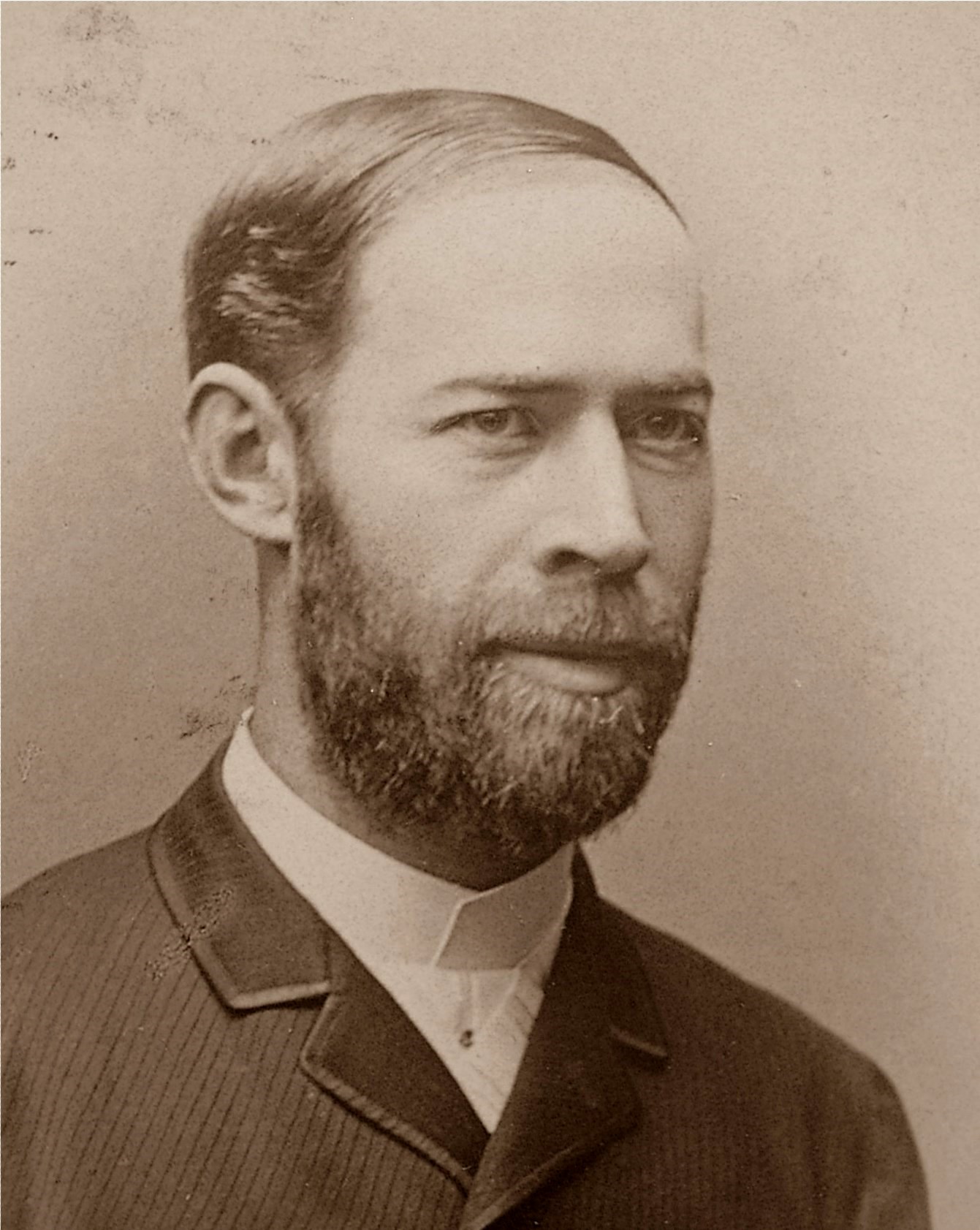
Heinrich Rudolf Hertz (/hɜːrts/ hurts;[3] German: [hɛʁts] ;[4][5] 22 February 1857 – 1 January 1894) was a German physicist who first conclusively proved the existence of the electromagnetic waves proposed by James Clerk Maxwell's equations of electromagnetism.

Key Information

Biography

[edit]

Heinrich Rudolf Hertz was born on 22 February 1857 in Hamburg, the son of Gustav Ferdinand Hertz, a lawyer and politician, and Anna Elisabeth Pfefferkorn.[6][7]

While studying at the Gelehrtenschule des Johanneums in Hamburg, Hertz showed an aptitude for sciences as well as languages, learning Arabic. He studied sciences and engineering in the German cities of Dresden, Munich, and Berlin, where he studied under Gustav Kirchhoff and Hermann von Helmholtz. In 1880, Hertz obtained his Ph.D. from the University of Berlin, and for the next three years remained for post-doctoral study under Helmholtz, serving as his assistant. In 1883, Hertz took a post as a lecturer in theoretical physics at the University of Kiel. In 1885, Hertz became a full professor at the University of Karlsruhe.[8]

In 1886, Hertz married Elisabeth Doll, the daughter of Max Doll, a lecturer in geometry at Karlsruhe. They had two daughters: Johanna, born on 20 October 1887 and Mathilde, born on 14 January 1891, who went on to become a notable biologist. During this time Hertz conducted his landmark research into electromagnetic waves.[9]

Hertz took a position of Professor of Physics and Director of the Physics Institute at the University of Bonn on 3 April 1889, a position he held until his death. During this time he worked on theoretical mechanics with his work published in the book Die Prinzipien der Mechanik in neuem Zusammenhange dargestellt (The Principles of Mechanics Presented in a New Form), published posthumously in 1894.[10]

Death

[edit]

In 1892, Hertz was diagnosed with an infection (after a bout of severe migraines) and underwent operations to treat the illness. He died due to complications after surgery which had attempted to cure his condition. Some consider his ailment to have been caused by a malignant bone condition.[11] He died on 1 January 1894 in Bonn, aged 36, and is buried in the Ohlsdorf Cemetery in Hamburg.[12][13][14]

Hertz's wife, Elisabeth Hertz (née Doll; 1864–1941), did not remarry. He was survived by his daughters, Johanna (1887–1967) and Mathilde (1891–1975).[15] Neither ever married or had children, hence Hertz has no living descendants.[16]

Scientific work

[edit]

Electromagnetic waves

[edit]
Hertz's 1887 apparatus for generating and detecting radio waves: a spark-gap transmitter (left) consisting of a dipole antenna with a spark gap (S) powered by high voltage pulses from a Ruhmkorff coil (T), and a receiver (right) consisting of a loop antenna and spark gap.
One of Hertz's radio wave receivers: a loop antenna with an adjustable spark micrometer (bottom).[17]

In 1864 Scottish mathematical physicist James Clerk Maxwell proposed a comprehensive theory of electromagnetism, now called Maxwell's equations. Maxwell's theory predicted that coupled electric and magnetic fields could travel through space as an "electromagnetic wave". Maxwell proposed that light consisted of electromagnetic waves of short wavelength, but no one had been able to prove this, or generate or detect electromagnetic waves of other wavelengths.[18]

During Hertz's studies in 1879 Helmholtz suggested that Hertz's doctoral dissertation be on testing Maxwell's theory. Helmholtz had also proposed the "Berlin Prize" problem that year at the Prussian Academy of Sciences for anyone who could experimentally prove an electromagnetic effect in the polarization and depolarization of insulators, something predicted by Maxwell's theory.[19][20] Helmholtz was sure Hertz was the most likely candidate to win it.[20] Not seeing any way to build an apparatus to experimentally test this, Hertz thought it was too difficult, and worked on electromagnetic induction instead. Hertz did produce an analysis of Maxwell's equations during his time at Kiel, showing they did have more validity than the then prevalent "action at a distance" theories.[21]

In the autumn of 1886, after Hertz received his professorship at Karlsruhe, he was experimenting with a pair of Riess spirals when he noticed that discharging a Leyden jar into one of these coils produced a spark in the other coil. With an idea on how to build an apparatus, Hertz now had a way to proceed with the "Berlin Prize" problem of 1879 on proving Maxwell's theory (although the actual prize had expired uncollected in 1882).[22][23] He used a dipole antenna consisting of two collinear one-meter wires with a spark gap between their inner ends, and zinc spheres attached to the outer ends for capacitance, as a radiator. The antenna was excited by pulses of high voltage of about 30 kilovolts applied between the two sides from a Ruhmkorff coil. He received the waves with a resonant single-loop antenna with a micrometer spark gap between the ends. This experiment produced and received what are now called radio waves in the very high frequency range.

Hertz's first radio transmitter: a capacitance loaded dipole resonator consisting of a pair of one meter copper wires with a 7.5 mm spark gap between them, ending in 30 cm zinc spheres.[17] When an induction coil applied a high voltage between the two sides, sparks across the spark gap created standing waves of radio frequency current in the wires, which radiated radio waves. The frequency of the waves was roughly 50 MHz, about that used in modern television transmitters.

Between 1886 and 1889 Hertz conducted a series of experiments that would prove the effects he was observing were results of Maxwell's predicted electromagnetic waves. Starting in November 1887 with his paper "On Electromagnetic Effects Produced by Electrical Disturbances in Insulators", Hertz sent a series of papers to Helmholtz at the Berlin Academy, including papers in 1888 that showed transverse free space electromagnetic waves traveling at a finite speed over a distance.[23][24] In the apparatus Hertz used, the electric and magnetic fields radiated away from the wires as transverse waves. Hertz had positioned the oscillator about 12 meters from a zinc reflecting plate to produce standing waves. Each wave was about 4 meters long.[citation needed] Using the ring detector, he recorded how the wave's magnitude and component direction varied. Hertz measured Maxwell's waves and demonstrated that the velocity of these waves was equal to the velocity of light. The electric field intensity, polarization and reflection of the waves were also measured by Hertz. These experiments established that light and these waves were both a form of electromagnetic radiation obeying the Maxwell equations.[25]

Hertz's directional spark transmitter (center), a half-wave dipole antenna made of two 13 cm brass rods with spark gap at center (closeup left) powered by a Ruhmkorff coil, on focal line of a 1.2 m x 2 m cylindrical sheet metal parabolic reflector.[26] It radiated a beam of 66 cm waves with frequency of about 450 MHz. Receiver (right) is similar parabolic dipole antenna with micrometer spark gap.
Hertz's demonstration of polarization of radio waves: the receiver does not respond when antennas are perpendicular as shown, but as receiver is rotated the received signal grows stronger (as shown by length of sparks) until it reaches a maximum when dipoles are parallel.[26]
Another demonstration of polarization: waves pass through polarizing filter to the receiver only when the wires are perpendicular to dipoles (A), not when parallel (B).[26]
Demonstration of refraction: radio waves bend when passing through a prism made of pitch, similarly to light waves when passing through a glass prism.[26]
Hertz's plot of standing waves created when radio waves are reflected from a sheet of metal

Hertz did not realize the practical importance of his radio wave experiments. He stated that,[27][28][29]

It's of no use whatsoever ... this is just an experiment that proves Maestro Maxwell was right—we just have these mysterious electromagnetic waves that we cannot see with the naked eye. But they are there.

Asked about the applications of his discoveries, Hertz replied,[27]

Nothing, I guess.

Hertz's proof of the existence of airborne electromagnetic waves led to an explosion of experimentation with this new form of electromagnetic radiation, which was called "Hertzian waves" until around 1910 when the term "radio waves" became current. Within 6 years Guglielmo Marconi began developing a radio wave based wireless telegraphy system,[30] leading to the wide use of radio communication.

Cathode rays

[edit]

In 1883, he tried to prove that the cathode rays are electrically neutral and got what he interpreted as a confident absence of deflection in electrostatic field. However, as J. J. Thomson explained in 1897, Hertz placed the deflecting electrodes in a highly-conductive area of the tube, resulting in a strong screening effect close to their surface.[31]

Nine years later Hertz began experimenting and demonstrated that cathode rays could penetrate very thin metal foil (such as aluminium). Philipp Lenard, a student of Heinrich Hertz, further researched this "ray effect". He developed a version of the cathode tube and studied the penetration by X-rays of various materials. However, Lenard did not realize that he was producing X-rays. Hermann von Helmholtz formulated mathematical equations for X-rays. He postulated a dispersion theory before Röntgen made his discovery and announcement. It was formed on the basis of the electromagnetic theory of light (Wiedmann's Annalen, Vol. XLVIII). However, he did not work with actual X-rays.[32]

Photoelectric effect

[edit]

Hertz helped establish the photoelectric effect (which was later explained by Albert Einstein) when he noticed that a charged object loses its charge more readily when illuminated by ultraviolet radiation (UV). In 1887, he made observations of the photoelectric effect and of the production and reception of electromagnetic (EM) waves, published in the journal Annalen der Physik. His receiver consisted of a coil with a spark gap, whereby a spark would be seen upon detection of EM waves. He placed the apparatus in a darkened box to see the spark better. He observed that the maximum spark length was reduced when in the box. A glass panel placed between the source of EM waves and the receiver absorbed UV that assisted the electrons in jumping across the gap. When removed, the spark length would increase. He observed no decrease in spark length when he substituted quartz for glass, as quartz does not absorb UV radiation. Hertz concluded his months of investigation and reported the results obtained. He did not further pursue investigation of this effect, nor did he make any attempt at explaining how the observed phenomenon was brought about.[33]

Contact mechanics

[edit]
Memorial of Heinrich Hertz on the campus of the Karlsruhe Institute of Technology, which translates as At this site, Heinrich Hertz discovered electromagnetic waves in the years 1885–1889

In 1881 and 1882, Hertz published two articles[34][35][36] on what was to become known as the field of contact mechanics, which proved to be an important basis for later theories in the field. Joseph Valentin Boussinesq published some critically important observations on Hertz's work, nevertheless establishing this work on contact mechanics to be of immense importance. His work basically summarises how two axi-symmetric objects placed in contact will behave under loading, he obtained results based upon the classical theory of elasticity and continuum mechanics. The most significant flaw of his theory was the neglect of any nature of adhesion between the two solids, which proves to be important as the materials composing the solids start to assume high elasticity. It was natural to neglect adhesion at the time, however, as there were no experimental methods of testing for it.[37]

To develop his theory Hertz used his observation of elliptical Newton's rings formed upon placing a glass sphere upon a lens as the basis of assuming that the pressure exerted by the sphere follows an elliptical distribution. He used the formation of Newton's rings again while validating his theory with experiments in calculating the displacement which the sphere has into the lens. Kenneth L. Johnson, K. Kendall and A. D. Roberts (JKR) used this theory as a basis while calculating the theoretical displacement or indentation depth in the presence of adhesion in 1971.[38] Hertz's theory is recovered from their formulation if the adhesion of the materials is assumed to be zero. Similar to this theory, however using different assumptions, B. V. Derjaguin, V. M. Muller and Y. P. Toporov published another theory in 1975, which came to be known as the DMT theory in the research community, which also recovered Hertz's formulations under the assumption of zero adhesion. This DMT theory proved to be premature and needed several revisions before it came to be accepted as another material contact theory in addition to the JKR theory. Both the DMT and the JKR theories form the basis of contact mechanics upon which all transition contact models are based and used in material parameter prediction in nanoindentation and atomic force microscopy. These models are central to the field of tribology and he was named as one of the 23 "Men of Tribology" by Duncan Dowson.[39] Despite preceding his great work on electromagnetism (which he himself considered with his characteristic soberness to be trivial[27]), Hertz's research on contact mechanics has facilitated the age of nanotechnology.

Hertz also described the "Hertzian cone", a type of fracture mode in brittle solids caused by the transmission of stress waves.[40]

Meteorology

[edit]

Hertz always had a deep interest in meteorology, probably derived from his contacts with Wilhelm von Bezold (who was his professor in a laboratory course at the Munich Polytechnic in the summer of 1878). As an assistant to Helmholtz in Berlin, he contributed a few minor articles in the field, including research on the evaporation of liquids,[41] a new kind of hygrometer, and a graphical means of determining the properties of moist air when subjected to adiabatic changes.[42]

Philosophy of science

[edit]

In the introduction of his 1894 book Principles of Mechanics, Hertz discusses the different "pictures" used to represent physics in his time including the picture of Newtonian mechanics (based on mass and forces), a second picture (based on conservation of energy and Hamilton's principle) and his own picture (based uniquely on space, time, mass and the Hertz principle), comparing them in terms of 'permissibility', 'correctness' and 'appropriateness'.[43] Hertz wanted to remove "empty assumptions" and argue against the Newtonian concept of force and against action at a distance.[43] Philosopher Ludwig Wittgenstein inspired by Hertz's work, extended his picture theory into a picture theory of language in his 1921 Tractatus Logico-Philosophicus which influenced logical positivism.[43] Wittgenstein also quotes him in the Blue and Brown Books.[44]

Third Reich treatment

[edit]

Because Hertz's family converted from Judaism to Lutheranism two decades before his birth, his legacy ran afoul of the Nazi government in the 1930s, a regime that classified people by "race" instead of religious affiliation.[45][46]

Hertz's name was removed from streets and institutions and there was even a movement to rename the frequency unit named in his honor (hertz) after Hermann von Helmholtz instead, keeping the symbol (Hz) unchanged.[46]

His family was also persecuted for their non-Aryan status. Hertz's youngest daughter, Mathilde, lost a lectureship at Berlin University after the Nazis came to power and within a few years she, her sister, and their mother left Germany and settled in England.[47]

Legacy and honors

[edit]
Heinrich Hertz

Heinrich Hertz's nephew, Gustav Ludwig Hertz was a Nobel Prize winner, and Gustav's son Carl Helmut Hertz invented medical ultrasonography. His daughter Mathilde Carmen Hertz was a well-known biologist and comparative psychologist. Hertz's grandnephew Hermann Gerhard Hertz, professor at the University of Karlsruhe, was a pioneer of NMR-spectroscopy and in 1995 published Hertz's laboratory notes.[48]

The SI unit hertz (Hz) was established in his honor by the International Electrotechnical Commission in 1930 for frequency, an expression of the number of times that a repeated event occurs per second.[49] It was adopted by the CGPM (Conférence générale des poids et mesures) in 1960, officially replacing the previous name, "cycles per second" (cps).[50]

In 1928 the Heinrich-Hertz Institute for Oscillation Research was founded in Berlin. Today known as the Fraunhofer Institute for Telecommunications, Heinrich Hertz Institute, HHI.

In 1969, in East Germany, a Heinrich Hertz memorial medal[51] was cast.

The IEEE Heinrich Hertz Medal, established in 1987, is "for outstanding achievements in Hertzian waves [...] presented annually to an individual for achievements which are theoretical or experimental in nature".

The Submillimeter Radio Telescope at Mt. Graham, Arizona, constructed in 1992 is named after him.

A crater that lies on the far side of the Moon, just behind the eastern limb, is the Hertz crater, named in his honor.

On his birthday in 2012, Google honored Hertz with a Google doodle, inspired by his life's work, on its home page.[52][53]

Works

[edit]

Books

[edit]
  • Ueber die Induction in rotirenden Kugeln (in German). Berlin: Gustav Schade. 1880.
  • Die Prinzipien der Mechanik in neuem Zusammenhange dargestellt (in German). Leipzig: Johann Ambrosius Barth. 1894.
  • Schriften vermischten Inhalts (in German). Leipzig: Johann Ambrosius Barth. 1895.

Articles

[edit]
  • Hertz, H.R. "Ueber sehr schnelle electrische Schwingungen", Annalen der Physik, vol. 267, no. 7, p. 421–448, May 1887 doi:10.1002/andp.18872670707
  • Hertz, H.R. "Ueber einen Einfluss des ultravioletten Lichtes auf die electrische Entladung", Annalen der Physik, vol. 267, no. 8, p. 983–1000, June 1887 doi:10.1002/andp.18872670827
  • Hertz, H.R. "Ueber die Einwirkung einer geradlinigen electrischen Schwingung auf eine benachbarte Strombahn", Annalen der Physik, vol. 270, no. 5, p. 155–170, March 1888 doi:10.1002/andp.18882700510
  • Hertz, H.R. "Ueber die Ausbreitungsgeschwindigkeit der electrodynamischen Wirkungen", Annalen der Physik, vol. 270, no. 7, p. 551–569, May 1888 doi:10.1002/andp.18882700708
  • Hertz, H. R.(1899) The Principles of Mechanics Presented in a New Form, London, Macmillan, with an introduction by Hermann von Helmholtz (English translation of Die Prinzipien der Mechanik in neuem Zusammenhange dargestellt, Leipzig, posthumously published in 1894).

See also

[edit]

Lists and histories

Electromagnetic radiation

Other

References

[edit]

Further reading

[edit]
[edit]
Revisions and contributorsEdit on WikipediaRead on Wikipedia
from Grokipedia
Heinrich Rudolf Hertz (22 February 1857 – 1 January 1894) was a German who experimentally verified the existence of electromagnetic waves as predicted by James Clerk Maxwell's . Born in to a prosperous family, Hertz studied engineering and physics under in , earning his doctorate in 1880 before advancing through academic positions at institutions including the and Karlsruhe Polytechnic. Between 1886 and 1888 at , he conducted pioneering experiments using spark-gap transmitters and loop antennas to generate, detect, and measure properties such as reflection, , and polarization of radio waves traveling at the , providing empirical confirmation of Maxwell's theoretical framework and disproving rival action-at-a-distance models. Appointed professor of physics at the in 1889, Hertz's brief career also included early observations on the , linking light intensity to emission rates, though he did not pursue its deeper implications. His work directly enabled subsequent developments in radio technology, and the SI unit of frequency, the hertz (Hz), was named in his honor. Hertz succumbed to a chronic disorder at age 36, truncating what promised to be a major influence on 20th-century physics.

Early Life and Education

Family Background and Childhood

Heinrich Rudolf Hertz was born on February 22, 1857, in , then part of the Kingdom of Hanover within the . His father, Gustav Ferdinand Hertz, was a prominent lawyer, advocate, and later politician who served in the and rose to become a privy councillor. Gustav originated from a Jewish family but converted to in 1834, prior to his marriage. His mother, Anna Elisabeth Pfefferkorn, came from a Lutheran family of educators and was the daughter of a rector. Hertz was the eldest of five children in a prosperous Hanseatic merchant family, which emphasized intellectual pursuits and provided a stable, affluent environment in Hamburg's educated elite. The family adhered to , in which Hertz was raised, reflecting his father's conversion and the mother's background, though religious practice took a secondary role to educational development. During his childhood, Hertz displayed early , constructing models and experimenting with simple devices, interests nurtured by his parents' encouragement of scientific over strict doctrinal adherence. This hands-on engagement foreshadowed his later experimental prowess, amid Hamburg's vibrant commercial and intellectual milieu.

Academic Studies and Influences

Heinrich Hertz began his higher education with engineering in mind, attending the Polytechnic in Dresden in 1876 before shifting focus to natural sciences. In 1877, he enrolled at the University of Munich, studying advanced mathematics, mechanics, and experimental physics for one year under Philipp von Jolly, who recommended readings in Lagrange's analytical mechanics, Laplace's celestial mechanics, and Poisson's probability theory. This period solidified Hertz's mathematical foundation, though he found pure engineering unappealing and pivoted toward physics. In 1878, Hertz moved to the University of Berlin, where he studied under Hermann von Helmholtz and Gustav Kirchhoff, immersing himself in theoretical physics and laboratory work. Helmholtz, a leading figure in physiology, physics, and electromagnetism, served as his primary mentor, guiding Hertz toward experimental investigations of electrical inertia and suggesting research aligned with James Clerk Maxwell's electromagnetic theory, though Hertz initially pursued other topics. Kirchhoff, renowned for circuit theory and spectroscopy, influenced Hertz's grasp of mathematical physics and precise measurement techniques. These professors emphasized empirical verification alongside theory, shaping Hertz's later approach to confirming untested predictions through direct experimentation. Hertz completed his doctorate at the University of in 1880, submitting his Über die Induction in rotirenden Kugeln in January after three months of work, followed by his examination in February, earning magna cum laude—a rare distinction. The analyzed in rotating conducting spheres, demonstrating Hertz's early skill in combining theory with novel apparatus design to test hypotheses on electrical rotation axes posed by the . Overall, Helmholtz's holistic integration of sensory physiology with physical laws and Kirchhoff's analytical rigor profoundly influenced Hertz, fostering a commitment to causal mechanisms over mere description and prioritizing verifiable phenomena in physics. This foundation, built on first-hand laboratory experience rather than rote textbook learning, distinguished Hertz from contemporaries more wedded to abstract speculation.

Professional Career

Early Positions and Mentorship

Following his doctoral dissertation on electromagnetic induction in rotating spheres, defended in February 1880 at the University of Berlin, Hertz was appointed as a research assistant to Hermann von Helmholtz at the Berlin Physical Institute in August 1880. Helmholtz, a leading figure in 19th-century physics renowned for contributions to thermodynamics, electrodynamics, and sensory physiology, provided Hertz with direct mentorship during this three-year tenure (1880–1883), fostering his experimental skills amid the institute's focus on precise measurements and theoretical inquiry. Hertz also benefited from the intellectual environment shaped by Gustav Kirchhoff, another Berlin professor whose spectroscopic and circuit theory work influenced Hertz's early research interests, though Helmholtz remained the primary guide whom Hertz deeply admired. During his assistantship, Hertz contributed to practical operations and pursued independent investigations, including refinements to devices, which honed his apparatus-building expertise essential for later electromagnetic experiments. This role, salaried and hands-on, marked Hertz's transition from student to professional physicist, emphasizing empirical validation over abstract theory in line with Helmholtz's methodological emphasis on quantifiable phenomena. In March 1883, seeking greater independence, Hertz relocated to the University of as a (unsalaried lecturer) in , a position that required him to deliver courses and qualify via (a post-doctoral qualification for university teaching) completed by May 1883. At , lacking dedicated laboratory facilities, Hertz focused on lecturing and theoretical work, including elasticity problems, but grew dissatisfied with limited research opportunities, prompting his 1885 move to a professorship at . This early phase underscored mentorship's role in bridging academic training to original inquiry, with Helmholtz's influence evident in Hertz's commitment to experimental rigor over speculative modeling.

Professorships and Research Environment

Hertz accepted the position of full professor of physics at the in March 1885, succeeding August Kundt and serving until 1889. The institution's physics laboratory provided extensive facilities optimized for experimental research, including ample indoor space for high-voltage setups and wave propagation tests over distances up to 16 meters, which facilitated his confirmation of electromagnetic waves using spark-gap transmitters and loop resonators. This technical university environment emphasized practical applications, allowing Hertz autonomy in directing apparatus construction and testing without the constraints of a traditional university's broader administrative duties. In December 1888, Hertz received an offer for an ordinary professorship in physics at the , which he assumed on April 3, 1889, alongside the directorship of the newly established Physics Institute. The Bonn laboratory, though still developing under his leadership, offered resources for continued electrical discharge studies and mechanics investigations, supported by university funding for instrumentation amid Germany's expanding academic infrastructure for natural sciences. However, his tenure there was marked by increasing administrative responsibilities and health challenges, limiting the scale of experimental work compared to , though it enabled pedagogical integration of his findings into lectures.

Scientific Contributions

Experimental Confirmation of Electromagnetic Waves

In late 1887, Heinrich Hertz announced the experimental generation and detection of electromagnetic waves using a spark-gap transmitter consisting of a dipole antenna powered by an induction coil, which produced oscillating electric discharges across a small gap between two polished spheres or rods. The receiver was a resonant loop antenna with its own adjustable spark gap, where induced currents from incoming waves caused visible micro-sparks, confirming wave propagation over distances up to 12 meters. These experiments, conducted at the Technische Hochschule in Karlsruhe between 1886 and 1888, directly verified James Clerk Maxwell's prediction that accelerating charges produce transverse electromagnetic waves traveling at the speed of light. Hertz measured wavelengths by establishing standing waves through reflection off a large zinc sheet placed behind the transmitter, observing nodes and antinodes where spark intensity in the receiver varied periodically; one such setup yielded a wavelength of approximately 4 meters corresponding to frequencies in the tens of megahertz range. He further demonstrated wave properties akin to , including reflection from metal surfaces, through large prisms of pitch or paraffin, and polarization using wire grids that blocked waves aligned parallel to the wires while allowing ones to pass. These observations aligned with , showing electromagnetic disturbances propagate through space without a medium, refuting action-at-a-distance theories prevalent in continental physics. The apparatus improvements, such as enclosing the in a to reduce and using parabolic reflectors for directional transmission, enhanced signal strength and precision, enabling detection of interference patterns and effects. Hertz's results, published in series of papers starting with "Über elektromagnetische Wirkungen elektrischer Störungen in Isolatoren" in 1887, provided empirical validation that and constitute a , paving the way for radio technology despite Hertz's initial view of the waves as a curiosity without practical application.

Investigations into Cathode Rays and Photoelectric Effect

In 1883, while at the University of Kiel, Hertz conducted experiments to investigate the properties of produced in low-pressure gas discharge tubes. He attempted to deflect these rays using both electrostatic and magnetostatic fields but reported no observable deflection, leading him to conclude that their electrostatic and electromagnetic properties were either negligible or very feeble. This result, published in the , supported interpretations of as neutral waves rather than charged particles, though subsequent analyses attributed the null deflection to experimental limitations, including insufficient vacuum quality that allowed residual gas ions to screen applied . Hertz's setup involved a Crookes tube-like apparatus with rays directed toward fluorescent screens or detectors, emphasizing empirical over theoretical preconceptions. Hertz further examined the penetrative capabilities of cathode rays, demonstrating that they could traverse thin metal foils, such as aluminum or gold, without significant attenuation, as evidenced by continued on downstream screens. Collaborating with his assistant , he refined these tests by employing extremely thin, porous metal layers—often gold or silver foils melted onto the tube's glass envelope—which permitted rays to pass through and induce glows beyond the barrier, confirming their high penetrability compared to visible light or other emissions. These findings, detailed in Hertz's 1883–1884 publications, contributed to ongoing debates on ray composition, influencing later work by J.J. Thomson who achieved deflections in higher vacuums, revealing cathode rays as streams of negatively charged particles (s). During his electromagnetic wave experiments in 1887 at the Technische Hochschule Karlsruhe, Hertz serendipitously observed the while studying spark discharges between electrodes. He noted that radiation from a primary illuminated the receiver gap's metal electrodes, thereby lengthening the maximum spark distance in air by facilitating discharge at lower voltages, an effect absent with visible light. This phenomenon, reported in his paper "Über einen Einfluss des ultravioletten Lichtes auf die electrische Entladung" (, 1887), indicated that UV light imparted negative electrical charges to the electrodes, effectively reducing the potential barrier for sparking. Hertz attributed this to a "discharge of negative electricity" from illuminated surfaces, observing it most pronounced with clean metals like or in partial or dry air conditions. Though Hertz did not deeply theorize the effect—viewing it as a practical aiding his detection—he quantitatively described its dependence on light wavelength and intensity, noting stricter proportionality for UV than longer waves, and its enhancement by surface cleanliness. Lenard later extended these observations using specialized tubes, confirming electron emission but introducing intensity misconceptions that Einstein resolved in 1905 by invoking light quanta. Hertz's discovery underscored a non-thermal ejection mechanism, challenging classical wave theories of light-matter interaction and laying groundwork for , despite his own adherence to continuous electromagnetic models.

Contributions to Mechanics and Other Fields

In 1880, Hertz completed his doctoral dissertation titled Über die Induction in rotirenden Kugeln (On the Induction in Rotating Spheres), which examined effects in mechanically rotating conducting spheres. This work integrated principles of , particularly the dynamics of rotation and inertial forces, with electromagnetic theory to model induced currents under rotational motion. Hertz's most notable contribution to came in 1882 with his "Über die Berührung fester elastischer Körper" (On the Contact of Elastic Solids), where he formulated the theory of contact stresses between two curved elastic surfaces. Assuming frictionless contact, small deformations, and , Hertz derived equations for the radius of the contact area and the distribution of compressive stresses, showing that the maximum pressure occurs at the center of the contact zone and follows an elliptical distribution. This analysis, known as Hertzian contact theory, provided the foundational framework for understanding elastic deformation in non-conformal contacts. The Hertzian theory has enduring applications in , including the design of rolling-element bearings, cams, and gears, where it predicts contact stresses to prevent and . Hertz's derivations relied on solving the Boussinesq-Cerruti problem for half-space elasticity, reducing the complex three-dimensional stress field to tractable geometric and material parameters such as the reduced modulus of elasticity and relative curvature. Beyond , Hertz conducted early investigations into the inertia of rapidly rotating bodies during his time in (1880–1883), contributing to experimental validations of rotational dynamics principles amid his broader electrical studies. These efforts underscored his interest in refining mechanical models through precise experimentation, though they were secondary to his electromagnetic pursuits.

Philosophical Views on

Critique of Positivism and Mechanics Principles

In his posthumously published Die Prinzipien der Mechanik (1894), Heinrich Hertz sought to reconstruct on a foundation free from the ambiguities inherent in Newtonian formulations, particularly the undefined role of as a hybrid of kinematic description and dynamic causation. He argued that traditional mechanics suffered from "logical obscurity" by treating as an cause bridging observable motions and unobservable mechanisms, leading to inconsistent deductions and unnecessary metaphysical assumptions. To resolve this, Hertz eliminated entirely, deriving all mechanical laws from a single postulate: the governing systems of constrained point masses, expressed via in a geometrically invariant form using quaternions and differential constraints. This reformulation emphasized as primary, with dynamics emerging as constrained evolutions, applicable to rigid bodies, continua, and contact phenomena without adjustments. Hertz contended that the principles of —such as Newton's laws or conservation tenets—are not absolute or a priori truths but provisional "images" or symbolic representations tailored to and . He outlined three criteria for evaluating such images: Zulässigkeit (permissibility, requiring internal logical consistency and freedom from contradiction), Richtigkeit (correctness, ensuring predicted consequences align with observable facts), and Zweckmäßigkeit (appropriateness, favoring maximal and permeability to further logical connections over rivals). By this metric, traditional failed appropriateness due to its proliferation of equivalent but incommensurable formulations (e.g., Newtonian vs. Lagrangian), while energetic alternatives (as in Helmholtz's work) erred by dissolving into abstract functions detached from material reality. Hertz's own image, rooted in a mechanistic of hidden masses and interactions, prioritized deductive fertility, allowing to encompass phenomena like elasticity and hydrodynamics under unified constraints. Although Hertz's stress on empirical alignment and rejection of metaphysics superficially resembled positivist doctrines, his framework implicitly critiqued strict —exemplified by —by insisting on substantive, realist models rather than purely phenomenological descriptions. Mach advocated economizing thought through eliminative descriptions, dismissing atoms as metaphysical; Hertz, conversely, retained unobservable point atoms and mechanisms as integral to permissible images, arguing that progresses by selecting robust representations capable of explaining latent effects, not merely cataloging sensations. This divergence underscores Hertz's view that positivism's aversion to "hidden" entities impoverishes theory construction, rendering it inadequate for the causal depth demanded by ; as he noted, our comprises only "a small part of the ," yet effective images must bridge observables and the concealed without dogmatic assertion. Such positions positioned Hertz's mechanics as a balanced alternative, influencing later debates on theory choice while highlighting the contingency of foundational principles amid evolving evidence.

Personal Life and Death

Marriage, Family, and Health Decline

Heinrich Hertz married Elisabeth Doll, the daughter of his colleague Max Doll, a professor of mathematics at the Karlsruhe Polytechnic, on July 31, 1886. The couple settled in , where Hertz held his professorship, and their marriage coincided with a period of professional stability following his experimental successes. Hertz and Elisabeth had two daughters: , born on October 20, 1887, and Mathilde , born on January 14, 1891. Neither daughter married or had children, leaving Hertz without living descendants. Elisabeth outlived her husband by nearly five decades, dying in 1941 without remarrying. Hertz's health began deteriorating in the early 1890s, with initial symptoms including severe migraines that emerged even before his 1892 appointment in Bonn. These escalated into chronic pain, dental abscesses, and bone erosion affecting his jaw and teeth, prompting multiple surgeries in attempts to alleviate the condition, which some contemporaries and later analyses attributed to a malignant bone disorder or possibly an autoimmune vasculitis such as granulomatosis with polyangiitis (formerly Wegener's granulomatosis). The illness progressively impaired his ability to work and teach, forcing him to dictate lectures and rely on assistants, though he continued research efforts amid mounting physical frailty.

Final Years and Cause of Death

In 1889, Hertz accepted the position of full professor of physics at the , succeeding his former mentor Eugen Golling, and relocated there with his family to focus on both teaching and further experimental work. Despite the demands of the role, he persisted in lecturing and research amid emerging health difficulties that had begun earlier, including persistent toothaches prompting extensive dental extractions and treatments as early as 1888. These issues escalated into a severe, chronic originating in the nasal passages, which spread to the and caused debilitating pain, rendering sustained work increasingly challenging. By 1892, Hertz's condition had deteriorated markedly, with symptoms including facial swelling, recurrent abscesses, and systemic exhaustion that interrupted his academic duties; he nonetheless attempted to resume after brief recoveries. Multiple surgical interventions followed, aimed at draining infected tissues and removing necrotic from the affected areas, but these procedures failed to halt the progression, leading to complications such as widespread infection and toxemia. The underlying pathology involved destructive inflammation of blood vessels and tissues in the upper , consistent with (GPA, formerly Wegener's granulomatosis), an autoimmune that erodes and —though this specific was unavailable at the time and applied retrospectively based on clinical descriptions. Hertz succumbed to on January 1, 1894, in , at age 36, remaining lucid until the end despite the agony of blood poisoning from the untreated spread of infection. His untimely death deprived physics of further contributions from a researcher at the peak of productivity, with findings confirming suppurative processes in the skull base as the immediate fatal mechanism, though contemporary accounts emphasized the intractable nature of the sinus without recognizing its vasculitic .

Reception During the Nazi Era

Ideological Rejection Despite Scientific Merit

Despite his groundbreaking experimental verification of James Clerk Maxwell's electromagnetic theory through the generation and detection of radio waves between 1886 and 1888, Heinrich Hertz faced ideological repudiation from the Nazi regime owing to his paternal Jewish ancestry. Although Hertz had been raised Lutheran and baptized as such, Nazi racial classifications under the 1935 deemed individuals with Jewish grandparents as "Mischlinge" or fully non-Aryan, retroactively tainting his legacy regardless of religious practice. Proponents of , such as Nobel laureate , explicitly contested Jewish attributions of scientific prowess to Hertz, asserting in a 1934 pamphlet that "respect for facts and aptitude for exact observation reside in the " and dismissing Hertz's invocation by as evidence of such traits. This rejection manifested in tangible erasures of Hertz's honors. In 1933–1934, shortly after the Nazi seizure of power, authorities removed Hertz's portrait from its prominent display in Hamburg's Altes Rathaus (Old City Hall), where it had symbolized local scientific pride since his death in 1894. Street names honoring him, such as Hamburg's Hertzstraße, were targeted for renaming; sought and received approval from on September 25, 1938, to excise such "non-Aryan" commemorations amid broader campaigns to "Aryanize" public nomenclature. The Heinrich-Hertz-Institut für Schwingungsforschung in Berlin, established in his name, purged Jewish personnel under the 1933 Civil Service Law, prioritizing ideological purity over institutional continuity. Even Hertz's former assistant, —a fervent Nazi and fellow Nobelist who advanced —conceded Hertz's eminence but qualified it by referencing his "Jewish blood," reflecting the regime's selective tolerance for empirical results when detached from their originator's heritage. While Hertz's wave experiments underpinned practical technologies like , which the Nazis exploited militarily, this utilitarian acceptance did not mitigate the broader ideological drive to attribute successes to "" influences, such as German laboratory traditions, rather than Hertz's individual genius. The contradiction highlighted the regime's prioritization of racial dogma over scientific causality, though Hertz's foundational contributions proved resilient against such suppression.

Impact on Family and Legacy Suppression

Following Heinrich Hertz's death in 1894, his widow Elisabeth Doll and their two surviving daughters, Johanna and Mathilde, encountered severe repercussions under the Nazi regime due to the family's partial Jewish ancestry via Hertz's father, Gustav Ferdinand Hertz, who had converted to in 1834. Although the family adhered to and Hertz himself identified as Christian, the of 1935 classified them as non-Aryan based on racial criteria, rendering them subject to discriminatory measures irrespective of religious practice. Mathilde Carmen Hertz, a and who had earned her in 1921 and held a position at the University of , was dismissed from her academic post in 1933 shortly after the Nazi seizure of power, as part of the broader purge of individuals deemed racially ineligible under the Law for the Restoration of the Professional . The family's persecution escalated, compelling Elisabeth and her daughters to flee for by 1938, where they resided in reduced circumstances. provided financial aid of £250 to the exiled Hertz family that year, underscoring their plight and the international recognition of their hardship despite lacking direct involvement in Jewish communal life. This displacement disrupted their lives profoundly; Mathilde continued limited scholarly work in exile but never regained her prior professional standing in , while the family navigated economic instability amid broader anti-Semitic policies that targeted even assimilated descendants of converts. Regarding Hertz's scientific legacy, the Nazis actively denigrated his personal reputation owing to his paternal Jewish lineage, attempting to disentangle his foundational electromagnetic experiments from his identity in ideological narratives favoring "Aryan" science. Public commemorations and institutional honors linked to Hertz were curtailed or reframed during the Third Reich, reflecting a pattern of suppressing acknowledgments of Jewish or partially Jewish contributors to physics, even as his empirical verification of Maxwell's equations underpinned technologies like radar that the regime exploited. However, the eponymous unit of frequency, hertz (Hz), persisted in technical usage without alteration, indicating pragmatic retention of his discoveries amid ideological rejection— a selective suppression that prioritized utility over heroic attribution. This approach aligned with Nazi efforts to rewrite scientific history, as seen in campaigns by figures like Philipp Lenard, Hertz's former assistant, who promoted "deutsche Physik" while downplaying non-Aryan influences. Postwar, Hertz's legacy was rehabilitated in West Germany, but the era's distortions delayed full recognition in some educational contexts until denazification processes advanced.

Enduring Legacy

Influence on Modern Physics and Technology

Hertz's generation and detection of electromagnetic waves between 1887 and 1888 experimentally confirmed James Clerk Maxwell's 1865 theory of , demonstrating that radio waves propagate through space at the , approximately 300,000 kilometers per second. This validation shifted physics from theoretical speculation to empirical foundation, enabling subsequent engineers to harness radio frequencies for practical applications. The principles Hertz established directly informed Guglielmo Marconi's development of in 1895, where spark-gap transmitters similar to Hertz's apparatus transmitted signals over distances, laying the groundwork for broadcast radio by the early 1900s and techniques refined by in 1906. In modern technology, Hertz's work underpins systems, first operationalized in 1935 by , microwave communication networks, and global positioning systems, all manipulating radio waves for detection, transmission, and navigation. In physics, Hertz's methodology of reducing mechanics to empirical forces influenced Albert Einstein's 1905 , which unified electric and while positing the invariance of speed observed in Hertz's waves. The named the unit of frequency "hertz" (Hz), defined as one , in his honor in 1930, standardizing measurements in power grids operating at 50 or 60 Hz and in spectrum analysis up to gigahertz bands used in networks. Hertz's incidental observation of the in 1887, where discharged a charged body more rapidly, provided data later quantum-mechanically explained by Einstein in 1905, contributing to the concept.

Honors, Units, and Institutional Recognition

Heinrich Hertz received several prestigious awards during his lifetime for his contributions to and . In 1879, he was awarded a prize by the University of for experimentally demonstrating that possesses no , as proposed by . In 1888, he received the from the Italian Scientific Society for his work on electric waves. The following year, 1889, Hertz won the Baumgartner Prize from the Academy of Sciences and the La Caze Prize from the [French Academy of Sciences](/page/French Academy of Sciences), recognizing his electromagnetic research. In 1890, he was honored with the from the Royal Society for his experimental confirmation of James Clerk Maxwell's electromagnetic theory. He also received the Bressa Prize for his scientific achievements. The SI unit of frequency, the hertz (Hz), which denotes one cycle per second, was named in Hertz's honor by the in 1930, reflecting his pioneering generation and detection of electromagnetic waves. Posthumously, numerous institutions and awards have been established in Hertz's name to commemorate his legacy. The Heinrich Hertz Institute for Research on Oscillations was founded in in 1927, later becoming part of Fraunhofer Society, focusing on communications . The [Karlsruhe Institute of Technology](/page/Karlsruhe Institute of Technology) maintains the Heinrich Hertz Chair, honoring his professorship there from 1885 to 1889, and awards the Heinrich Hertz Prize every three years for achievements in energy research. The IEEE established the Heinrich Hertz Medal in 1983 for contributions to electromagnetics, awarded until 2009. Monuments, such as a bust in , and various research centers worldwide further recognize his foundational role in physics.

References

Add your contribution
Related Hubs
User Avatar
No comments yet.