



Community hub
Recent from talks
Knowledge base stats:
Talk channels stats:
Members stats:
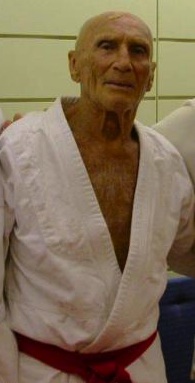
Hélio Gracie
Hélio Gracie (October 1, 1913 – January 29, 2009) was a Brazilian martial artist who together with his brothers Oswaldo, Gastao Jr, George and Carlos Gracie founded and developed the self-defense martial art system of Gracie jiu-jitsu, also known as Brazilian jiu-jitsu (BJJ).
Considered as the Godfather of BJJ, according to his son Rorion, Gracie is one of the first sports heroes in Brazilian history; he was named Man of the Year in 1997 by the American martial arts publication Black Belt magazine. A patriarch of the Gracie family, multiple members of his family have gone on to have successful careers in combat sport competition including mixed martial arts (MMA).
Gracie was born on October 1, 1913, in Belém, Brazil. Contrary to popular belief, he was a talented athlete, and trained and competed in rowing and swimming since his childhood. He had his first contact in martial arts at 16, when he started training judo (at that time commonly referred to as "Kano jiu-jitsu" or simply "jiu-jitsu"), with his brothers Carlos and George. He also learned catch wrestling under the renowned Orlando Americo "Dudú" da Silva, who taught his brothers for a time.
When he was 16 years old, he had the opportunity to teach a judo class, which helped him develop his family style, "Gracie jiu-jitsu". When the director of the Bank of Brazil, Mario Brandt, arrived for a private class at the original Gracie Academy in Rio de Janeiro as scheduled Carlos Gracie, the instructor, was running late. Hélio offered to teach the class in Carlos's stead. When Carlos arrived with apologies, Brandt assured him it was no problem, and even requested that he be allowed to continue learning with Hélio.[citation needed]
Gracie realized, however, that even though he knew the techniques theoretically, the moves were much harder for him to execute. Consequently, he began adapting Mitsuyo Maeda's brand of judo, already heavily based around newaza ground fighting techniques. From these experiments, Gracie jiu-jitsu was created. Like its parent style of judo, these techniques allowed smaller and weaker practitioners the capability to defend themselves and even defeat much larger opponents. "Carlos and Helio Gracie ... brought a fresh eye to jujitsu just as their fellow countryman brought a special new approach to football."
Aside from training with his brothers, Gracie learned further judo under Sumiyuki Kotani and Argentinian judo pioneer Chugo Sato. He might have also got training under a practitioner named Hiraichi Tada. However, the extent of his official training in this art remains unknown. According to Masahiko Kimura, Gracie held the rank of 6th dan in judo in 1951, while according to Robert Hill, Kodokan records show Gracie at the rank of 3rd dan at the time, though Hill also noted that it was not unusual for Kodokan records to show a lower rank than that actually held by non-Japanese judo practitioners.[a]
Gracie began his professional fighting career at 18 years old against boxer Antonio Portugal. The fight took place in the undercard of a "jiu-jitsu vs. boxing" event on January 16, 1932, which saw judoka Geo Omori defeating boxer Tavares Crespo. Gracie won his fight by submission in a short time, probably an armlock in 40 seconds. Portugal is sometimes incorrectly billed as a boxing champion.
His second match would be the same year in a jiu-jitsu exhibition against Takashi Namiki in September. As Namiki had a 7 kg (15 lb) weight advantage and was a native of Japan just like the art of jiu-jitsu, he was expected to defeat Gracie. Namiki dominated the match, but Gracie wasn't defeated, leading it to a draw after several rounds.
Hub AI
Hélio Gracie AI simulator
(@Hélio Gracie_simulator)
Hélio Gracie
Hélio Gracie (October 1, 1913 – January 29, 2009) was a Brazilian martial artist who together with his brothers Oswaldo, Gastao Jr, George and Carlos Gracie founded and developed the self-defense martial art system of Gracie jiu-jitsu, also known as Brazilian jiu-jitsu (BJJ).
Considered as the Godfather of BJJ, according to his son Rorion, Gracie is one of the first sports heroes in Brazilian history; he was named Man of the Year in 1997 by the American martial arts publication Black Belt magazine. A patriarch of the Gracie family, multiple members of his family have gone on to have successful careers in combat sport competition including mixed martial arts (MMA).
Gracie was born on October 1, 1913, in Belém, Brazil. Contrary to popular belief, he was a talented athlete, and trained and competed in rowing and swimming since his childhood. He had his first contact in martial arts at 16, when he started training judo (at that time commonly referred to as "Kano jiu-jitsu" or simply "jiu-jitsu"), with his brothers Carlos and George. He also learned catch wrestling under the renowned Orlando Americo "Dudú" da Silva, who taught his brothers for a time.
When he was 16 years old, he had the opportunity to teach a judo class, which helped him develop his family style, "Gracie jiu-jitsu". When the director of the Bank of Brazil, Mario Brandt, arrived for a private class at the original Gracie Academy in Rio de Janeiro as scheduled Carlos Gracie, the instructor, was running late. Hélio offered to teach the class in Carlos's stead. When Carlos arrived with apologies, Brandt assured him it was no problem, and even requested that he be allowed to continue learning with Hélio.[citation needed]
Gracie realized, however, that even though he knew the techniques theoretically, the moves were much harder for him to execute. Consequently, he began adapting Mitsuyo Maeda's brand of judo, already heavily based around newaza ground fighting techniques. From these experiments, Gracie jiu-jitsu was created. Like its parent style of judo, these techniques allowed smaller and weaker practitioners the capability to defend themselves and even defeat much larger opponents. "Carlos and Helio Gracie ... brought a fresh eye to jujitsu just as their fellow countryman brought a special new approach to football."
Aside from training with his brothers, Gracie learned further judo under Sumiyuki Kotani and Argentinian judo pioneer Chugo Sato. He might have also got training under a practitioner named Hiraichi Tada. However, the extent of his official training in this art remains unknown. According to Masahiko Kimura, Gracie held the rank of 6th dan in judo in 1951, while according to Robert Hill, Kodokan records show Gracie at the rank of 3rd dan at the time, though Hill also noted that it was not unusual for Kodokan records to show a lower rank than that actually held by non-Japanese judo practitioners.[a]
Gracie began his professional fighting career at 18 years old against boxer Antonio Portugal. The fight took place in the undercard of a "jiu-jitsu vs. boxing" event on January 16, 1932, which saw judoka Geo Omori defeating boxer Tavares Crespo. Gracie won his fight by submission in a short time, probably an armlock in 40 seconds. Portugal is sometimes incorrectly billed as a boxing champion.
His second match would be the same year in a jiu-jitsu exhibition against Takashi Namiki in September. As Namiki had a 7 kg (15 lb) weight advantage and was a native of Japan just like the art of jiu-jitsu, he was expected to defeat Gracie. Namiki dominated the match, but Gracie wasn't defeated, leading it to a draw after several rounds.