Hubbry Logo
logo
Rio de Janeiro
Community hub

Rio de Janeiro

logo
0 subscribers
Be the first to start a discussion here.
Contribute something to knowledge base
Hub AI

Rio de Janeiro AI simulator

(@Rio de Janeiro_simulator)

Rio de Janeiro

Rio de Janeiro, or simply Rio, is the capital of the state of Rio de Janeiro. It is the second-most-populous city in Brazil (after São Paulo) and the sixth-most-populous city in the Americas.

Founded in 1565, the city was initially the seat of the Captaincy of Rio de Janeiro, a domain of the Portuguese Empire. In 1763, it became the capital of the State of Brazil. In 1808, when the Portuguese Royal Court moved to Brazil, Rio de Janeiro became the seat of the court of Queen Maria I of Portugal. Under the leadership of her son, prince regent John of Braganza, Maria raised Brazil to the dignity of a kingdom, within the United Kingdom of Portugal, Brazil, and Algarves. Rio remained as the capital of the pluricontinental monarchy until 1822, when the Brazilian War of Independence began. This is one of the few instances in history that the capital of a colonizing country officially shifted to a city in one of its colonies. Rio de Janeiro subsequently served as the capital of the Empire of Brazil, until 1889, and then the capital of republican Brazil until 1960 when the capital was transferred to Brasília.

Rio de Janeiro has the second largest municipal GDP in the country, and 30th-largest in the world in 2008. This is estimated at R$343 billion. In the city are the headquarters of Brazilian oil, mining, and telecommunications companies, including two of the country's major corporations, Petrobras and Vale, and Latin America's largest telemedia conglomerate, Grupo Globo. The home of many universities and institutes, it is the second-largest center of research and development in Brazil, accounting for 17 percent of national scientific output according to 2005 data. Despite the high perception of crime, the city actually has a lower incidence of crime than most state capitals in Brazil.

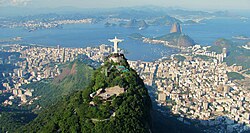
Rio de Janeiro is one of the most visited cities in the Southern Hemisphere and is known for its natural settings, carnival, samba, bossa nova, and beaches such as Barra da Tijuca, Copacabana, Ipanema, and Leblon. In addition to the beaches, landmarks include the statue of Christ the Redeemer atop Corcovado mountain, named one of the New Seven Wonders of the World; Sugarloaf Mountain with its cable car; the Sambódromo, a permanent grandstand-lined parade avenue which is used during Carnival; and Maracanã Stadium, one of the world's largest football stadiums. Rio de Janeiro was the host of the 2016 Summer Olympics and the Paralympics, making the city the first South American and Portuguese-speaking city to ever host the events, and the third time the Olympics were held in a Southern Hemisphere city. The Maracanã Stadium held the finals of the 1950 and 2014 FIFA World Cups, the 2013 FIFA Confederations Cup, and the XV Pan American Games. The city hosted the G20 summit in 2024, and will host the FIFA Women's World Cup in 2027.

Portugal Portuguese Empire 1565–1815
United Kingdom of Portugal, Brazil and the Algarves 1815–1822
Empire of Brazil 1822–1889
Brazil Republic of Brazil 1889–present

The region of Rio was inhabited by the Tupi, Puri, Botocudo and Maxakalí peoples.

Europeans first encountered Guanabara Bay on 1 January 1502 (hence Rio de Janeiro, "January River"), during a Portuguese expedition under explorer Gaspar de Lemos, captain of a ship in Pedro Álvares Cabral's fleet, or under Gonçalo Coelho. Allegedly the Florentine explorer Amerigo Vespucci participated as an observer at the invitation of King Manuel I in the same expedition.

In 1555, one of the islands of Guanabara Bay, now called Villegagnon Island, was occupied by 500 French colonists under the French admiral Nicolas Durand de Villegaignon. Consequently, Villegagnon built Fort Coligny on the island when attempting to establish the France Antarctique colony. Eventually this French settlement became too much of a threat to the established Portuguese colony and in 1560 the order was made to get rid of them. A years-long military aggression was then initiated by the new Governor General of Brazil Mem de Sá, and later continued by his nephew Estácio de Sá. On 20 January 1567, a final defeat was imposed on the French forces and they were decisively expelled from Brazil for good.

See all
capital and largest city of the state of Rio de Janeiro, Brazil
User Avatar
No comments yet.