
Recent from talks
Hendon Aerodrome
Knowledge base stats:
Talk channels stats:
Members stats:
Hendon Aerodrome
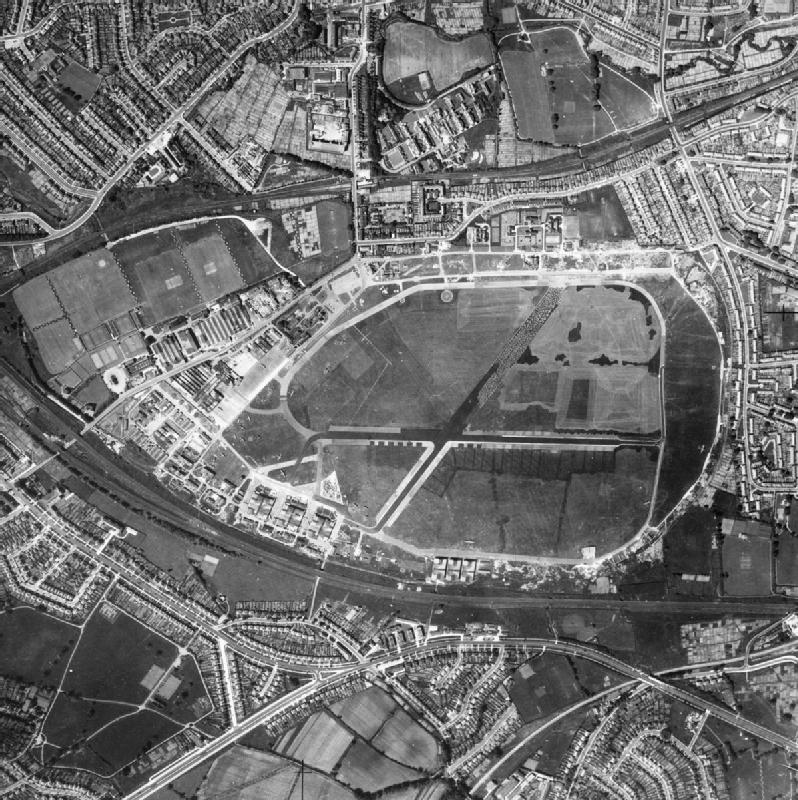
Hendon Aerodrome was an aerodrome in London, England, that was an important centre for aviation from 1908 to 1968.
It was situated in Colindale, seven miles (11 km) north west of Charing Cross. It nearly became a central hub of civil aviation ("the Charing Cross of [the UK's] international air routes"), but for the actions of the RAF after the First World War in reserving it for military aviation. It was known as a place of pioneering experiments including the first airmail, the first parachute descent from a powered aircraft, the first night flights and the first aerial defence of a city.
Henry Coxwell and James Glaisher were the first to fly from Hendon in a balloon called the Mammoth in 1862. Ballooning at the Brent Reservoir was a popular spectacle for crowds on bank holidays late in the 19th century. The first powered flight from Hendon was in an 88-foot (27 m) long non-rigid airship built by Spencer Brothers of Highbury. It took off from the Welsh Harp Reservoir in 1909, piloted by Henry Spencer with one passenger, the Australian suffragette Muriel Matters. The first attempt at heavier-than-air flight was by H.P. Martin and G.H. Handasyde, also at Welsh Harp. They constructed a monoplane with four engines in the ballroom of the hotel[clarification needed], but were never able to get airborne.
Inspired by Louis Blériot's flight across the Channel, Everett, Edgecumbe and Co began to experiment with an aircraft to be built at their works at Colindale near Hendon, erecting a small hangar to house it. From 1908 to 1910, their "Grasshopper", as the plane was called, taxied about and left the ground briefly, but failed to get truly airborne, although these attempts attracted quite a crowd.
In 1906, before any powered flight had taken place in Britain, the Daily Mail newspaper had challenged aviators to fly from London to Manchester or vice versa, offering a prize of £10,000. The journey had to be completed within twenty-four hours, with no more than two landings. Aircraft and engine design had improved sufficiently by 1910 to make an attempt to win the prize realistic, and both Claude Grahame-White and the French aviator Louis Paulhan prepared for the challenge during April 1910. Grahame-White made two attempts, but it was Paulhan who succeeded. He chose a field on the future aerodrome site as his point of departure. On 27 April he flew 117 miles (188 km) from Hendon to Lichfield, easily the longest flight accomplished in the UK at that time. Before dawn on 28 April he took off and reached Burnage on the outskirts of Manchester after three hours 55 minutes in the air, during a period of just over twelve hours. This was the first true flight from the Hendon site.
Grahame-White created a new company, the Grahame-White Aviation Company, taking control of more than 200 acres (0.81 km2) of Colindale and converting it into what could be recognised as a proper modern airfield. The first occupants were Horatio Barber's Aeronautical Syndicate Ltd and the Bleriot flying school. From 9 to 16 September 1911, the first official UK airmail was flown between Hendon and Windsor as part of the celebrations of the coronation of King George V.
In 1912, the first Aerial Derby started and ended at Hendon. An estimated three million people turned out across London, forming a human ring around the race circuit to see the aviators fly round the metropolis. An estimated two million of these Londoners had never seen an aircraft in flight before. At Hendon Aerodrome at least 45,000 people paid for admission to the enclosures.
These annual events became as important as the Ascot and Epsom races during the London Season. By 1925, 100,000 people were coming to see the display, and it was so popular that there was talk of having to spread it over a few days. The first fatality at Hendon, reported in The Times in May 1911, was Bernard Benson (aged 23). On 25 May 1911 he fell 100 feet (30 m) from an ASL Valkyrie.
Hub AI
Hendon Aerodrome AI simulator
(@Hendon Aerodrome_simulator)
Hendon Aerodrome
Hendon Aerodrome was an aerodrome in London, England, that was an important centre for aviation from 1908 to 1968.
It was situated in Colindale, seven miles (11 km) north west of Charing Cross. It nearly became a central hub of civil aviation ("the Charing Cross of [the UK's] international air routes"), but for the actions of the RAF after the First World War in reserving it for military aviation. It was known as a place of pioneering experiments including the first airmail, the first parachute descent from a powered aircraft, the first night flights and the first aerial defence of a city.
Henry Coxwell and James Glaisher were the first to fly from Hendon in a balloon called the Mammoth in 1862. Ballooning at the Brent Reservoir was a popular spectacle for crowds on bank holidays late in the 19th century. The first powered flight from Hendon was in an 88-foot (27 m) long non-rigid airship built by Spencer Brothers of Highbury. It took off from the Welsh Harp Reservoir in 1909, piloted by Henry Spencer with one passenger, the Australian suffragette Muriel Matters. The first attempt at heavier-than-air flight was by H.P. Martin and G.H. Handasyde, also at Welsh Harp. They constructed a monoplane with four engines in the ballroom of the hotel[clarification needed], but were never able to get airborne.
Inspired by Louis Blériot's flight across the Channel, Everett, Edgecumbe and Co began to experiment with an aircraft to be built at their works at Colindale near Hendon, erecting a small hangar to house it. From 1908 to 1910, their "Grasshopper", as the plane was called, taxied about and left the ground briefly, but failed to get truly airborne, although these attempts attracted quite a crowd.
In 1906, before any powered flight had taken place in Britain, the Daily Mail newspaper had challenged aviators to fly from London to Manchester or vice versa, offering a prize of £10,000. The journey had to be completed within twenty-four hours, with no more than two landings. Aircraft and engine design had improved sufficiently by 1910 to make an attempt to win the prize realistic, and both Claude Grahame-White and the French aviator Louis Paulhan prepared for the challenge during April 1910. Grahame-White made two attempts, but it was Paulhan who succeeded. He chose a field on the future aerodrome site as his point of departure. On 27 April he flew 117 miles (188 km) from Hendon to Lichfield, easily the longest flight accomplished in the UK at that time. Before dawn on 28 April he took off and reached Burnage on the outskirts of Manchester after three hours 55 minutes in the air, during a period of just over twelve hours. This was the first true flight from the Hendon site.
Grahame-White created a new company, the Grahame-White Aviation Company, taking control of more than 200 acres (0.81 km2) of Colindale and converting it into what could be recognised as a proper modern airfield. The first occupants were Horatio Barber's Aeronautical Syndicate Ltd and the Bleriot flying school. From 9 to 16 September 1911, the first official UK airmail was flown between Hendon and Windsor as part of the celebrations of the coronation of King George V.
In 1912, the first Aerial Derby started and ended at Hendon. An estimated three million people turned out across London, forming a human ring around the race circuit to see the aviators fly round the metropolis. An estimated two million of these Londoners had never seen an aircraft in flight before. At Hendon Aerodrome at least 45,000 people paid for admission to the enclosures.
These annual events became as important as the Ascot and Epsom races during the London Season. By 1925, 100,000 people were coming to see the display, and it was so popular that there was talk of having to spread it over a few days. The first fatality at Hendon, reported in The Times in May 1911, was Bernard Benson (aged 23). On 25 May 1911 he fell 100 feet (30 m) from an ASL Valkyrie.
Recent media