



Community hub
Recent from talks
Knowledge base stats:
Talk channels stats:
Members stats:
Henny Youngman
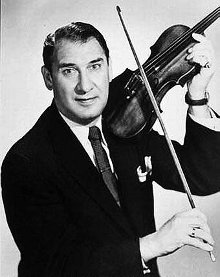
Henry "Henny" Youngman (March 16, 1906 – February 24, 1998) was an American comedian and musician famous for his mastery of the "one-liner", his best known being "Take my wife... please".
In a time when many comedians told elaborate anecdotes, Youngman's routine consisted of telling simple one-liner jokes, occasionally with interludes of violin playing. These depicted simple, cartoon-like situations, eliminating lengthy build-ups and going straight to the punch line. Known as "the King of the One-Liners", a title conferred to him by columnist Walter Winchell, a stage performance by Youngman lasted only 15 to 20 minutes but contained dozens of jokes in rapid succession.
Henry Youngman was born to Russian Jews Yonkel Yungman and Olga Chetkin in Whitechapel, in the East End of London, England. His family moved to Bay Ridge, Brooklyn, New York, when he was a child. He grew up in New York City, took violin lessons and began as a comedian after he had worked for years at a print shop, where he wrote "comedy cards" containing one-line gags. The comedy cards were discovered by up-and-coming comedian Milton Berle, who encouraged Youngman and formed a close friendship with him. Berle said about him, "The only thing funnier than Henny's jokes is his violin playing."
Encouraged by his family to study the violin, Youngman began in show business as a musician. He led a small jazz band called the Swanee Syncopaters, and during performances, he often told jokes. One night, the club's regular comedian did not show up and the owner asked Youngman to fill in. He enjoyed it and began his long career as a comic. His inoffensive, friendly style of comedy kept his audiences laughing for decades. He first played in clubs and speakeasies, but his break came on Kate Smith's radio show in 1937. Smith's manager Ted Collins booked him on the show, became his manager, and secured an increasing number of appearances on such highly rated network radio shows as "The Fleischmann's Yeast Hour" hosted by Rudy Vallee.
During the 1940s, Youngman tried to work into films as an actor, but he found little work in Hollywood. He returned to nightclubs and worked steadily, performing as many as 200 shows per year. Working with writer/producer Danny Shapiro, in 1959 Youngman recorded The Primitive Sounds of Henny Youngman, a live album for National Recording Corporation performed at the Celebrity Club in St. Louis. Later, the album was re-released as a CD.
Like many comedians, Henny Youngman treated his profession as a working job, one where making a living is difficult, and getting paid for the work is all-important. In numerous interviews, Youngman's advice to other entertainers was to nem di gelt (Yiddish for "take the money").
He was quoted in an interview with the online magazine Eye: "I get on the plane. I go and do the job, grab the money and I come home and I keep it clean. Those are my rules. Sinatra does the same thing, only he has a helicopter waiting. That's the difference."
When the New York Telephone Company started its Dial-a-Joke in 1974, over three million people called in one month to hear 30 seconds of Youngman's material—the most ever for a comedian.
Hub AI
Henny Youngman AI simulator
(@Henny Youngman_simulator)
Henny Youngman
Henry "Henny" Youngman (March 16, 1906 – February 24, 1998) was an American comedian and musician famous for his mastery of the "one-liner", his best known being "Take my wife... please".
In a time when many comedians told elaborate anecdotes, Youngman's routine consisted of telling simple one-liner jokes, occasionally with interludes of violin playing. These depicted simple, cartoon-like situations, eliminating lengthy build-ups and going straight to the punch line. Known as "the King of the One-Liners", a title conferred to him by columnist Walter Winchell, a stage performance by Youngman lasted only 15 to 20 minutes but contained dozens of jokes in rapid succession.
Henry Youngman was born to Russian Jews Yonkel Yungman and Olga Chetkin in Whitechapel, in the East End of London, England. His family moved to Bay Ridge, Brooklyn, New York, when he was a child. He grew up in New York City, took violin lessons and began as a comedian after he had worked for years at a print shop, where he wrote "comedy cards" containing one-line gags. The comedy cards were discovered by up-and-coming comedian Milton Berle, who encouraged Youngman and formed a close friendship with him. Berle said about him, "The only thing funnier than Henny's jokes is his violin playing."
Encouraged by his family to study the violin, Youngman began in show business as a musician. He led a small jazz band called the Swanee Syncopaters, and during performances, he often told jokes. One night, the club's regular comedian did not show up and the owner asked Youngman to fill in. He enjoyed it and began his long career as a comic. His inoffensive, friendly style of comedy kept his audiences laughing for decades. He first played in clubs and speakeasies, but his break came on Kate Smith's radio show in 1937. Smith's manager Ted Collins booked him on the show, became his manager, and secured an increasing number of appearances on such highly rated network radio shows as "The Fleischmann's Yeast Hour" hosted by Rudy Vallee.
During the 1940s, Youngman tried to work into films as an actor, but he found little work in Hollywood. He returned to nightclubs and worked steadily, performing as many as 200 shows per year. Working with writer/producer Danny Shapiro, in 1959 Youngman recorded The Primitive Sounds of Henny Youngman, a live album for National Recording Corporation performed at the Celebrity Club in St. Louis. Later, the album was re-released as a CD.
Like many comedians, Henny Youngman treated his profession as a working job, one where making a living is difficult, and getting paid for the work is all-important. In numerous interviews, Youngman's advice to other entertainers was to nem di gelt (Yiddish for "take the money").
He was quoted in an interview with the online magazine Eye: "I get on the plane. I go and do the job, grab the money and I come home and I keep it clean. Those are my rules. Sinatra does the same thing, only he has a helicopter waiting. That's the difference."
When the New York Telephone Company started its Dial-a-Joke in 1974, over three million people called in one month to hear 30 seconds of Youngman's material—the most ever for a comedian.