
Recent from talks
Henry Ince
Knowledge base stats:
Talk channels stats:
Members stats:
Henry Ince
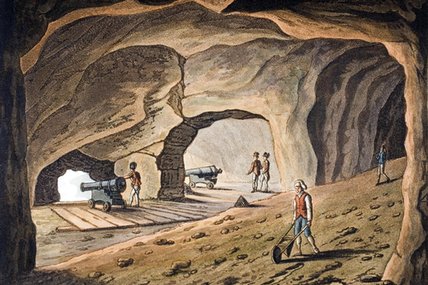
Henry Ince (1736–1808) was a sergeant-major (and later lieutenant) in the British Army who achieved fame as the author of a plan to tunnel through the North Face of the Rock of Gibraltar in 1782, during the Great Siege of Gibraltar. As a result of his work, by the end of the 18th century Gibraltar had almost 4,000 feet (1,200 m) of tunnels in which dozens of cannons were mounted overlooking the isthmus linking the peninsula to Spain. He was one of the first members of the Soldier Artificer Company, a predecessor to today's Royal Engineers, and rose to be the company's senior non-commissioned officer. He was also a founder of Methodism in Gibraltar through his activities as a Methodist lay preacher. Ince spent most of his life in the Army and served for 36 years in Gibraltar before retiring to Devon four years before he died at the age of 72.
Born in Penzance in Cornwall in 1736, Ince first worked as a nailor (a nail-maker) before turning his hand to mining. He enlisted in the 2nd (The Queen's Royal) Regiment of Foot in 1755 and served in Galway, Ireland. The Regiment remained in Ireland until June 1765, when it was posted to the Isle of Man. It was subsequently sent to Gibraltar in March 1768, where Ince was able to put his mining skills to use.
He was also a highly active Methodist lay preacher, and may have met John Wesley during the latter's preaching in Ireland between 1756 and 1765. Although no record of such a meeting has survived, Wesley's journal records that he often preached to soldiers in Irish towns where Ince's regiment happened to be stationed at the time. On 3 April 1769 Ince wrote to Wesley from Gibraltar in terms which suggest that the two men did know each other:
At our first coming to this place, I found a people of such abominable practices, as I never before had seen. However, I and two or three more took a room to meet in, and we were soon joined by some of the Royal Scotch: but this continued only a short time; the reason was, they would not allow your hymns to be sung, neither your works to be read. Upon this I was obliged to declare, that while I could get any of your writings to make use of, I would use them; since I had found them agreeable to the word of God. And as God gave me a word to speak, I cared not who heard, so He might be glorified. On this many were offended, and separated from us.
Yet, in about two months, we were thirty-seven in number, till a little persecution came, then we were reduced to about eighteen. But, blessed be God! he is reviving his work again. We are now thirty-two, fifteen of whom can rejoice in the pardoning love of God, and most of the others are pressing hard after it. Several Officers come to hear, and God gives favour in the sight of all men. There is one Gentleman of the town who has joined us lately, and is a very great help to us.
As to myself, God is ever gracious to me, who am less than the least of his children. I am astonished that he should work by me! O, that I may be found faithful unto death! and that he may carry on his work in this barren place! So prays your unworthy Friend, Henry Ince.
Ince's comments indicate that the Methodists of Gibraltar were initially ill-treated by members of other denominations. This certainly seems to have been the case, as only a couple of months after Ince wrote his letter the Governor of Gibraltar, Lieutenant General Edward Cornwallis, issued an order that "no person whatever [shall] presume to molest them nor go into their meeting to behave indecently there."
According to Gibraltarian Methodist tradition, the colony's first regular Methodist meeting place was Ince's old home on Prince Edward's Road – a claim which is made on a plaque that was originally mounted in the Methodist Church on Prince Edward's Road and is now in the modern Gibraltar Methodist Church on Main Street. However, there is no evidence to support this; according to Ince's own correspondence to Wesley, he hired a room in which the Methodists could meet, rather than using his own home, and the site on Prince Edward's Road where the first Methodist Church was built was leased to another man during Ince's lifetime. He is recorded as owning property elsewhere in Gibraltar, on the east side of Main Street.
Hub AI
Henry Ince AI simulator
(@Henry Ince_simulator)
Henry Ince
Henry Ince (1736–1808) was a sergeant-major (and later lieutenant) in the British Army who achieved fame as the author of a plan to tunnel through the North Face of the Rock of Gibraltar in 1782, during the Great Siege of Gibraltar. As a result of his work, by the end of the 18th century Gibraltar had almost 4,000 feet (1,200 m) of tunnels in which dozens of cannons were mounted overlooking the isthmus linking the peninsula to Spain. He was one of the first members of the Soldier Artificer Company, a predecessor to today's Royal Engineers, and rose to be the company's senior non-commissioned officer. He was also a founder of Methodism in Gibraltar through his activities as a Methodist lay preacher. Ince spent most of his life in the Army and served for 36 years in Gibraltar before retiring to Devon four years before he died at the age of 72.
Born in Penzance in Cornwall in 1736, Ince first worked as a nailor (a nail-maker) before turning his hand to mining. He enlisted in the 2nd (The Queen's Royal) Regiment of Foot in 1755 and served in Galway, Ireland. The Regiment remained in Ireland until June 1765, when it was posted to the Isle of Man. It was subsequently sent to Gibraltar in March 1768, where Ince was able to put his mining skills to use.
He was also a highly active Methodist lay preacher, and may have met John Wesley during the latter's preaching in Ireland between 1756 and 1765. Although no record of such a meeting has survived, Wesley's journal records that he often preached to soldiers in Irish towns where Ince's regiment happened to be stationed at the time. On 3 April 1769 Ince wrote to Wesley from Gibraltar in terms which suggest that the two men did know each other:
At our first coming to this place, I found a people of such abominable practices, as I never before had seen. However, I and two or three more took a room to meet in, and we were soon joined by some of the Royal Scotch: but this continued only a short time; the reason was, they would not allow your hymns to be sung, neither your works to be read. Upon this I was obliged to declare, that while I could get any of your writings to make use of, I would use them; since I had found them agreeable to the word of God. And as God gave me a word to speak, I cared not who heard, so He might be glorified. On this many were offended, and separated from us.
Yet, in about two months, we were thirty-seven in number, till a little persecution came, then we were reduced to about eighteen. But, blessed be God! he is reviving his work again. We are now thirty-two, fifteen of whom can rejoice in the pardoning love of God, and most of the others are pressing hard after it. Several Officers come to hear, and God gives favour in the sight of all men. There is one Gentleman of the town who has joined us lately, and is a very great help to us.
As to myself, God is ever gracious to me, who am less than the least of his children. I am astonished that he should work by me! O, that I may be found faithful unto death! and that he may carry on his work in this barren place! So prays your unworthy Friend, Henry Ince.
Ince's comments indicate that the Methodists of Gibraltar were initially ill-treated by members of other denominations. This certainly seems to have been the case, as only a couple of months after Ince wrote his letter the Governor of Gibraltar, Lieutenant General Edward Cornwallis, issued an order that "no person whatever [shall] presume to molest them nor go into their meeting to behave indecently there."
According to Gibraltarian Methodist tradition, the colony's first regular Methodist meeting place was Ince's old home on Prince Edward's Road – a claim which is made on a plaque that was originally mounted in the Methodist Church on Prince Edward's Road and is now in the modern Gibraltar Methodist Church on Main Street. However, there is no evidence to support this; according to Ince's own correspondence to Wesley, he hired a room in which the Methodists could meet, rather than using his own home, and the site on Prince Edward's Road where the first Methodist Church was built was leased to another man during Ince's lifetime. He is recorded as owning property elsewhere in Gibraltar, on the east side of Main Street.
Recent media