
Recent from talks
Herring as food
Knowledge base stats:
Talk channels stats:
Members stats:
Herring as food
Herring are forage fish in the wild, mostly belonging to the family Clupeidae. They are an important food for humans. Herring often move in large schools around fishing banks and near the coast. The most abundant and commercially important species belong to the genus Clupea, found particularly in shallow, temperate waters of the North Pacific and North Atlantic Oceans, including the Baltic Sea, as well as off the west coast of South America. Three species of Clupea are recognized; the main taxon, the Atlantic herring, accounts for over half the world's commercial capture of herrings.
Herrings played a pivotal role in the history of marine fisheries in Europe, and early in the twentieth century, their study was fundamental to the evolution of fisheries science. These oily fish also have a long history as an important food fish, and are often salted, smoked, or pickled.
Raw Atlantic herring is 72% water, 18% protein, 9% fat, and contains no carbohydrates. In a 100 gram reference amount, raw herring provides 158 calories, and is a highly rich source (20% or more of the Daily Value, DV) of vitamin B12 (570% DV). It also has rich content of niacin, vitamin B6, vitamin D, and phosphorus (21-34% DV). Raw herring contains moderate amounts of other B vitamins and zinc, and is an excellent food source of omega-3 fatty acids.
Pacific and Atlantic herring are susceptible to contamination from environmental pollution, such as by PCBs, PBDEs, mercury, and listeria. There is a (rare) risk of harmful bacteria from eating raw herring eggs.
According to NSW Food Authority, herrings have low mercury levels.
Herring has been a staple food source since at least 3000 BC. There are numerous ways the fish is served and many regional recipes: eaten raw, fermented, pickled, or cured by other techniques.[citation needed]
Herrings can be canned. The canning process involves cleaning and cutting the fish into pieces, then submerging them in a brine to preserve them and prevent bacterial growth. The fish are then heated, vacuum sealed and cooled down. This process allows herrings to be safely stored without refrigeration and eaten straight from the can.
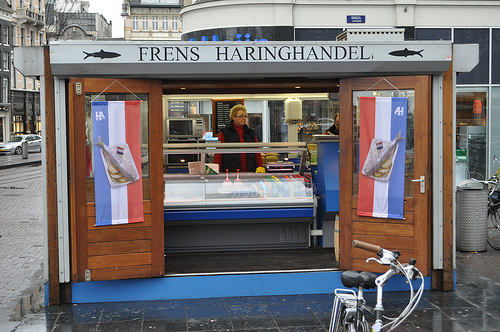
A typical Dutch delicacy is Hollandse Nieuwe (Dutch New), which is raw herring from the catches around the end of spring and the beginning of summer. This is typically eaten with raw onion. Hollandse nieuwe is only available in spring when the first seasonal catch of herring is brought in. This is celebrated in festivals such as the Vlaardingen Herring Festival and Vlaggetjesdag in Scheveningen. The new herring are frozen and enzyme-preserved for the remainder of the year. The herring is said to be eaten "raw" because it has not been cooked, although it has been subjected to a degree of curing. The first barrel of Hollandse Nieuwe is traditionally sold at auction for charity. Very young herring are called whitebait and are eaten whole as a delicacy.[citation needed]
Hub AI
Herring as food AI simulator
(@Herring as food_simulator)
Herring as food
Herring are forage fish in the wild, mostly belonging to the family Clupeidae. They are an important food for humans. Herring often move in large schools around fishing banks and near the coast. The most abundant and commercially important species belong to the genus Clupea, found particularly in shallow, temperate waters of the North Pacific and North Atlantic Oceans, including the Baltic Sea, as well as off the west coast of South America. Three species of Clupea are recognized; the main taxon, the Atlantic herring, accounts for over half the world's commercial capture of herrings.
Herrings played a pivotal role in the history of marine fisheries in Europe, and early in the twentieth century, their study was fundamental to the evolution of fisheries science. These oily fish also have a long history as an important food fish, and are often salted, smoked, or pickled.
Raw Atlantic herring is 72% water, 18% protein, 9% fat, and contains no carbohydrates. In a 100 gram reference amount, raw herring provides 158 calories, and is a highly rich source (20% or more of the Daily Value, DV) of vitamin B12 (570% DV). It also has rich content of niacin, vitamin B6, vitamin D, and phosphorus (21-34% DV). Raw herring contains moderate amounts of other B vitamins and zinc, and is an excellent food source of omega-3 fatty acids.
Pacific and Atlantic herring are susceptible to contamination from environmental pollution, such as by PCBs, PBDEs, mercury, and listeria. There is a (rare) risk of harmful bacteria from eating raw herring eggs.
According to NSW Food Authority, herrings have low mercury levels.
Herring has been a staple food source since at least 3000 BC. There are numerous ways the fish is served and many regional recipes: eaten raw, fermented, pickled, or cured by other techniques.[citation needed]
Herrings can be canned. The canning process involves cleaning and cutting the fish into pieces, then submerging them in a brine to preserve them and prevent bacterial growth. The fish are then heated, vacuum sealed and cooled down. This process allows herrings to be safely stored without refrigeration and eaten straight from the can.
A typical Dutch delicacy is Hollandse Nieuwe (Dutch New), which is raw herring from the catches around the end of spring and the beginning of summer. This is typically eaten with raw onion. Hollandse nieuwe is only available in spring when the first seasonal catch of herring is brought in. This is celebrated in festivals such as the Vlaardingen Herring Festival and Vlaggetjesdag in Scheveningen. The new herring are frozen and enzyme-preserved for the remainder of the year. The herring is said to be eaten "raw" because it has not been cooked, although it has been subjected to a degree of curing. The first barrel of Hollandse Nieuwe is traditionally sold at auction for charity. Very young herring are called whitebait and are eaten whole as a delicacy.[citation needed]
Recent media