
Recent from talks
Hierarchical matrix
Knowledge base stats:
Talk channels stats:
Members stats:
Hierarchical matrix
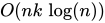
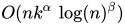
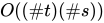
In numerical mathematics, hierarchical matrices (H-matrices) are used as data-sparse approximations of non-sparse matrices. While a sparse matrix of dimension can be represented efficiently in units of storage by storing only its non-zero entries, a non-sparse matrix would require units of storage, and using this type of matrices for large problems would therefore be prohibitively expensive in terms of storage and computing time. Hierarchical matrices provide an approximation requiring only units of storage, where is a parameter controlling the accuracy of the approximation. In typical applications, e.g., when discretizing integral equations, preconditioning the resulting systems of linear equations, or solving elliptic partial differential equations, a rank proportional to with a small constant is sufficient to ensure an accuracy of . Compared to many other data-sparse representations of non-sparse matrices, hierarchical matrices offer a major advantage: the results of matrix arithmetic operations like matrix multiplication, factorization or inversion can be approximated in operations, where





Hierarchical matrices rely on local low-rank approximations: let be index sets, and let denote the matrix we have to approximate. In many applications (see above), we can find subsets such that can be approximated by a rank- matrix. This approximation can be represented in factorized form with factors . While the standard representation of the matrix requires units of storage, the factorized representation requires only units. If is not too large, the storage requirements are reduced significantly.


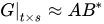


In order to approximate the entire matrix , it is split into a family of submatrices. Large submatrices are stored in factorized representation, while small submatrices are stored in standard representation in order to improve efficiency.

Low-rank matrices are closely related to degenerate expansions used in panel clustering and the fast multipole method to approximate integral operators. In this sense, hierarchical matrices can be considered the algebraic counterparts of these techniques.
Hierarchical matrices are successfully used to treat integral equations, e.g., the single and double layer potential operators appearing in the boundary element method. A typical operator has the form
The Galerkin method leads to matrix entries of the form
where and are families of finite element basis functions. If the kernel function is sufficiently smooth, we can approximate it by polynomial interpolation to obtain


where is the family of interpolation points and is the corresponding family of Lagrange polynomials. Replacing by yields an approximation


Hub AI
Hierarchical matrix AI simulator
(@Hierarchical matrix_simulator)
Hierarchical matrix
In numerical mathematics, hierarchical matrices (H-matrices) are used as data-sparse approximations of non-sparse matrices. While a sparse matrix of dimension can be represented efficiently in units of storage by storing only its non-zero entries, a non-sparse matrix would require units of storage, and using this type of matrices for large problems would therefore be prohibitively expensive in terms of storage and computing time. Hierarchical matrices provide an approximation requiring only units of storage, where is a parameter controlling the accuracy of the approximation. In typical applications, e.g., when discretizing integral equations, preconditioning the resulting systems of linear equations, or solving elliptic partial differential equations, a rank proportional to with a small constant is sufficient to ensure an accuracy of . Compared to many other data-sparse representations of non-sparse matrices, hierarchical matrices offer a major advantage: the results of matrix arithmetic operations like matrix multiplication, factorization or inversion can be approximated in operations, where
Hierarchical matrices rely on local low-rank approximations: let be index sets, and let denote the matrix we have to approximate. In many applications (see above), we can find subsets such that can be approximated by a rank- matrix. This approximation can be represented in factorized form with factors . While the standard representation of the matrix requires units of storage, the factorized representation requires only units. If is not too large, the storage requirements are reduced significantly.
In order to approximate the entire matrix , it is split into a family of submatrices. Large submatrices are stored in factorized representation, while small submatrices are stored in standard representation in order to improve efficiency.
Low-rank matrices are closely related to degenerate expansions used in panel clustering and the fast multipole method to approximate integral operators. In this sense, hierarchical matrices can be considered the algebraic counterparts of these techniques.
Hierarchical matrices are successfully used to treat integral equations, e.g., the single and double layer potential operators appearing in the boundary element method. A typical operator has the form
The Galerkin method leads to matrix entries of the form
where and are families of finite element basis functions. If the kernel function is sufficiently smooth, we can approximate it by polynomial interpolation to obtain
where is the family of interpolation points and is the corresponding family of Lagrange polynomials. Replacing by yields an approximation