


Community hub
0 subscribers8 pages, 0 posts
Recent from talks
All channels
Be the first to start a discussion here.
Be the first to start a discussion here.
Be the first to start a discussion here.
Be the first to start a discussion here.
Contribute something
Welcome to the community hub built to collect knowledge and have discussions related to High Explosive Research.
Nothing was collected or created yet.
High Explosive Research
View on Wikipediafrom Wikipedia
Not found
High Explosive Research
View on Grokipediafrom Grokipedia
High Explosive Research (HER), initially known as Basic High Explosive Research (BHER), was the codename for the United Kingdom's independent nuclear weapons development program launched in 1947 to produce a plutonium implosion-type atomic bomb.[1][2] The initiative, directed by the Ministry of Supply as a civilian effort, responded to the U.S. Atomic Energy Act of 1946, which restricted sharing of nuclear technology, and was accelerated by the Soviet Union's first atomic test in 1949.[3]
Established initially at Fort Halstead under Chief Superintendent William Penney, the project emphasized precision high-explosive lenses essential for the symmetrical implosion required to achieve criticality in a plutonium core, building on British wartime contributions to explosive technology.[1] By 1950, operations shifted to the Aldermaston site, where design and production advanced rapidly despite limited resources and secrecy constraints.[1]
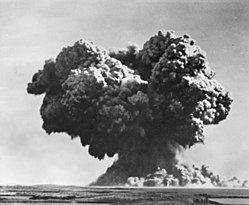
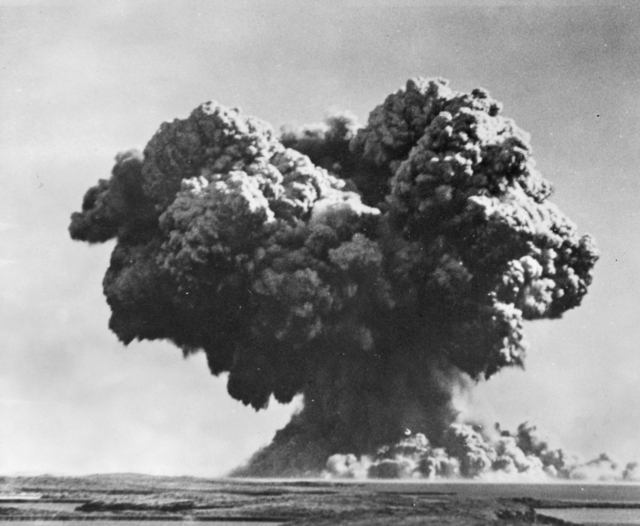
HER achieved its primary objective with the detonation of a 25-kiloton device during Operation Hurricane on 3 October 1952 aboard HMS Plym in the Monte Bello Islands, marking Britain as the third nation to possess nuclear weapons and laying the foundation for its Cold War deterrent.[3][4]
The first industrial-scale plutonium extraction facility for the UK's nuclear weapons program operated at Windscale (later Sellafield), commencing reprocessing in 1951 following the activation of the adjacent air-cooled production reactors. This pioneering plant processed irradiated metallic uranium fuel to isolate weapons-grade plutonium via solvent extraction, prioritizing rapid yield to meet urgent defense requirements. The process began with mechanical shearing of fuel elements, dissolution in concentrated nitric acid to form uranyl nitrate with dissolved plutonium and fission products, and subsequent purification stages to achieve high-purity plutonium nitrate suitable for conversion to metal.[51][49] Solvent extraction formed the core of the separation chemistry, employing organic diluents such as tributyl phosphate in kerosene to selectively partition plutonium(IV) nitrate from uranium and over 99.9999% of fission products, attaining empirical decontamination factors exceeding 10^6 for beta-gamma emitters. This efficiency stemmed from multi-stage counter-current contactors that exploited differences in redox states and complexation affinities, with plutonium reduced to the inextractable Pu(III) form to enable uranium-plutonium partitioning before final plutonium recovery via back-extraction and precipitation as oxalate. Initial operations in 1952 yielded the UK's first separated plutonium batch on March 28, supporting device assembly timelines.[72][73][74] Early plant throughput targeted modest outputs of around 5 kg of plutonium annually during commissioning, scaling to design capacities of up to 100 kg per year as operational refinements addressed corrosion, entrainment losses, and criticality risks inherent to handling fissile solutions. Recovery efficiencies for plutonium approached 95%, though early runs encountered challenges like incomplete dissolution and emulsion formation, necessitating iterative process tweaks based on empirical monitoring rather than fully mature modeling.[50][69] Waste streams from extraction, including raffinates laden with fission products and minor actinides, were managed through neutralization, evaporation, and controlled discharge to the Irish Sea, reflecting a production-first ethos that deferred comprehensive immobilization. These high-level liquids represented precursors to subsequent vitrification campaigns, where glass encapsulation would mitigate long-term leaching; however, 1950s priorities emphasized maximizing fissile recovery over immediate environmental containment, with discharges commencing in 1952 and totaling grams-scale plutonium releases over initial decades.[75][44]
Historical Background
Pre-War and Wartime Precursors
In December 1938, German chemists Otto Hahn and Fritz Strassmann conducted experiments bombarding uranium with neutrons, observing the production of lighter elements such as barium, which indicated the splitting of the uranium nucleus into fragments.[5][6] This empirical breakthrough, confirmed through radiochemical analysis, revealed that fission released approximately 200 million electron volts per event, along with multiple neutrons capable of sustaining a chain reaction under suitable conditions.[5] The theoretical interpretation of these results as nuclear fission was provided shortly thereafter by Lise Meitner and Otto Frisch, who calculated the energy release from the mass defect and emphasized the potential for exponential neutron multiplication.[5] In Britain, where Frisch had relocated as a refugee physicist, this discovery spurred early wartime investigations into weapon applications. In March 1940, Frisch and Rudolf Peierls at the University of Birmingham produced a confidential memorandum analyzing the feasibility of an explosive device, estimating that a supercritical mass of highly enriched uranium-235—on the order of 10 kilograms, assuming minimal impurities and efficient neutron economy—could initiate a rapid chain reaction yielding an explosion vastly exceeding conventional explosives.[7][8] Their calculations, based on neutron diffusion theory and cross-section approximations, demonstrated that separation of uranium isotopes was the primary barrier, rather than inherent impossibility. This memorandum prompted the British government to convene the MAUD Committee in April 1940, comprising leading physicists to assess uranium's military potential.[2] Over the following year, the committee's technical subcommittees verified the chain reaction's viability through independent modeling of neutron multiplication factors and critical size, concluding in two July 1941 reports that a bomb using 25 kilograms of uranium-235 could achieve an explosive yield equivalent to about 1,800 tons of TNT, far surpassing any prior ordnance.[2][7] These findings rested on empirical fission data and first-order diffusion equations, underscoring the causal pathway from moderated neutron economy to self-sustaining supercriticality, while dismissing alternative paths like plutonium as immature.Tube Alloys Initiative
The Tube Alloys project, codenamed in 1941, marked the United Kingdom's inaugural dedicated program for atomic weapons development amid World War II, operating independently with British government funding separate from broader war expenditures. Chemist Wallace Akers, recruited from Imperial Chemical Industries, directed the initiative under the Department of Scientific and Industrial Research, prioritizing uranium isotope separation techniques such as gaseous diffusion of uranium hexafluoride through porous barriers. This approach aimed to enrich uranium-235 for a fission bomb, drawing on prior theoretical work while addressing practical engineering challenges like barrier materials and scaling.[9][10] Building directly on the MAUD Committee's assessments, Tube Alloys formalized efforts after the committee's July 1941 reports affirmed the feasibility of a bomb requiring only about 25 pounds of highly enriched uranium-235, far less than previously estimated. These reports were handed over to U.S. counterparts in October 1941 via a British mission, delivering pivotal data on diffusion processes—including barrier permeability and stage efficiency—that validated and expedited American gaseous diffusion designs, shifting skepticism to commitment within months.[11][12] Tube Alloys advanced plutonium production concepts as an alternative fissile route, theorizing neutron irradiation of uranium-238 in a reactor to yield element 94 (plutonium-239), with early calculations by Egon Bretscher highlighting its bomb potential despite cross-section uncertainties. Researchers explored calutron-like electromagnetic alternatives but emphasized diffusion-scale prototypes, achieving laboratory enrichment of trace uranium quantities by late 1942 at facilities like Rhydymwyn Valley Works, where gaseous diffusion experiments tested membrane durability under wartime constraints. These self-reliant strides, though limited by resource scarcity and Luftwaffe threats, generated proprietary data on isotope handling and reactor moderation, selectively transferred to allies to bolster collective wartime deterrence without ceding full control.[13][14]Integration with Manhattan Project
The Quebec Agreement, signed on August 19, 1943, by President Franklin D. Roosevelt and Prime Minister Winston Churchill, formalized Anglo-American collaboration on atomic energy development, stipulating joint resource pooling for nuclear weapons and mutual non-use against each other without consent.[15][16] This accord enabled the dispatch of the British Mission to the United States in December 1943, comprising key scientists who integrated into Manhattan Project sites.[10] Led by James Chadwick, the mission provided expertise in reactor design and plutonium production, with Chadwick advising on Hanford's B Reactor operations to ensure reliable plutonium yields for bomb cores.[17][18] British personnel contributed to uranium enrichment efforts, particularly electromagnetic isotope separation; Mark Oliphant's team at the University of California's Berkeley Radiation Laboratory refined calutron technology, which was scaled up at Oak Ridge's Y-12 plant for U-235 production.[10] At Los Alamos, Otto Frisch advanced bomb physics calculations, including estimates of blast damage radii based on yield simulations that informed targeting assessments.[19] James Tuck's proposal of explosive lenses proved pivotal for the plutonium implosion design, enabling uniform compression of the fissile core despite initial American skepticism.[10] These inputs from approximately two dozen British experts enhanced the project's technical feasibility across enrichment, production, and assembly phases.[18] Under the Quebec Agreement, British scientists gained access to restricted U.S. facilities, including Hanford, Oak Ridge, and Los Alamos, until early 1946, fostering direct knowledge transfer that accelerated bomb development timelines.[20] General Leslie Groves acknowledged the British contributions as helpful in specialized areas like explosives and physics, though he emphasized U.S. industrial scale as decisive.[10] This integration underscored the complementary roles of British theoretical prowess and American manufacturing capacity in achieving the first nuclear weapons.[18]Post-War Severance of US-UK Collaboration
The United States Congress passed the Atomic Energy Act, commonly known as the McMahon Act, on July 26, 1946, with President Truman signing it into law on August 1, 1946, establishing the U.S. Atomic Energy Commission and strictly prohibiting the transfer of "restricted data" on atomic weapons to any foreign nation, including allies.[21] This legislation was motivated primarily by domestic political pressures to monopolize nuclear technology and heightened security concerns over Soviet espionage, particularly following the March 1946 arrest and confession of British physicist Alan Nunn May, who had passed Manhattan Project intelligence to Soviet agents while working under the Tube Alloys program.[22] American policymakers viewed the United Kingdom's security apparatus as vulnerable to penetration, citing lax vetting of personnel with leftist sympathies and prior leaks that potentially accelerated Soviet atomic progress, thus prioritizing unilateral control over wartime partnership.[23] The McMahon Act effectively nullified post-war provisions of the 1943 Quebec Agreement, which had envisioned continued Anglo-American collaboration on atomic matters after victory, leaving the United Kingdom excluded from access to U.S. plutonium production techniques, bomb designs, and gaseous diffusion plants despite British scientists' substantial wartime contributions to the Manhattan Project, including theoretical work on implosion and uranium enrichment.[24] By early 1947, when the Act took full effect, all technical exchanges ceased, compelling the UK to forgo reliance on American-supplied materials or data.[25] In response, British authorities initiated exploratory feasibility studies in late 1946, assessing domestic capabilities in uranium processing, explosive lens fabrication, and plutonium routes, which underscored the impracticality of dependence on the U.S. and affirmed the imperative for verifiable independent development to maintain strategic autonomy amid emerging Soviet threats.[24] These preliminary efforts highlighted resource constraints but emphasized self-reliant pathways, setting the stage for a sovereign program without invoking prior cooperative frameworks.Political and Strategic Imperatives
Attlee's Directive and Cabinet Decisions
On 8 January 1947, Prime Minister Clement Attlee chaired a secret meeting of the GEN.163 subcommittee of the Cabinet Defence Committee, authorizing the independent development and production of atomic bombs to ensure Britain's national security independent of United States cooperation, which had been curtailed by the 1946 Atomic Energy Act.[24][26] This directive established the High Explosive Research project under civilian oversight, initially led by scientists from the Ministry of Supply, without any parliamentary debate or public disclosure.[26] In 1948, amid severe post-war economic constraints including rationing and reconstruction demands, the full Cabinet endorsed the program's continuation and granted it high priority status, allocating initial funding estimated in the low millions of pounds to support plutonium production and bomb design, reflecting a calculated trade-off against domestic welfare priorities.[27] The underlying rationale rested on a pragmatic evaluation of military imbalances: Britain's limited conventional forces faced potential Soviet numerical superiority in Europe, rendering an independent nuclear capability essential for credible deterrence, as reliance on uncertain alliances alone would leave the nation asymmetrically vulnerable to aggression.[24][28]Geopolitical Rationale Amid Soviet Threat
The Soviet Union's rapid nuclear advancement, fueled by espionage from the Manhattan Project—including data leaked by spies such as Klaus Fuchs—enabled the production of plutonium for their first device by mid-1949, culminating in the RDS-1 test on August 29, 1949.[29] This plutonium implosion bomb, yielding approximately 22 kilotons, occurred years earlier than British and American intelligence anticipated, shattering the Western nuclear monopoly and heightening fears of Soviet strategic dominance in Europe.[30][31] For the United Kingdom, already committed to independent bomb development via Attlee's January 1947 cabinet directive, the test empirically confirmed the urgency of achieving a credible deterrent to counterbalance Soviet conventional superiority and prevent an imbalance that could embolden aggression.[24][28] Britain's post-war military posture, marked by severe economic strain, demobilization of over 5 million personnel by 1947, and the fiscal burdens of maintaining global commitments amid imperial retrenchment, eroded its capacity for large-scale conventional deterrence against the Red Army's estimated 175 divisions.[32] Nuclear capabilities thus represented a realist necessity, providing asymmetric leverage through the threat of retaliatory strikes on Soviet population centers, as British defense planning explicitly prioritized nuclear options to offset these vulnerabilities.[32] This approach aligned with causal assessments that conventional forces alone could not credibly deter a Soviet thrust into Western Europe, given the UK's reduced manpower and industrial base relative to pre-war levels. Pursuing nuclear independence hedged against U.S. retrenchment, exemplified by the 1946 Atomic Energy Act's prohibition on sharing restricted data with allies, which severed wartime Tube Alloys-Manhattan collaboration and underscored the risks of dependency.[24][28] By demonstrating self-reliance through the 1952 Operation Hurricane test—the UK's first atomic detonation—Britain regained negotiating leverage, paving the way for the 1958 U.S.-UK Mutual Defence Agreement that facilitated renewed exchanges of nuclear materials and designs.[33][34] This pact, amending prior U.S. restrictions, affirmed how independent capability reinforced alliance dynamics rather than isolating Britain, enabling sustained deterrence amid escalating Cold War tensions.[35]Organizational Framework and Leadership
The UK's High Explosive Research (HER) program operated under the administrative umbrella of the Ministry of Supply, which provided civilian control while incorporating military requirements for weapons development. This structure allowed for efficient allocation of limited post-war resources, prioritizing scientific expertise over expansive military bureaucracy. The Ministry coordinated fissile material production and bomb design efforts, ensuring alignment with national security needs without direct armed forces command.[1] Central to the research framework was the Atomic Energy Research Establishment (AERE) at Harwell, established in 1946 under the direction of Sir John Cockcroft, who oversaw foundational work in reactor physics and atomic energy applications.[36][37] Cockcroft's leadership facilitated the rapid setup of experimental facilities, enabling the UK's first nuclear reactor, GLEEP, to achieve criticality in August 1947 despite budgetary constraints.[38] For the weapons-specific implosion technology, HER was led by William Penney starting from Fort Halstead, with the project formalizing high-explosive research activities on 1 April 1950 and relocating to Aldermaston later that year.[39][1] Penney, drawing on his wartime experience in bomb effects analysis, directed a compact team focused on lens design and assembly, integrating inputs from AERE and production sites under Ministry oversight. This setup contributed to the first British plutonium-producing reactor at Windscale achieving criticality in October 1950, marking a key operational milestone.[40]Technical Foundations
Uranium Acquisition and Isotope Separation
Following the 1946 McMahon Act's restriction on nuclear collaboration, the United Kingdom relied on retained wartime stocks of uranium ore primarily sourced from the Belgian Congo through the Combined Development Trust to initiate its independent atomic weapons program. These stocks, accumulated during World War II, included thousands of tons of high-grade ore from mines like Shinkolobwe, which provided the bulk of early uranium supplies for Allied efforts.[41][42] Processing of this ore into uranium oxide concentrate, commonly known as yellowcake, commenced at the Springfields facility near Preston, established in 1946 for nuclear fuel production and operational for uranium metal output by 1950.[43] The facility handled conversion of imported concentrates, drawing from post-war reserves until domestic and allied sources could scale up, addressing raw material shortages critical to High Explosive Research timelines.[41] For isotope separation, the UK prioritized gaseous diffusion as the primary method for enriching U-235, constructing the Capenhurst plant near Chester, which adapted designs from wartime Tube Alloys and Manhattan Project exchanges. Construction began in the late 1940s, with initial low-level enrichment operations achieving approximately 0.9% U-235 assay by 1951, sufficient for feeding into further production cascades despite early technical hurdles like barrier corrosion and power demands.[44] Full-scale highly enriched uranium production followed in 1952, enabling weapon-grade material by the mid-1950s, though the process required massive infrastructure investment exceeding plutonium routes in energy efficiency for the era.[45] This empirical approach emphasized scalable throughput over higher theoretical separation factors, leveraging hexafluoride gas diffusion through porous membranes to incrementally concentrate the fissile isotope from natural uranium's 0.7% baseline.[46] Parallel exploration of electromagnetic isotope separation, akin to the US calutron method, was evaluated but abandoned due to prohibitive inefficiencies observed in wartime prototypes, including high electricity consumption—up to 50 times that of diffusion—and low yield per unit, rendering it unsuitable for the production volumes needed absent US assistance.[47] British assessments, informed by shared Manhattan data, confirmed calutrons' role as developmental tools rather than industrial processes, prioritizing gaseous diffusion's proven, if capital-intensive, path to achieve critical masses for implosion designs by the early 1950s.[48] This decision reflected causal trade-offs in resource allocation, favoring methods with demonstrated wartime viability over unscaled alternatives amid geopolitical urgency.Plutonium Pathway Development
The plutonium production pathway emerged as a strategic alternative to uranium-235 enrichment in the UK's nuclear weapons program, leveraging natural uranium fuel to minimize isotope separation requirements. This approach relied on graphite-moderated reactors to irradiate uranium targets, breeding plutonium-239 through neutron capture and subsequent beta decays, followed by chemical extraction. The method demanded fewer resources for fissile material production compared to gaseous diffusion plants, enabling faster development amid post-war constraints.[49] Windscale Piles 1 and 2, constructed at the renamed Sellafield site from 1947, embodied this pathway with air-cooled, graphite-moderated designs modeled on the U.S. Hanford B Reactor but adapted for urgency by using forced air circulation instead of water cooling to avoid delays in infrastructure. Pile 1 achieved criticality on October 3, 1950, validating the core's neutron multiplication factor exceeding 1 through controlled startup tests that confirmed self-sustaining fission chain reactions. Pile 2 followed on June 1951, with both reactors employing aluminum-canned natural uranium slugs in horizontal channels within a 24-meter diameter graphite stack.[50][49] Initial operations focused on low-burnup irradiation to produce weapons-grade plutonium-239 with low Pu-240 contamination, limiting higher isotopes that could cause predetonation in implosion designs. The first batch of metallic plutonium was extracted in 1952, supporting the core for Operation Hurricane's 25-kiloton yield test on October 3, 1952, which utilized UK-produced material alongside Canadian contributions. By 1953, facilities scaled to kilogram quantities per month, demonstrating the pathway's viability for sustained output.[51][4] Plutonium separation employed the bismuth phosphate process, precipitating Pu(IV) phosphate coprecipitated with bismuth phosphate from dissolved irradiated fuel, achieving over 95% recovery and decontamination factors exceeding 10^7 from fission products. This batch method, adapted from U.S. practices, yielded high-purity Pu-239 metal after reductive dissolution and further purification steps, essential for reliable weapon cores with minimal isotopic impurities. Empirical pile performance data confirmed efficient breeding, with k-effective values supporting the design's neutron economy for production-scale operations.[52][53]High-Explosive Lenses and Implosion Dynamics
The implosion mechanism in British nuclear designs relied on precisely shaped high-explosive lenses to generate converging detonation waves that symmetrically compressed a subcritical plutonium core, initiating supercriticality through uniform inward shock propagation. These lenses adapted the multi-point initiation system pioneered in the U.S. Fat Man device, utilizing 32 lenses arranged in an icosahedral pattern to ensure spherical convergence, with fast-detonating Composition B (a mix of RDX and TNT) paired with slower Baratol (barium nitrate-sensitized TNT) to shape and synchronize the waves.[2][54] Early development under High Explosive Research at Fort Halstead involved hydrodynamic testing of lens assemblies to validate wave-shaping, including setups akin to rafter configurations for measuring detonation front propagation and symmetry via flash radiography and pressure gauges.[55] Hydrodynamic instabilities, such as Rayleigh-Taylor perturbations at the explosive-core interface, posed risks of asymmetric compression that could prevent fission chain reaction onset; these were mitigated through first-principles modeling of shock hydrodynamics, drawing on empirical data from scaled experiments to predict and correct for growth rates amplified by convergence.[56] British calculations targeted convergence ratios exceeding 10—defined as the ratio of initial to final core radius—essential for achieving the density multiplication (approximately 2-3 times solid density) required for supercriticality in plutonium assemblies with inherent Pu-240 impurities.[57] Validation occurred via subcritical mockups substituting non-fissile surrogates for plutonium, confirming lens performance without nuclear yield. A critical British innovation involved advanced explosive casting methods to produce void-free lens components, overcoming defects like cracks or inclusions that could disrupt detonation uniformity; techniques emphasized controlled crystallization during pour-casting of molten explosives under vacuum to minimize heterogeneity.[58] These were rigorously tested in 1951 hydrodynamic trials at sites including Foulness, where full-scale lens arrays underwent simultaneous detonation to assess convergence fidelity, paving the way for the reliable implosion in the 1952 Operation Hurricane device.[55][2] Such empirical refinements ensured the double-layered lens design in early weapons like Blue Danube achieved the necessary precision for operational viability.[54]Infrastructure and Production
Uranium Metal Fabrication
The fabrication of uranium metal for the High Explosive Research (HER) project commenced with the reduction of uranium tetrafluoride (UF₄) to metallic uranium using a magnesium reduction process at the Springfields facility near Preston, Lancashire, which became operational for this purpose by 1947.[59] This metallothermic reaction, conducted in sealed bombs, yielded uranium ingots by displacing fluorine from UF₄ with molten magnesium, producing magnesium fluoride as a byproduct; the process required careful control of temperature and atmosphere to achieve initial yields suitable for further refinement.[60] Purity levels exceeding 99.5% were targeted to suppress neutron absorption by impurities such as boron or cadmium, which could degrade weapon performance in components like tampers.[61] Refined ingots underwent vacuum induction melting to prepare for casting, enabling the production of dense, homogeneous shapes critical for implosion assemblies. Uranium was melted in graphite crucibles under vacuum to minimize oxidation and gas entrapment, then cast into hemispherical forms for use as depleted uranium tampers surrounding plutonium pits; this step demanded precise density control (approximately 19 g/cm³) to prevent voids that might disrupt symmetric compression during detonation.[61] The process mirrored techniques developed for high-purity alloys, with electromagnetic stirring ensuring uniformity despite uranium's reactivity.[62] Scaling production to support device requirements—approximately 6 kg of fabricated uranium per weapon—presented challenges by 1952, as variability in ore sourcing led to inconsistent impurity profiles affecting reduction efficiency and final metallurgy. Domestic and imported feeds, including lower-grade concentrates, necessitated additional purification stages, yet HER achieved operational capacity through iterative process optimizations at Springfields, enabling integration into the first British implosion designs tested in Operation Hurricane.[63]Reactor Construction and Operation
The Windscale Piles, designated Pile 1 and Pile 2, were graphite-moderated, air-cooled nuclear reactors constructed at the Windscale site in Cumbria, England, between 1947 and 1951 to produce weapons-grade plutonium-239 via neutron irradiation of natural uranium.[49][51] Pile 1 achieved criticality and became operational on October 3, 1950, followed by Pile 2 on June 21, 1951, enabling the initial production runs that supplied plutonium for Britain's atomic weapons program, including the fissile core for Operation Hurricane in 1952.[49][64] Each pile featured a cylindrical graphite stack approximately 25 meters in diameter and 7.5 meters high, containing roughly 3,444 horizontal fuel channels for inserting uranium elements and 977 isotope channels for polonium-210 production, with cooling provided by forced air circulation through these channels via blower houses and exhausted through filters to a 400-foot chimney.[65][66] Operational parameters emphasized high plutonium output, with each pile designed for a thermal power of 180 MW, enabling irradiation of up to 180 metric tons of natural uranium fuel at maximum element temperatures of around 395°C.[67] Fuel elements consisted of cylindrical natural uranium metal slugs, each weighing about 2.5 kg and canned in aluminum sheaths to prevent corrosion and enhance heat transfer, loaded into magnesium-alloyed aluminum cartridges for insertion into the graphite channels.[67][68] This configuration achieved plutonium yields of approximately 0.6 to 1 gram of Pu-239 per kilogram of irradiated uranium, supporting annual production targets of around 100 kg per pile prior to disruptions, with the system's reliability validated through sustained operations from 1950 to 1957 that delivered weapons-grade material without major interruptions until the Pile 1 fire.[69][70] Safety features incorporated empirical safeguards against graphite Wigner energy buildup from neutron displacement, including periodic annealing procedures to release stored energy by controlled heating, though these proved insufficient during the October 1957 Pile 1 incident, where overheating led to a uranium cartridge fire and release of radioactive iodine-131.[50] Pre-1957 operations, however, demonstrated the piles' engineering robustness for defense purposes, with output metrics confirming consistent plutonium extraction feeds for weapon cores after on-site reprocessing began in 1952, informing subsequent incident mitigation strategies like enhanced monitoring and redundant cooling.[64][71] The air-cooling system's simplicity prioritized rapid plutonium throughput over power generation efficiency, aligning with strategic imperatives for fissile material production rather than electricity output.[50]Plutonium Extraction Processes
The first industrial-scale plutonium extraction facility for the UK's nuclear weapons program operated at Windscale (later Sellafield), commencing reprocessing in 1951 following the activation of the adjacent air-cooled production reactors. This pioneering plant processed irradiated metallic uranium fuel to isolate weapons-grade plutonium via solvent extraction, prioritizing rapid yield to meet urgent defense requirements. The process began with mechanical shearing of fuel elements, dissolution in concentrated nitric acid to form uranyl nitrate with dissolved plutonium and fission products, and subsequent purification stages to achieve high-purity plutonium nitrate suitable for conversion to metal.[51][49] Solvent extraction formed the core of the separation chemistry, employing organic diluents such as tributyl phosphate in kerosene to selectively partition plutonium(IV) nitrate from uranium and over 99.9999% of fission products, attaining empirical decontamination factors exceeding 10^6 for beta-gamma emitters. This efficiency stemmed from multi-stage counter-current contactors that exploited differences in redox states and complexation affinities, with plutonium reduced to the inextractable Pu(III) form to enable uranium-plutonium partitioning before final plutonium recovery via back-extraction and precipitation as oxalate. Initial operations in 1952 yielded the UK's first separated plutonium batch on March 28, supporting device assembly timelines.[72][73][74] Early plant throughput targeted modest outputs of around 5 kg of plutonium annually during commissioning, scaling to design capacities of up to 100 kg per year as operational refinements addressed corrosion, entrainment losses, and criticality risks inherent to handling fissile solutions. Recovery efficiencies for plutonium approached 95%, though early runs encountered challenges like incomplete dissolution and emulsion formation, necessitating iterative process tweaks based on empirical monitoring rather than fully mature modeling.[50][69] Waste streams from extraction, including raffinates laden with fission products and minor actinides, were managed through neutralization, evaporation, and controlled discharge to the Irish Sea, reflecting a production-first ethos that deferred comprehensive immobilization. These high-level liquids represented precursors to subsequent vitrification campaigns, where glass encapsulation would mitigate long-term leaching; however, 1950s priorities emphasized maximizing fissile recovery over immediate environmental containment, with discharges commencing in 1952 and totaling grams-scale plutonium releases over initial decades.[75][44]