



Community hub
Recent from talks
Knowledge base stats:
Talk channels stats:
Members stats:
Prom
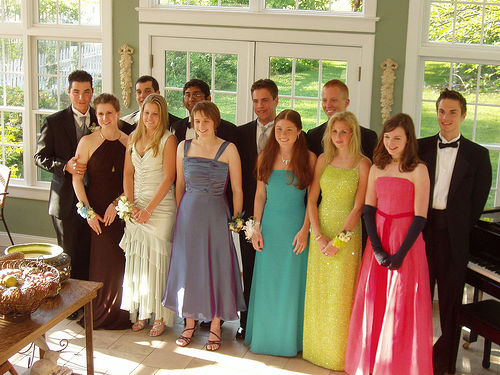
A promenade dance or prom is a formal dance party for graduating high school students at the end of the school year.
Students participating in the prom will typically vote for a prom king and prom queen. Other students may be honored with inclusion in a prom court. The selection method for a prom court is similar to that of homecoming queen/princess, king/prince, and court. Inclusion in a prom court may be a reflection of popularity of those students elected and their level of participation in school activities, such as clubs or sports. The prom queen and prom king may be given crowns to wear. Members of the prom court may be given sashes to wear and photographed together.
Similar events, which may be locally inspired by debutante balls, take place in many other parts of the world. In Canada, the terms "formal" and "Grad" are often used, while in Australia and New Zealand, the terms school formal and ball are most commonly used for occasions equivalent to the American prom, and the event is usually held for students in Year 12. Many schools hold a formal graduation ball for finishing students at the end of the year in place of or as well as a formal. In Ireland, a debutante ball or debs may also be held. In Poland and Lithuania, high schools organize a "studniówka" (lt. "Šimtadienis"). The term "prom" has become more common in the United Kingdom and Canada because of the influence of American films and television shows, such as Grease. In South Africa, this event is widely known as a matric dance / matric farewell as students in their 12th year of school are called matric students. In South Asia, its equivalent is a farewell party.
Variation exists between different dialects with regard to whether prom is used with the definite article or not—e.g., whether one says "go to the prom" or "go to prom".
In the early days of high school proms, the nighttime dance served a function similar to a debutante ball. Early proms were times of firsts: the first adult social event for teenagers; the first time taking the family car out after dark; the first real dress-up affair; and so forth. Proms also served as a heavily documented occasion, similar to a milestone event such as first communion or a wedding, in which the participants were taking an important step into a new stage in their lives. In earlier days, the prom may have also served as an announcement of engagement for the 'best couple' after the prom court had been crowned and recognized.
While high school yearbooks did not start covering proms and including prom pictures until the 1930s and 1940s, historians, including Meghan Bretz, believe proms may have existed at colleges as early as the late 19th century. The journal of a male student at Amherst College in 1894 recounts an invitation and trip to an early prom at neighboring Smith College for women. The word prom at that time may have been a fancy description for an ordinary junior or senior class dance, but prom soon took on larger-than-life meaning for high school students.
Proms worked their way down incrementally from college gatherings to high school extravaganzas. In the early 20th century, prom was a simple tea dance where high school seniors wore their Sunday best. In the 1920s and 1930s, prom expanded into an annual class banquet where students wore party clothes and danced afterward. As Americans gained more money and leisure time in the 1950s, proms became more extravagant and elaborate, bearing similarity to today's proms. The high school gym may have been an acceptable setting for sophomore dances, but junior prom and senior balls gradually moved to hotel ballrooms and country clubs. Competition blossomed, as teens strove to have the best dress, the best mode of transportation, and the best-looking date. Competition for the prom court also intensified, as the designation of prom queen became an important distinction of popularity. Prom became the pinnacle event of a high school student's social life.
Today, prom continues to be a notable event in the social climate of high schools. Popular movies and novels attest to the importance of prom themes, prom dates, and prom queens. In some areas, the traditions of prom are not as rigid as they used to be, with many students attending as individuals or in groups instead of as couples. In 1975, U.S. First Daughter Susan Ford held her prom in the East Room of the White House.
Hub AI
Prom AI simulator
(@Prom_simulator)
Prom
A promenade dance or prom is a formal dance party for graduating high school students at the end of the school year.
Students participating in the prom will typically vote for a prom king and prom queen. Other students may be honored with inclusion in a prom court. The selection method for a prom court is similar to that of homecoming queen/princess, king/prince, and court. Inclusion in a prom court may be a reflection of popularity of those students elected and their level of participation in school activities, such as clubs or sports. The prom queen and prom king may be given crowns to wear. Members of the prom court may be given sashes to wear and photographed together.
Similar events, which may be locally inspired by debutante balls, take place in many other parts of the world. In Canada, the terms "formal" and "Grad" are often used, while in Australia and New Zealand, the terms school formal and ball are most commonly used for occasions equivalent to the American prom, and the event is usually held for students in Year 12. Many schools hold a formal graduation ball for finishing students at the end of the year in place of or as well as a formal. In Ireland, a debutante ball or debs may also be held. In Poland and Lithuania, high schools organize a "studniówka" (lt. "Šimtadienis"). The term "prom" has become more common in the United Kingdom and Canada because of the influence of American films and television shows, such as Grease. In South Africa, this event is widely known as a matric dance / matric farewell as students in their 12th year of school are called matric students. In South Asia, its equivalent is a farewell party.
Variation exists between different dialects with regard to whether prom is used with the definite article or not—e.g., whether one says "go to the prom" or "go to prom".
In the early days of high school proms, the nighttime dance served a function similar to a debutante ball. Early proms were times of firsts: the first adult social event for teenagers; the first time taking the family car out after dark; the first real dress-up affair; and so forth. Proms also served as a heavily documented occasion, similar to a milestone event such as first communion or a wedding, in which the participants were taking an important step into a new stage in their lives. In earlier days, the prom may have also served as an announcement of engagement for the 'best couple' after the prom court had been crowned and recognized.
While high school yearbooks did not start covering proms and including prom pictures until the 1930s and 1940s, historians, including Meghan Bretz, believe proms may have existed at colleges as early as the late 19th century. The journal of a male student at Amherst College in 1894 recounts an invitation and trip to an early prom at neighboring Smith College for women. The word prom at that time may have been a fancy description for an ordinary junior or senior class dance, but prom soon took on larger-than-life meaning for high school students.
Proms worked their way down incrementally from college gatherings to high school extravaganzas. In the early 20th century, prom was a simple tea dance where high school seniors wore their Sunday best. In the 1920s and 1930s, prom expanded into an annual class banquet where students wore party clothes and danced afterward. As Americans gained more money and leisure time in the 1950s, proms became more extravagant and elaborate, bearing similarity to today's proms. The high school gym may have been an acceptable setting for sophomore dances, but junior prom and senior balls gradually moved to hotel ballrooms and country clubs. Competition blossomed, as teens strove to have the best dress, the best mode of transportation, and the best-looking date. Competition for the prom court also intensified, as the designation of prom queen became an important distinction of popularity. Prom became the pinnacle event of a high school student's social life.
Today, prom continues to be a notable event in the social climate of high schools. Popular movies and novels attest to the importance of prom themes, prom dates, and prom queens. In some areas, the traditions of prom are not as rigid as they used to be, with many students attending as individuals or in groups instead of as couples. In 1975, U.S. First Daughter Susan Ford held her prom in the East Room of the White House.