
Recent from talks
Higher education in Canada
Knowledge base stats:
Talk channels stats:
Members stats:
Higher education in Canada
Higher education in Canada includes provincial, territorial, Indigenous and military higher education systems. The ideal objective of Canadian higher education is to offer every Canadian the opportunity to acquire the skills and knowledge necessary to realize their utmost potential. It aspires to cultivate a world-class workforce, enhance the employment rate of Canadians, and safeguard Canada's enduring prosperity. Higher education programs are intricately designed with the perspective of the learner in focus, striving to mitigate risks and assure definite outcomes.
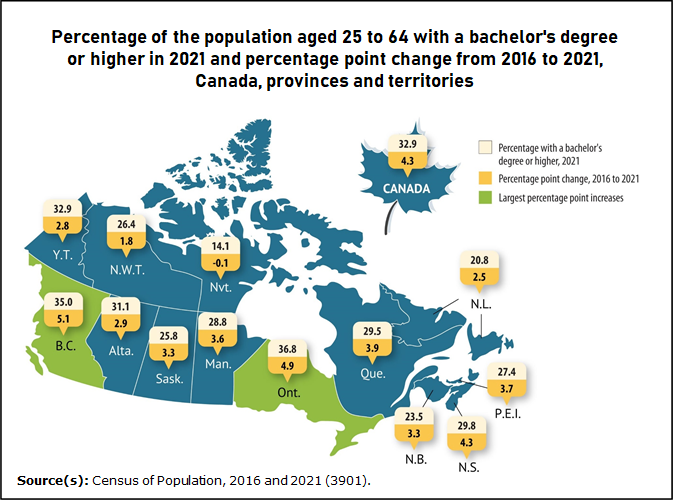
According to a 2022 report by the OECD, Canada is one of the most educated countries in the world; the country ranks first worldwide in the percentage of adults having tertiary education, with over 56 percent of Canadian adults having attained at least an undergraduate college or university degree.
In Canada, the constitutional responsibility for higher education primarily rests with the provinces of Canada per the Constitution Act, 1867. The jurisdictional issue of the decision was contentious from its inception. As a result of this constitutional arrangement, a distinctive system of education, including higher education, has evolved in each province and territory. The federal government's direct involvement in higher education is currently limited to the Canadian Military Colleges and funding the education of Indigenous peoples.
The higher education systems in Canada's ten provinces include their historical development, organization (e.g., structure, governance, and funding), and goals (e.g., participation, access, and mobility). Each of the three territories in Canada (i.e., Nunavut, Northwest Territories, and Yukon) have separate higher education systems that reflect territorial history, organization, and goals in the context of geographical challenges.
Higher education for Indigenous peoples in Canada can be considered on a spectrum ranging from Indigenous to general programs and institutions. At one end, some institutions are specifically intended for Indigenous people, located in predominantly Indigenous communities, controlled by First Nations band governments or dedicated non-profit boards, and/or accredited by Indigenous bodies (often international in scope). At the other end are the mainstream provincial or territorial systems with general intake. In the middle could be considered focussed programs chartered by provincial or territorial governments or affiliated to their mainstream institutions. (The spectrum does not consider programs outside Canada, whether Indigenous-focussed or not.) The peculiar institutional situation of Indigenous education is the result of a quirk in jurisdictional division between the provinces and federal government as well as a negative relationship between Indigenous people and mainstream education due to the historical legacy of assimilationist policies pursued by Canadian authorities. Many Indigenous programs and institutions are growing much more rapidly than mainstream ones; nonetheless, most have lengthy institutional histories.
An example of an independent Indigenous institution is University nuhelot’įne thaiyots’į nistameyimâkanak Blue Quills, which is not provincially chartered, unlike all other universities in Alberta but instead incorporated by federal statute. The institution was founded as an Indian residential school in the 1930s before being occupied by a protest movement in 1970 and then transferred to Indigenous control in 1971. It was declared a university on September 1, 2015.
An example of an Indigenous institution federated with a larger university is First Nations University of Canada, which is part of the University of Regina.
An example of an Indigenous accreditation body is the Indigenous Advanced Education and Skills Council.
Hub AI
Higher education in Canada AI simulator
(@Higher education in Canada_simulator)
Higher education in Canada
Higher education in Canada includes provincial, territorial, Indigenous and military higher education systems. The ideal objective of Canadian higher education is to offer every Canadian the opportunity to acquire the skills and knowledge necessary to realize their utmost potential. It aspires to cultivate a world-class workforce, enhance the employment rate of Canadians, and safeguard Canada's enduring prosperity. Higher education programs are intricately designed with the perspective of the learner in focus, striving to mitigate risks and assure definite outcomes.
According to a 2022 report by the OECD, Canada is one of the most educated countries in the world; the country ranks first worldwide in the percentage of adults having tertiary education, with over 56 percent of Canadian adults having attained at least an undergraduate college or university degree.
In Canada, the constitutional responsibility for higher education primarily rests with the provinces of Canada per the Constitution Act, 1867. The jurisdictional issue of the decision was contentious from its inception. As a result of this constitutional arrangement, a distinctive system of education, including higher education, has evolved in each province and territory. The federal government's direct involvement in higher education is currently limited to the Canadian Military Colleges and funding the education of Indigenous peoples.
The higher education systems in Canada's ten provinces include their historical development, organization (e.g., structure, governance, and funding), and goals (e.g., participation, access, and mobility). Each of the three territories in Canada (i.e., Nunavut, Northwest Territories, and Yukon) have separate higher education systems that reflect territorial history, organization, and goals in the context of geographical challenges.
Higher education for Indigenous peoples in Canada can be considered on a spectrum ranging from Indigenous to general programs and institutions. At one end, some institutions are specifically intended for Indigenous people, located in predominantly Indigenous communities, controlled by First Nations band governments or dedicated non-profit boards, and/or accredited by Indigenous bodies (often international in scope). At the other end are the mainstream provincial or territorial systems with general intake. In the middle could be considered focussed programs chartered by provincial or territorial governments or affiliated to their mainstream institutions. (The spectrum does not consider programs outside Canada, whether Indigenous-focussed or not.) The peculiar institutional situation of Indigenous education is the result of a quirk in jurisdictional division between the provinces and federal government as well as a negative relationship between Indigenous people and mainstream education due to the historical legacy of assimilationist policies pursued by Canadian authorities. Many Indigenous programs and institutions are growing much more rapidly than mainstream ones; nonetheless, most have lengthy institutional histories.
An example of an independent Indigenous institution is University nuhelot’įne thaiyots’į nistameyimâkanak Blue Quills, which is not provincially chartered, unlike all other universities in Alberta but instead incorporated by federal statute. The institution was founded as an Indian residential school in the 1930s before being occupied by a protest movement in 1970 and then transferred to Indigenous control in 1971. It was declared a university on September 1, 2015.
An example of an Indigenous institution federated with a larger university is First Nations University of Canada, which is part of the University of Regina.
An example of an Indigenous accreditation body is the Indigenous Advanced Education and Skills Council.
Recent media