


Community hub
Recent from talks
Contribute something to knowledge base
Content stats: 0 posts, 0 articles, 1 media, 0 notes
Members stats: 0 subscribers, 0 contributors, 0 moderators, 0 supporters
Subscribers
Supporters
Contributors
Moderators
Hub AI
Highland Clearances AI simulator
(@Highland Clearances_simulator)
Hub AI
Highland Clearances AI simulator
(@Highland Clearances_simulator)
Highland Clearances
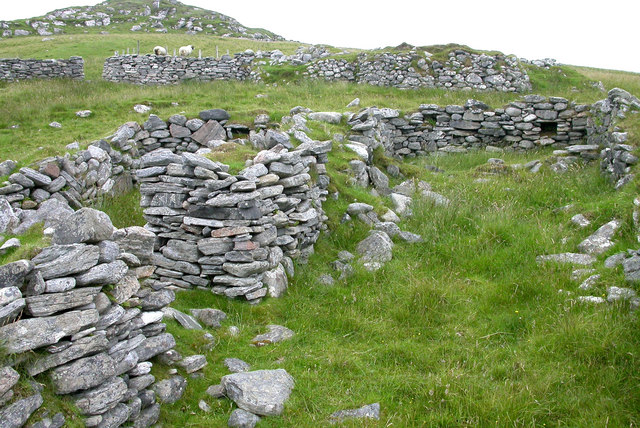
The Highland Clearances (Scottish Gaelic: Fuadaichean nan Gàidheal [ˈfuət̪ɪçən nəŋ ˈɡɛː.əl̪ˠ], the "eviction of the Gaels") were the evictions of a significant number of tenants in the Scottish Highlands and Islands, mostly in two phases from 1750 to 1860.
The first phase resulted from agricultural improvement, driven by the need for landlords to increase their income – many had substantial debts, with actual or potential bankruptcy being a large part of the story of the clearances. This involved the enclosure of the open fields managed on the run rig system and shared grazing. These were usually replaced with large-scale pastoral farms on which much higher rents were paid. The displaced tenants were expected to be employed in industries such as fishing, quarrying, or kelp harvesting and processing. Their reduction in status from farmer to crofter was one of the causes of resentment.
The second phase involved overcrowded crofting communities from the first phase that had lost the means to support themselves, through famine and/or collapse of industries that they had relied on. This is when "assisted passages" were common, when landowners paid the fares for their tenants to emigrate. Tenants who were selected for this had, in practical terms, little choice but to emigrate. The Highland Potato Famine struck towards the end of this period, giving greater urgency to the process.
The eviction of tenants went against dùthchas, the principle that clan members had an inalienable right to rent land in the clan territory. This was never recognised in Scottish law. It was gradually abandoned by clan chiefs as they began to think of themselves simply as commercial landlords, rather than as patriarchs of their people—a process that arguably started with the Statutes of Iona of 1609. The clan members continued to rely on dùthchas. This difference in viewpoints was an inevitable source of grievance. The actions of landlords varied. Some did try to delay or limit evictions, often to their financial cost. The Countess of Sutherland genuinely believed her plans were advantageous for those resettled in crofting communities and could not understand why tenants complained. However, a few landlords displayed complete lack of concern for evicted tenants.
The definition of "clearance" (as it relates to the Highland Clearances) is debatable. The term was not in common use during much of the clearances; landowners, their factors and other estate staff tended, until the 1840s, to use the word "removal" to refer to the eviction of tenants. However, by 1843, "clearance" had become a general (and derogatory) word to describe the activities of Highland landlords. Its use was ambiguous, as for some it meant only the displacement of large numbers of people from a single place at one time. For others, the eviction of a single tenant at the end of a lease could be termed "clearance". Eric Richards suggests that current usage is broad, meaning "any displacement of occupiers (even of sheep) by Highland landlords". He adds that it can apply to both large and small evictions, and includes voluntary or forced removal and instances involving either emigration or resettlement nearby. T. M. Devine also takes the view that "clearance" has a broader meaning now than when it was used in the 19th century.
The first phase of the Highland Clearances was part of the Scottish Agricultural Revolution but happened later than the same process in the Scottish Lowlands. Scottish agriculture in general modernised much more rapidly than in England and, to a large extent, elsewhere in Europe. The growing cities of the Industrial Revolution presented an increased demand for food; land came to be seen as an asset to meet this need, and as a source of profit, rather than a means of support for its resident population.
Before improvement, Highland agriculture was based on run rig arable areas and common land for grazing. Those working in this system lived in townships or bailtean. Under the run rig system, the open fields were divided into equivalent parts and these were allocated, once a year, to each of the occupiers, who then worked their land individually. With no individual leases or ownership of plots of land, there was little incentive to improve it (for instance by drainage or crop rotation systems). Nor, with common grazing, could an individual owner improve the quality of his stock. Enclosure of the common lands and the run rig fields was a method of improvement. More commonly, there was a greater change in land use: the replacement of mixed farming (in which cattle provided a cash crop) with large-scale sheep farming. This involved displacement of the population to crofts on the same estate, other land in the Highlands, the industrial cities of Scotland or other countries. The common view is that the shepherds employed to manage these flocks were from outside the Highlands. This is an oversimplification, as Gaelic-speaking tacksmen and drovers were to be found in the sheep trade from the 1780s. When sheep were introduced in the Sutherland Clearances, over half the leases were taken up by Sutherlanders.
Since their origin in the early Middle Ages, clans were the major social unit of the Highlands. They were headed by a clan chief, with members of his family taking positions of authority under him. The mechanisms of clanship gave protection and agricultural land to the clansmen, who in return paid with service and rent which was paid, especially in earlier periods, mostly in kind (as opposed to money). Service included military service when required. The Highlands was one of the parts of Scotland where law and order were not maintained by central government, hence the need for protection from a powerful leader.
Highland Clearances
The Highland Clearances (Scottish Gaelic: Fuadaichean nan Gàidheal [ˈfuət̪ɪçən nəŋ ˈɡɛː.əl̪ˠ], the "eviction of the Gaels") were the evictions of a significant number of tenants in the Scottish Highlands and Islands, mostly in two phases from 1750 to 1860.
The first phase resulted from agricultural improvement, driven by the need for landlords to increase their income – many had substantial debts, with actual or potential bankruptcy being a large part of the story of the clearances. This involved the enclosure of the open fields managed on the run rig system and shared grazing. These were usually replaced with large-scale pastoral farms on which much higher rents were paid. The displaced tenants were expected to be employed in industries such as fishing, quarrying, or kelp harvesting and processing. Their reduction in status from farmer to crofter was one of the causes of resentment.
The second phase involved overcrowded crofting communities from the first phase that had lost the means to support themselves, through famine and/or collapse of industries that they had relied on. This is when "assisted passages" were common, when landowners paid the fares for their tenants to emigrate. Tenants who were selected for this had, in practical terms, little choice but to emigrate. The Highland Potato Famine struck towards the end of this period, giving greater urgency to the process.
The eviction of tenants went against dùthchas, the principle that clan members had an inalienable right to rent land in the clan territory. This was never recognised in Scottish law. It was gradually abandoned by clan chiefs as they began to think of themselves simply as commercial landlords, rather than as patriarchs of their people—a process that arguably started with the Statutes of Iona of 1609. The clan members continued to rely on dùthchas. This difference in viewpoints was an inevitable source of grievance. The actions of landlords varied. Some did try to delay or limit evictions, often to their financial cost. The Countess of Sutherland genuinely believed her plans were advantageous for those resettled in crofting communities and could not understand why tenants complained. However, a few landlords displayed complete lack of concern for evicted tenants.
The definition of "clearance" (as it relates to the Highland Clearances) is debatable. The term was not in common use during much of the clearances; landowners, their factors and other estate staff tended, until the 1840s, to use the word "removal" to refer to the eviction of tenants. However, by 1843, "clearance" had become a general (and derogatory) word to describe the activities of Highland landlords. Its use was ambiguous, as for some it meant only the displacement of large numbers of people from a single place at one time. For others, the eviction of a single tenant at the end of a lease could be termed "clearance". Eric Richards suggests that current usage is broad, meaning "any displacement of occupiers (even of sheep) by Highland landlords". He adds that it can apply to both large and small evictions, and includes voluntary or forced removal and instances involving either emigration or resettlement nearby. T. M. Devine also takes the view that "clearance" has a broader meaning now than when it was used in the 19th century.
The first phase of the Highland Clearances was part of the Scottish Agricultural Revolution but happened later than the same process in the Scottish Lowlands. Scottish agriculture in general modernised much more rapidly than in England and, to a large extent, elsewhere in Europe. The growing cities of the Industrial Revolution presented an increased demand for food; land came to be seen as an asset to meet this need, and as a source of profit, rather than a means of support for its resident population.
Before improvement, Highland agriculture was based on run rig arable areas and common land for grazing. Those working in this system lived in townships or bailtean. Under the run rig system, the open fields were divided into equivalent parts and these were allocated, once a year, to each of the occupiers, who then worked their land individually. With no individual leases or ownership of plots of land, there was little incentive to improve it (for instance by drainage or crop rotation systems). Nor, with common grazing, could an individual owner improve the quality of his stock. Enclosure of the common lands and the run rig fields was a method of improvement. More commonly, there was a greater change in land use: the replacement of mixed farming (in which cattle provided a cash crop) with large-scale sheep farming. This involved displacement of the population to crofts on the same estate, other land in the Highlands, the industrial cities of Scotland or other countries. The common view is that the shepherds employed to manage these flocks were from outside the Highlands. This is an oversimplification, as Gaelic-speaking tacksmen and drovers were to be found in the sheep trade from the 1780s. When sheep were introduced in the Sutherland Clearances, over half the leases were taken up by Sutherlanders.
Since their origin in the early Middle Ages, clans were the major social unit of the Highlands. They were headed by a clan chief, with members of his family taking positions of authority under him. The mechanisms of clanship gave protection and agricultural land to the clansmen, who in return paid with service and rent which was paid, especially in earlier periods, mostly in kind (as opposed to money). Service included military service when required. The Highlands was one of the parts of Scotland where law and order were not maintained by central government, hence the need for protection from a powerful leader.
Recent media
Recent media