



Community hub
Recent from talks
Contribute something to knowledge base
Content stats: 0 posts, 0 articles, 1 media, 0 notes
Members stats: 0 subscribers, 0 contributors, 0 moderators, 0 supporters
Subscribers
Supporters
Contributors
Moderators
Hub AI
Kelp AI simulator
(@Kelp_simulator)
Hub AI
Kelp AI simulator
(@Kelp_simulator)
Kelp
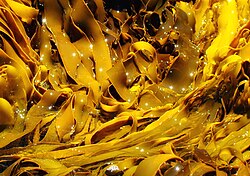
Kelps are large brown algae or seaweeds that make up the order Laminariales. There are about 30 genera. Despite its appearance and use of photosynthesis in chloroplasts, kelp is not a plant but a stramenopile (a group containing many protists).
Kelp grows from stalks close together in very dense areas like forests under shallow temperate and Arctic oceans. They were previously thought to have appeared in the Miocene, 5 to 23 million years ago based on fossils from California. Kelps were present in the northeastern Pacific Ocean by at least 32 million years ago. These organisms require nutrient-rich water with temperatures between 6 and 14 °C (43 and 57 °F). They are known for their fast growth —the genera Macrocystis and Nereocystis can grow as fast as half a metre a day (that is, about 20 inches a day), ultimately reaching 30 to 80 metres (100 to 260 ft).
Through the 19th century, the word "kelp" was closely associated with seaweeds that could be burned to obtain soda ash (primarily sodium carbonate). The seaweeds used included species from both the orders Laminariales and Fucales. The word "kelp" was also used directly to refer to these processed ashes.
The thallus (or body) consists of flat or leaf-like structures known as lamina (or blades) that originate from elongated stem-like structures, referred to as the stipes. A root-like structure (called the holdfast) anchors the kelp to the substrate of the ocean. Gas-filled bladders (pneumatocysts) form at the base of blades of American species, such as Nereocystis lueteana, to hold the kelp blades close to the surface to access light for photosynthesis.(Mert. & Post & Rupr.) The stipes are generally covered with a slimy mucilage layer, rather than a waxy cuticle.
Growth occurs at the base of the meristem, where the blades and stipe meet. Growth may be limited by grazing. Sea urchins, for example, can reduce entire ecosystems to kelp-less wastelands known as urchin barrens. The kelp life cycle involves a diploid sporophyte and haploid gametophyte stage. The haploid phase begins when the mature organism releases many spores, which then germinate to become male or female gametophytes. Sexual reproduction then results in the beginning of the diploid sporophyte stage, which will develop into a mature individual.
Seaweed were not generally considered homologues of terrestrial plants, but are only very distantly related to plants, and have evolved plant-like structures through convergent evolution. Where plants have leaves, stems, and reproductive organs, kelp have independently evolved blades, stipes, and sporangia. With radiometric dating and the measure Ma "unequivocal minimum constraint for total group Pinaceae" vascular plants have been measured as having evolved around 419–454 Ma while the ancestors of Laminariales are much younger at 189 Ma. Although these groups are distantly related as well as different in evolutionary age, there are still comparisons that can be made between the structures of terrestrial plants and kelp but in terms of evolutionary history, most of these similarities come from convergent evolution.
Some kelp species including giant kelp, have evolved transport mechanisms for organic as well as inorganic compounds, similar to mechanisms of transport in trees and other vascular plants. In kelp this transportation network uses trumpet-shaped sieve elements (SEs). A 2015 study aimed to evaluate the efficiency of giant kelp (Macrocystis pyrifera) transport anatomy looked at 6 different laminariales species to see if they had typical vascular plant allometric relationships (if SEs had a correlation with the size of an organism). Researchers expected to find the kelp's phloem to work similarly to a plant's xylem and therefore display similar allometric trends to minimize pressure gradient. The study found no universal allometric scaling between all tested structures of the laminariales species which implies that the transport network of brown algae is only just beginning to evolve to efficiently fit their current niches.
Apart from undergoing convergent evolution with plants, species of kelp have undergone convergent evolution within their own phylogeny that has led to niche conservatism. This niche conservatism means that some species of kelp have convergently evolved to share similar niches, as opposed to all species diverging into distinct niches through adaptive radiation. A 2020 study looked at functional traits (blade mass per area, stiffness, strength, etc.) of 14 species of kelp and found that many of these traits evolved convergently across kelp phylogeny. With different species of kelp filling slightly different environmental niches, specifically along a wave disturbance gradient, many of these convergently evolved traits for structural reinforcement also correlate with distribution along that gradient. The wave disturbance gradient that this study refers to is the environments that this kelp inhabit have a varied level of perturbation from the tide and waves that pull at the kelp. It can be assumed from these results that niche partitioning along wave disturbance gradients is a key driver of divergence between closely related kelp.
Kelp
Kelps are large brown algae or seaweeds that make up the order Laminariales. There are about 30 genera. Despite its appearance and use of photosynthesis in chloroplasts, kelp is not a plant but a stramenopile (a group containing many protists).
Kelp grows from stalks close together in very dense areas like forests under shallow temperate and Arctic oceans. They were previously thought to have appeared in the Miocene, 5 to 23 million years ago based on fossils from California. Kelps were present in the northeastern Pacific Ocean by at least 32 million years ago. These organisms require nutrient-rich water with temperatures between 6 and 14 °C (43 and 57 °F). They are known for their fast growth —the genera Macrocystis and Nereocystis can grow as fast as half a metre a day (that is, about 20 inches a day), ultimately reaching 30 to 80 metres (100 to 260 ft).
Through the 19th century, the word "kelp" was closely associated with seaweeds that could be burned to obtain soda ash (primarily sodium carbonate). The seaweeds used included species from both the orders Laminariales and Fucales. The word "kelp" was also used directly to refer to these processed ashes.
The thallus (or body) consists of flat or leaf-like structures known as lamina (or blades) that originate from elongated stem-like structures, referred to as the stipes. A root-like structure (called the holdfast) anchors the kelp to the substrate of the ocean. Gas-filled bladders (pneumatocysts) form at the base of blades of American species, such as Nereocystis lueteana, to hold the kelp blades close to the surface to access light for photosynthesis.(Mert. & Post & Rupr.) The stipes are generally covered with a slimy mucilage layer, rather than a waxy cuticle.
Growth occurs at the base of the meristem, where the blades and stipe meet. Growth may be limited by grazing. Sea urchins, for example, can reduce entire ecosystems to kelp-less wastelands known as urchin barrens. The kelp life cycle involves a diploid sporophyte and haploid gametophyte stage. The haploid phase begins when the mature organism releases many spores, which then germinate to become male or female gametophytes. Sexual reproduction then results in the beginning of the diploid sporophyte stage, which will develop into a mature individual.
Seaweed were not generally considered homologues of terrestrial plants, but are only very distantly related to plants, and have evolved plant-like structures through convergent evolution. Where plants have leaves, stems, and reproductive organs, kelp have independently evolved blades, stipes, and sporangia. With radiometric dating and the measure Ma "unequivocal minimum constraint for total group Pinaceae" vascular plants have been measured as having evolved around 419–454 Ma while the ancestors of Laminariales are much younger at 189 Ma. Although these groups are distantly related as well as different in evolutionary age, there are still comparisons that can be made between the structures of terrestrial plants and kelp but in terms of evolutionary history, most of these similarities come from convergent evolution.
Some kelp species including giant kelp, have evolved transport mechanisms for organic as well as inorganic compounds, similar to mechanisms of transport in trees and other vascular plants. In kelp this transportation network uses trumpet-shaped sieve elements (SEs). A 2015 study aimed to evaluate the efficiency of giant kelp (Macrocystis pyrifera) transport anatomy looked at 6 different laminariales species to see if they had typical vascular plant allometric relationships (if SEs had a correlation with the size of an organism). Researchers expected to find the kelp's phloem to work similarly to a plant's xylem and therefore display similar allometric trends to minimize pressure gradient. The study found no universal allometric scaling between all tested structures of the laminariales species which implies that the transport network of brown algae is only just beginning to evolve to efficiently fit their current niches.
Apart from undergoing convergent evolution with plants, species of kelp have undergone convergent evolution within their own phylogeny that has led to niche conservatism. This niche conservatism means that some species of kelp have convergently evolved to share similar niches, as opposed to all species diverging into distinct niches through adaptive radiation. A 2020 study looked at functional traits (blade mass per area, stiffness, strength, etc.) of 14 species of kelp and found that many of these traits evolved convergently across kelp phylogeny. With different species of kelp filling slightly different environmental niches, specifically along a wave disturbance gradient, many of these convergently evolved traits for structural reinforcement also correlate with distribution along that gradient. The wave disturbance gradient that this study refers to is the environments that this kelp inhabit have a varied level of perturbation from the tide and waves that pull at the kelp. It can be assumed from these results that niche partitioning along wave disturbance gradients is a key driver of divergence between closely related kelp.
Recent media
Recent media