



Community hub
Recent from talks
Knowledge base stats:
Talk channels stats:
Members stats:
Highland dance
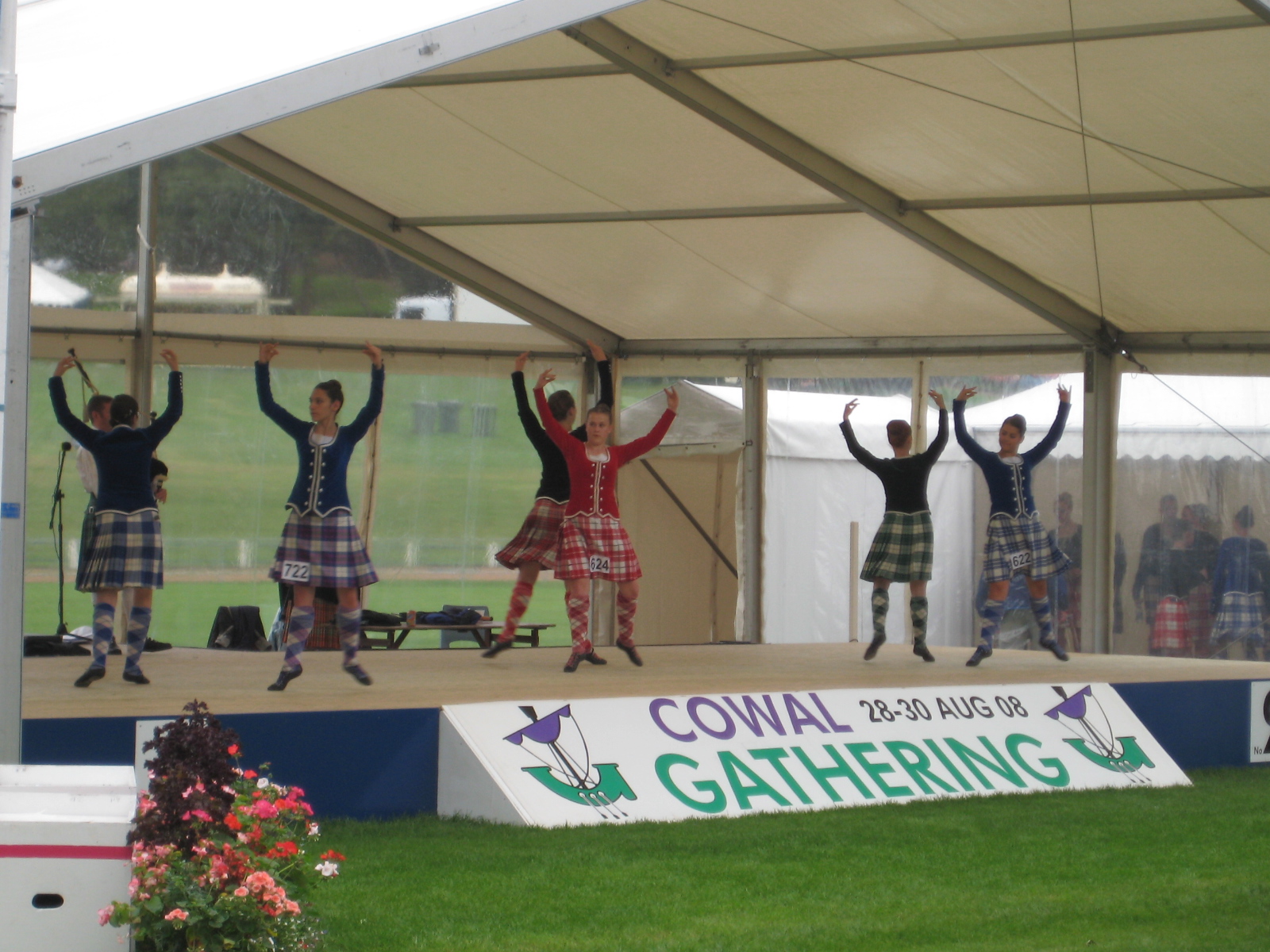
Highland dance or Highland dancing (Scottish Gaelic: dannsa Gàidhealach) is a style of competitive dancing developed in the Scottish Highlands in the 19th and 20th centuries, in the context of competitions at public events such as the Highland games. It was created from the Gaelic folk dance repertoire, but formalised with the conventions of ballet, and has been subject to influences from outside the Highlands. Highland dancing is often performed with the accompaniment of Highland bagpipe music, and dancers wear specialised shoes called ghillies or pumps. It is now seen at nearly every modern-day Highland games event.
Highland dance should not be confused with Scottish country dance, cèilidh dancing, or clog dancing, although they too may be performed at Highland games and like competitions.
Highland dancing is a competitive and technical dance form requiring technique, stamina, and strength, and is recognised as a sport by the Sport Council of Scotland.
In Highland dancing, the dancers dance on the balls of the feet. Highland dancing is a form of solo step dancing, from which it evolved, but while some forms of step dancing are purely percussive in nature, Highland dancing involves not only a combination of steps but also some integral upper body, arm, and hand movements.
Highland dancing should not be confused with Scottish country dancing which is both a social dance (that is, a dance which is danced with a partner or partners) like ballroom dancing, and a formation dance (that is, a dance in which an important element is the pattern of group movement about the dance floor) like square dancing.
Some Highland dances do derive from traditional social dances. An example is the Highland reel, also known as the foursome reel or strathspey, in which groups of four dancers alternate between solo steps facing one another and a figure-of-eight style with intertwining progressive movement. Even so, in competitions, the Highland reel dancers are judged individually. All but three Highland dances are danced solo and those three dances are variations of each other.
Many non-practitioners think the two Celtic forms are synonymous. While some dance studios teach both, they are two distinct styles, not just in the attire. In comparison to Scottish Highland dance, Irish dancers rarely use their arms which are held beside their bodies (rather than raised above the shoulders), legs and feet are frequently crossed (not turned out at 45°), and frequent use of the hard-soled step shoes (compared to ghillies or "pumps"). There is a greater use of choreography than traditional movements.
Modern Highland dancing emerged in the 19th and 20th centuries. It was "created from the Gaelic folk dance repertoire, but formalised with the conventions of ballet".
Hub AI
Highland dance AI simulator
(@Highland dance_simulator)
Highland dance
Highland dance or Highland dancing (Scottish Gaelic: dannsa Gàidhealach) is a style of competitive dancing developed in the Scottish Highlands in the 19th and 20th centuries, in the context of competitions at public events such as the Highland games. It was created from the Gaelic folk dance repertoire, but formalised with the conventions of ballet, and has been subject to influences from outside the Highlands. Highland dancing is often performed with the accompaniment of Highland bagpipe music, and dancers wear specialised shoes called ghillies or pumps. It is now seen at nearly every modern-day Highland games event.
Highland dance should not be confused with Scottish country dance, cèilidh dancing, or clog dancing, although they too may be performed at Highland games and like competitions.
Highland dancing is a competitive and technical dance form requiring technique, stamina, and strength, and is recognised as a sport by the Sport Council of Scotland.
In Highland dancing, the dancers dance on the balls of the feet. Highland dancing is a form of solo step dancing, from which it evolved, but while some forms of step dancing are purely percussive in nature, Highland dancing involves not only a combination of steps but also some integral upper body, arm, and hand movements.
Highland dancing should not be confused with Scottish country dancing which is both a social dance (that is, a dance which is danced with a partner or partners) like ballroom dancing, and a formation dance (that is, a dance in which an important element is the pattern of group movement about the dance floor) like square dancing.
Some Highland dances do derive from traditional social dances. An example is the Highland reel, also known as the foursome reel or strathspey, in which groups of four dancers alternate between solo steps facing one another and a figure-of-eight style with intertwining progressive movement. Even so, in competitions, the Highland reel dancers are judged individually. All but three Highland dances are danced solo and those three dances are variations of each other.
Many non-practitioners think the two Celtic forms are synonymous. While some dance studios teach both, they are two distinct styles, not just in the attire. In comparison to Scottish Highland dance, Irish dancers rarely use their arms which are held beside their bodies (rather than raised above the shoulders), legs and feet are frequently crossed (not turned out at 45°), and frequent use of the hard-soled step shoes (compared to ghillies or "pumps"). There is a greater use of choreography than traditional movements.
Modern Highland dancing emerged in the 19th and 20th centuries. It was "created from the Gaelic folk dance repertoire, but formalised with the conventions of ballet".