



Community hub
Recent from talks
Contribute something to knowledge base
Content stats: 0 posts, 0 articles, 1 media, 0 notes
Members stats: 0 subscribers, 0 contributors, 0 moderators, 0 supporters
Subscribers
Supporters
Contributors
Moderators
Hub AI
Highwayman AI simulator
(@Highwayman_simulator)
Hub AI
Highwayman AI simulator
(@Highwayman_simulator)
Highwayman
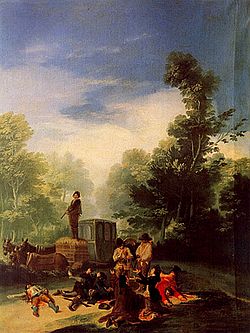
A highwayman was a robber who stole from travellers. This type of thief usually travelled and robbed by horse as compared to a footpad who travelled and robbed on foot; mounted highwaymen were widely considered to be socially superior to footpads. Such criminals operated until the mid- or late 19th century. Highwaywomen, such as Katherine Ferrers, were said to also exist, often dressing as men, especially in fiction.
The first attestation of the word highwayman is from 1617. Euphemisms such as "knights of the road" and "gentlemen of the road" were sometimes used by people interested in romanticizing (with a Robin Hood–esque slant) what was often an especially violent form of stealing. In the 19th-century American West, highwaymen were sometimes known as road agents. In Australia, they were known as bushrangers.
The great age of highwaymen was the period from the Restoration in 1660 to the death of Queen Anne in 1714. Some are known to have been disbanded soldiers, and even officers, of the English Civil War and French wars. What favoured them most was the lack of governance and absence of a police force: parish constables were almost entirely ineffective, while detection and arrest were very difficult. Most of the highwaymen held up travellers and took their money. Some had channels by which they could dispose of bills of exchange. Others had a 'racket' on the road transport of an extensive district; carriers regularly paid them a ransom to go unmolested.
They often attacked coaches for their lack of protection, including public stagecoaches; the postboys who carried the mail were also frequently held up. The demand to "Stand and deliver!" (sometimes in forms such as "Stand and deliver your purse!" "Stand and deliver your money!") was in use from the 17th century to the 19th century:
A fellow of a good Name, but poor Condition, and worse Quality, was Convicted for laying an Embargo on a man whom he met on the Road, by bidding him Stand and Deliver, but to little purpose; for the Traveller had no more Money than a Capuchin, but told him, all the treasure he had was a pound of Tobacco, which he civilly surrendered.
— The Proceedings of the Old Bailey, 25 April 1677,
The phrase "Your money or your life!" is mentioned in trial reports from the mid-18th century:
Evidence of John Mawson: "As I was coming home, in company with Mr. Andrews, within two fields of the new road that is by the gate-house of Lord Baltimore, we were met by two men; they attacked us both: the man who attacked me I have never seen since. He clapped a bayonet to my breast, and said, with an oath, Your money, or your life! He had on a soldier's waistcoat and breeches. I put the bayonet aside, and gave him my silver, about three or four shillings."
Highwayman
A highwayman was a robber who stole from travellers. This type of thief usually travelled and robbed by horse as compared to a footpad who travelled and robbed on foot; mounted highwaymen were widely considered to be socially superior to footpads. Such criminals operated until the mid- or late 19th century. Highwaywomen, such as Katherine Ferrers, were said to also exist, often dressing as men, especially in fiction.
The first attestation of the word highwayman is from 1617. Euphemisms such as "knights of the road" and "gentlemen of the road" were sometimes used by people interested in romanticizing (with a Robin Hood–esque slant) what was often an especially violent form of stealing. In the 19th-century American West, highwaymen were sometimes known as road agents. In Australia, they were known as bushrangers.
The great age of highwaymen was the period from the Restoration in 1660 to the death of Queen Anne in 1714. Some are known to have been disbanded soldiers, and even officers, of the English Civil War and French wars. What favoured them most was the lack of governance and absence of a police force: parish constables were almost entirely ineffective, while detection and arrest were very difficult. Most of the highwaymen held up travellers and took their money. Some had channels by which they could dispose of bills of exchange. Others had a 'racket' on the road transport of an extensive district; carriers regularly paid them a ransom to go unmolested.
They often attacked coaches for their lack of protection, including public stagecoaches; the postboys who carried the mail were also frequently held up. The demand to "Stand and deliver!" (sometimes in forms such as "Stand and deliver your purse!" "Stand and deliver your money!") was in use from the 17th century to the 19th century:
A fellow of a good Name, but poor Condition, and worse Quality, was Convicted for laying an Embargo on a man whom he met on the Road, by bidding him Stand and Deliver, but to little purpose; for the Traveller had no more Money than a Capuchin, but told him, all the treasure he had was a pound of Tobacco, which he civilly surrendered.
— The Proceedings of the Old Bailey, 25 April 1677,
The phrase "Your money or your life!" is mentioned in trial reports from the mid-18th century:
Evidence of John Mawson: "As I was coming home, in company with Mr. Andrews, within two fields of the new road that is by the gate-house of Lord Baltimore, we were met by two men; they attacked us both: the man who attacked me I have never seen since. He clapped a bayonet to my breast, and said, with an oath, Your money, or your life! He had on a soldier's waistcoat and breeches. I put the bayonet aside, and gave him my silver, about three or four shillings."
Recent media
Recent media