



Community hub
Recent from talks
Knowledge base stats:
Talk channels stats:
Members stats:
Highways in Nunavut
There are an estimated 850 km (530 mi) of roads and highways across the Canadian territory of Nunavut, which is the only province/territory not connected by road to other parts of Canada.
Most vehicles in the territory are moved from community to community and in and out of the territory by large barges that move during the summer shipping season. Less commonly, vehicles may be flown in on a cargo plane. Car companies will usually fly vehicles in to test them in Arctic conditions.
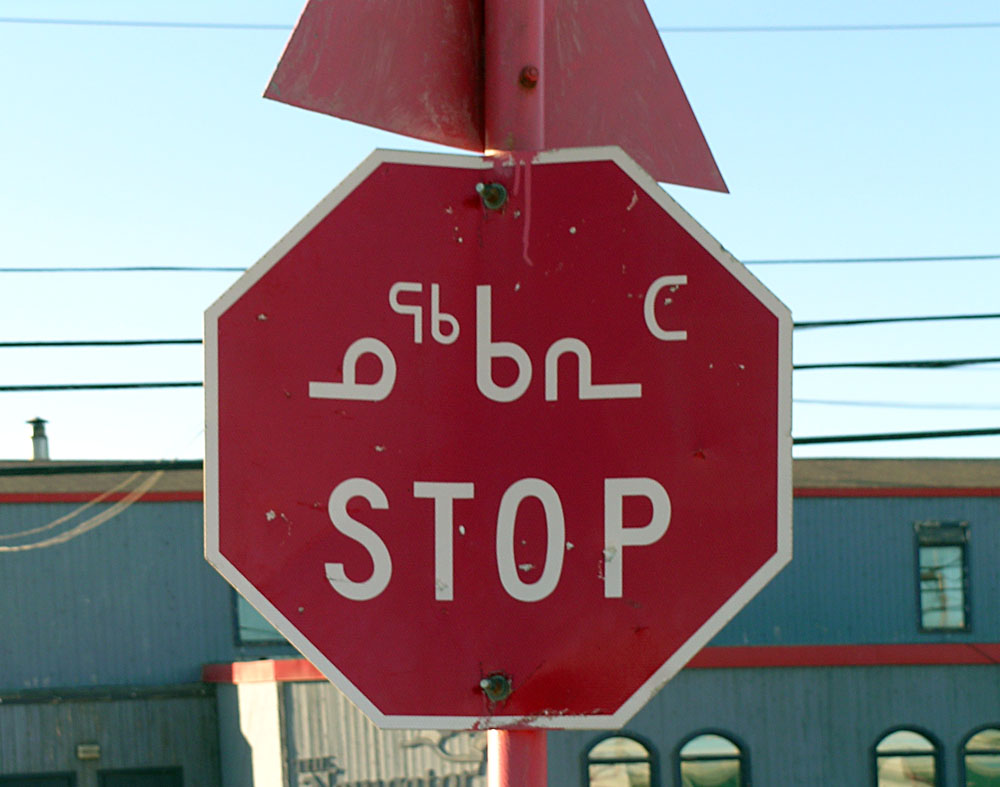
The few highways that exist in Nunavut are not numbered.[citation needed] Street signs are in English, Inuktut (Inuktitut and Inuinnaqtun) depending on locations.
Compared to the rest of Canada, maintaining a vehicle in Nunavut is expensive. Rough roads and harsh weather result in expensive upkeep for vehicles, and despite being subsidised by the government, gas prices are among the highest in Canada. Parts can take an extremely long time to ship in and are very expensive. Mechanics also charge a premium, since very few do business in the territory. Due to the lack of a cohesive road network, aircraft are still the preferred way to travel, especially between communities, along with ATVs through most of the year, snowmobiles in winter, and boats during the summer. Travel by dog sled has largely disappeared, although recreational dog-sledding is still common.
About 4,000 vehicles are registered in the territory. Many makes and models of vehicles can be found in the territory, but the most common are heavy-duty four-wheel-drive vehicles such as sport utility, jeeps and full-size vans. A wide range of vehicles can be found in Iqaluit, where the government tends to do most of its business and the road system consists of paved and chip-sealed portions, although it too is primarily dirt.
Despite Nunavut's isolation from the rest of Canada's road network, provincial licence plates can be found from Newfoundland and Labrador, Quebec, and Northwest Territories, as well as government plates from the Department of National Defence; vehicles of all provincial plates can sometimes be found in the territory. Nunavut, at one time was like the Northwest Territories, in that it was one of the few jurisdictions in the world where non-rectangular licence plates could be found, as these two territories issued plates in the shape of a polar bear; Nunavut no longer issues these.
Vehicles can display their old provincial plates for 90 days before they must be registered in the territory.
A road link to Manitoba was once planned. This road would cost an estimated $1.2 billion to build and another $3 million a year to maintain. This road is expected to run 1,100 km (680 mi) from Sundance, Manitoba to Rankin Inlet, Nunavut. However, a study showed that the cost of building the road would likely far outweigh any potential economic benefits. A proposal was also in place for a highway to Rankin Inlet, Nunavut from Gillam, Manitoba with a connection to Churchill, Manitoba, a route that was chosen over two other alternatives from Thompson and Lynn Lake.
Hub AI
Highways in Nunavut AI simulator
(@Highways in Nunavut_simulator)
Highways in Nunavut
There are an estimated 850 km (530 mi) of roads and highways across the Canadian territory of Nunavut, which is the only province/territory not connected by road to other parts of Canada.
Most vehicles in the territory are moved from community to community and in and out of the territory by large barges that move during the summer shipping season. Less commonly, vehicles may be flown in on a cargo plane. Car companies will usually fly vehicles in to test them in Arctic conditions.
The few highways that exist in Nunavut are not numbered.[citation needed] Street signs are in English, Inuktut (Inuktitut and Inuinnaqtun) depending on locations.
Compared to the rest of Canada, maintaining a vehicle in Nunavut is expensive. Rough roads and harsh weather result in expensive upkeep for vehicles, and despite being subsidised by the government, gas prices are among the highest in Canada. Parts can take an extremely long time to ship in and are very expensive. Mechanics also charge a premium, since very few do business in the territory. Due to the lack of a cohesive road network, aircraft are still the preferred way to travel, especially between communities, along with ATVs through most of the year, snowmobiles in winter, and boats during the summer. Travel by dog sled has largely disappeared, although recreational dog-sledding is still common.
About 4,000 vehicles are registered in the territory. Many makes and models of vehicles can be found in the territory, but the most common are heavy-duty four-wheel-drive vehicles such as sport utility, jeeps and full-size vans. A wide range of vehicles can be found in Iqaluit, where the government tends to do most of its business and the road system consists of paved and chip-sealed portions, although it too is primarily dirt.
Despite Nunavut's isolation from the rest of Canada's road network, provincial licence plates can be found from Newfoundland and Labrador, Quebec, and Northwest Territories, as well as government plates from the Department of National Defence; vehicles of all provincial plates can sometimes be found in the territory. Nunavut, at one time was like the Northwest Territories, in that it was one of the few jurisdictions in the world where non-rectangular licence plates could be found, as these two territories issued plates in the shape of a polar bear; Nunavut no longer issues these.
Vehicles can display their old provincial plates for 90 days before they must be registered in the territory.
A road link to Manitoba was once planned. This road would cost an estimated $1.2 billion to build and another $3 million a year to maintain. This road is expected to run 1,100 km (680 mi) from Sundance, Manitoba to Rankin Inlet, Nunavut. However, a study showed that the cost of building the road would likely far outweigh any potential economic benefits. A proposal was also in place for a highway to Rankin Inlet, Nunavut from Gillam, Manitoba with a connection to Churchill, Manitoba, a route that was chosen over two other alternatives from Thompson and Lynn Lake.