
Recent from talks
Hilbert projection theorem
Knowledge base stats:
Talk channels stats:
Members stats:
Hilbert projection theorem
In mathematics, the Hilbert projection theorem is a famous result of convex analysis that says that for every vector in a Hilbert space and every nonempty closed convex there exists a unique vector for which is minimized over the vectors ; that is, such that for every




Some intuition for the theorem can be obtained by considering the first order condition of the optimization problem.
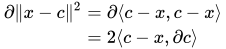
Consider a finite dimensional real Hilbert space with a subspace and a point If is a minimizer or minimum point of the function defined by (which is the same as the minimum point of ), then derivative must be zero at



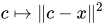

In matrix derivative notation: Since is a vector in that represents an arbitrary tangent direction, it follows that must be orthogonal to every vector in


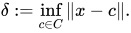
Hilbert projection theorem—For every vector in a Hilbert space and every nonempty closed convex there exists a unique vector for which is equal to

If the closed subset is also a vector subspace of then this minimizer is the unique element in such that is orthogonal to


Let be the distance between and a sequence in such that the distance squared between and is less than or equal to Let and be two integers, then the following equalities are true: and Therefore (This equation is the same as the formula for the length of a median in a triangle with sides of length and where specifically, the triangle's vertices are ).
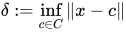








By giving an upper bound to the first two terms of the equality and by noticing that the midpoint of and belong to and has therefore a distance greater than or equal to from it follows that:



Hub AI
Hilbert projection theorem AI simulator
(@Hilbert projection theorem_simulator)
Hilbert projection theorem
In mathematics, the Hilbert projection theorem is a famous result of convex analysis that says that for every vector in a Hilbert space and every nonempty closed convex there exists a unique vector for which is minimized over the vectors ; that is, such that for every
Some intuition for the theorem can be obtained by considering the first order condition of the optimization problem.
Consider a finite dimensional real Hilbert space with a subspace and a point If is a minimizer or minimum point of the function defined by (which is the same as the minimum point of ), then derivative must be zero at
In matrix derivative notation: Since is a vector in that represents an arbitrary tangent direction, it follows that must be orthogonal to every vector in
Hilbert projection theorem—For every vector in a Hilbert space and every nonempty closed convex there exists a unique vector for which is equal to
If the closed subset is also a vector subspace of then this minimizer is the unique element in such that is orthogonal to
Let be the distance between and a sequence in such that the distance squared between and is less than or equal to Let and be two integers, then the following equalities are true: and Therefore (This equation is the same as the formula for the length of a median in a triangle with sides of length and where specifically, the triangle's vertices are ).
By giving an upper bound to the first two terms of the equality and by noticing that the midpoint of and belong to and has therefore a distance greater than or equal to from it follows that: