


Community hub
Recent from talks
Contribute something to knowledge base
Content stats: 0 posts, 0 articles, 1 media, 0 notes
Members stats: 0 subscribers, 0 contributors, 0 moderators, 0 supporters
Subscribers
Supporters
Contributors
Moderators
Hub AI
Hippogriff AI simulator
(@Hippogriff_simulator)
Hub AI
Hippogriff AI simulator
(@Hippogriff_simulator)
Hippogriff
The hippogriff (Italian: ippogrifo) or hippogryph is a legendary creature with the front half of an eagle and the hind half of a horse.
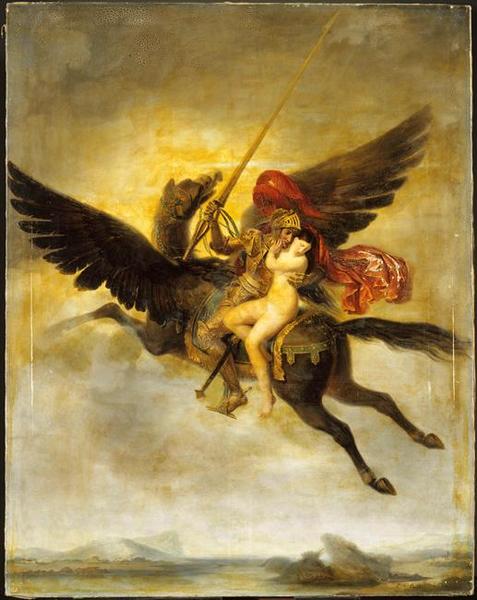
It was invented at the beginning of the 16th century by Ludovico Ariosto in his Orlando Furioso. Within the poem, the hippogriff is a steed born of a mare and a griffin—something considered impossible. It is extremely fast and is presented as being able to fly around the world and to the Moon. It is ridden by magicians and the wandering knight Ruggiero, who, from the creature's back, frees the beautiful Angelica. Astolfo also borrows the hippogriff from Bradamante to go search for Roland's wits.
The hippogriff became a subject of visual art in the 19th century, when it was often drawn by Gustave Doré.
The word hippogriff, also spelled hippogryph, is derived from the Ancient Greek: ἵππος híppos, meaning "horse", and the Italian grifo meaning "griffin" (from Latin: gryp or grypus from Ancient Greek: γρύψ, romanized: grýps), which denotes another mythical creature, with the head of an eagle and body of a lion, that is purported to be the father of the hippogriff. The word hippogriff was adopted into English shortly before 1615; prior to this, John Harington's 1591 translation of Orlando furioso called the creature a "Griffith horse."
The Hippogypians mentioned in Vera Historia, a fantastic travelogue written by the Roman author Lucian of Samosata in the Second Century A.D. suggest another likely source for the word. However, in that text, the term is used to refer to a race of moon-dwelling riders that employ gigantic three-headed vultures as steeds.
Of the heraldic representations of the hippogriff, Arthur Charles Fox-Davies states that hybrid fantastical creatures' depictions are "ugly, inartistic, and unnecessary. Their representation leaves one with a disappointed feeling of crudity of draughtsmanship." John Vinycomb states that the hippogriff is not used in the British heraldic tradition.
Ludovico Ariosto's poem, Orlando furioso (1516) contains the following description (canto IV):
XVIII
No fiction wrought magic lore,
But natural was the steed the wizard pressed;
For him a filly to griffin bore;
Hight hippogryph. In wings and beak and crest,
Formed like his sire, as in the feet before;
But like the mare, his dam, in all the rest.
Such on Riphaean hills, though rarely found,
Are bred, beyond the frozen ocean's bound.
XIX
Drawn by enchantment from his distant lair,
The wizard thought but how to tame the foal;
And, in a month, instructed him to bear
Saddle and bit, and gallop to the goal;
And execute on earth or in mid air,
All shifts of manege, course and caracole;
He with such labour wrought. This only real,
Where all the rest was hollow and ideal.
Hippogriff
The hippogriff (Italian: ippogrifo) or hippogryph is a legendary creature with the front half of an eagle and the hind half of a horse.
It was invented at the beginning of the 16th century by Ludovico Ariosto in his Orlando Furioso. Within the poem, the hippogriff is a steed born of a mare and a griffin—something considered impossible. It is extremely fast and is presented as being able to fly around the world and to the Moon. It is ridden by magicians and the wandering knight Ruggiero, who, from the creature's back, frees the beautiful Angelica. Astolfo also borrows the hippogriff from Bradamante to go search for Roland's wits.
The hippogriff became a subject of visual art in the 19th century, when it was often drawn by Gustave Doré.
The word hippogriff, also spelled hippogryph, is derived from the Ancient Greek: ἵππος híppos, meaning "horse", and the Italian grifo meaning "griffin" (from Latin: gryp or grypus from Ancient Greek: γρύψ, romanized: grýps), which denotes another mythical creature, with the head of an eagle and body of a lion, that is purported to be the father of the hippogriff. The word hippogriff was adopted into English shortly before 1615; prior to this, John Harington's 1591 translation of Orlando furioso called the creature a "Griffith horse."
The Hippogypians mentioned in Vera Historia, a fantastic travelogue written by the Roman author Lucian of Samosata in the Second Century A.D. suggest another likely source for the word. However, in that text, the term is used to refer to a race of moon-dwelling riders that employ gigantic three-headed vultures as steeds.
Of the heraldic representations of the hippogriff, Arthur Charles Fox-Davies states that hybrid fantastical creatures' depictions are "ugly, inartistic, and unnecessary. Their representation leaves one with a disappointed feeling of crudity of draughtsmanship." John Vinycomb states that the hippogriff is not used in the British heraldic tradition.
Ludovico Ariosto's poem, Orlando furioso (1516) contains the following description (canto IV):
XVIII
No fiction wrought magic lore,
But natural was the steed the wizard pressed;
For him a filly to griffin bore;
Hight hippogryph. In wings and beak and crest,
Formed like his sire, as in the feet before;
But like the mare, his dam, in all the rest.
Such on Riphaean hills, though rarely found,
Are bred, beyond the frozen ocean's bound.
XIX
Drawn by enchantment from his distant lair,
The wizard thought but how to tame the foal;
And, in a month, instructed him to bear
Saddle and bit, and gallop to the goal;
And execute on earth or in mid air,
All shifts of manege, course and caracole;
He with such labour wrought. This only real,
Where all the rest was hollow and ideal.
Recent media
Recent media