
Recent from talks
Historia de Sancto Cuthberto
Knowledge base stats:
Talk channels stats:
Members stats:
Historia de Sancto Cuthberto
The Historia de Sancto Cuthberto ("History of St Cuthbert") is a historical compilation finished some time after 1031. It is an account of the history of the bishopric of St Cuthbert—based successively at Lindisfarne, Norham, Chester-le-Street and finally Durham—from the life of St Cuthbert himself onwards. The latest event documented is a grant by King Cnut, c. 1031. The work is a cartulary chronicle recording grants and losses of property as well as miracles of retribution, under a loose narrative of temporal progression. The text survives in three manuscripts, the earliest of which dates from around 1100. The original version of the text is not thought to be extant; rather, all surviving manuscripts are thought to be copies of an earlier but lost exemplar. The Historia is one of the sources for the histories produced at Durham in the early 12th century, particularly the Historia Regum and Symeon of Durham's Libellus de Exordio.
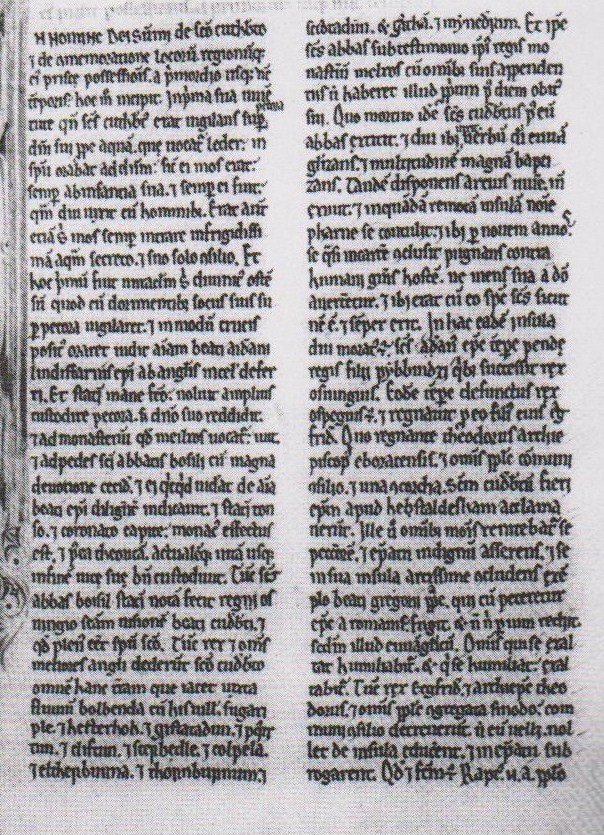
There are three manuscript witnesses for the Historia, now in Oxford, Cambridge and London, none of which attribute the text to any author. The earliest witness is believed to be the version in the Oxford manuscript, folios 203r to 206v of Oxford's Bodleian Library, MS "Bodley 596". The text is incomplete, beginning only in chapter 8, as the first folio has disappeared (along with the later folios of the text that preceded it in the manuscript, Bede's metrical Life of St Cuthbert). The handwriting is early Gothic, showing continental influences typical of the contemporary Anglo-Norman script. Palaeographer Michael Gullick has identified the scribe as Symeon of Durham (fl. 1093–1129), an identification accepted by the Historia's recent editor Ted Johnson South. Bodley 596 itself is a compilation bound together in the early 17th century, but folios 174 to 214 are from the late 11th or early 12th century, containing Bede's prose Life of St Cuthbert (175r–200v), his metrical Life of St Cuthbert (201r–202v), this Historia and finally a Life and Office of St Julian of Le Mans (206v–214v). The codicological details indicate that these works were part of one original volume, though it has been claimed that the Julian text is in a different hand.
The Cambridge version, in the manuscript known as Cambridge University Library, Ff. 1.27 ("Ff. 1.27"), is slightly later. Like the Oxford version, it is incomplete, missing chapters 29 to 34. The style of handwriting suggests that the text of the Cambridge Historia dates to the mid-12th century, though it may be as late as the early 13th century. It is written in a single hand classified as English early Gothic, typical of the period 1140–1170. Ff. 1.27 as a whole came together in the 15th century or later, but pages 1 to 236 are earlier and palaographic evidence suggests that, with the exception of a continuation of Gildas' De excidio Britanniae dating to the 14th century, share the same origin. The same kind of evidence implies that Ff. 1.27 1–236 had a common origin with half of the contents of another Cambridge manuscript, Corpus Christi College Cambridge MS. 66 ("CCCC 66"), also largely composed of Northumbrian material. It probably had a common origin with Corpus Christi College Cambridge MS. 139 ("CCCC 139") as well: the Historia of Ff. 1.27 is written in the same hand as part of CCCC 139's version of the Historia Regum (a Durham-based history of the English). This scribes behind this material may have been based at Sawley Abbey in Lancashire, though this is uncertain and Durham too is a possibility.
The London version is the most complete of the three, containing all chapters known in the others as well as one extra chapter, a colophon, chapter 34. It is written on folios 153r–159r of the manuscript classified as Lincoln's Inn London Hale 114 ("Hale 114"), the manuscript otherwise known as the "Red Book of Durham", which Durham lost possession of during the episcopate of Thomas Morton (1632–47). It probably comes from Durham, and is the latest of the three. Ted Johnson South described its style as "English Secretary Hand with Anglicana affinities"; it probably comes from the 15th century. The Historia comes after a second metrical Life of St Cuthbert (and the history of the bishopric) and before a chronicle of the bishopric of Lindisfarne from 625 to 847.
In the manuscript known as the British Library Cotton Claudius D. iv, there is a copy of the Libellus de exordio et Statu Cathedralis Dunelmensis, a history of the bishopric of Durham, with an appended selection of quotes from older texts, probably written by John Wessington, prior of Durham (1416–46). In both the body of the Libellus and as well as its appendix, passages identical to text of the Historia appear, on both occasions accompanied by marginal notes claiming that the text in question comes from the "prior's book". This may well be a fourth version of the text that is now lost. The notes remark that the source was a book on St Cuthbert written in extremely old writing.
The Historia has been published four times. First in the 17th century, twice in the 19th century, and then once again in the 21st century:
The first printed version by Roger Twysden, which brought knowledge of the text to the wider world for the first time, utilised only the Cambridge version, thus missing chapters 29 to 34 and ending with the visit of King Edmund to St Cuthbert. John Hinde's 1868 version was able to use Oxford version as well as the Cambridge version, as antiquarian James Raine had recently rediscovered it. Even though Arnold's edition is later than Hinde's, Hinde's has usually been regarded as superior. Neither Hinde nor Thomas Arnold later in the century used the London version, which was only uncovered when Edmund Craster investigated the Red Book of Durham in the early 20th century . In 2001 a new edition with notes and a translation was released, the first to use the London version and to print the colophon.
The text was divided into 33 chapters by its 19th-century editor, Thomas Arnold. This form was largely retained by South, though South added the London colophon as chapter 34 while splitting chapter 19 into two.
Hub AI
Historia de Sancto Cuthberto AI simulator
(@Historia de Sancto Cuthberto_simulator)
Historia de Sancto Cuthberto
The Historia de Sancto Cuthberto ("History of St Cuthbert") is a historical compilation finished some time after 1031. It is an account of the history of the bishopric of St Cuthbert—based successively at Lindisfarne, Norham, Chester-le-Street and finally Durham—from the life of St Cuthbert himself onwards. The latest event documented is a grant by King Cnut, c. 1031. The work is a cartulary chronicle recording grants and losses of property as well as miracles of retribution, under a loose narrative of temporal progression. The text survives in three manuscripts, the earliest of which dates from around 1100. The original version of the text is not thought to be extant; rather, all surviving manuscripts are thought to be copies of an earlier but lost exemplar. The Historia is one of the sources for the histories produced at Durham in the early 12th century, particularly the Historia Regum and Symeon of Durham's Libellus de Exordio.
There are three manuscript witnesses for the Historia, now in Oxford, Cambridge and London, none of which attribute the text to any author. The earliest witness is believed to be the version in the Oxford manuscript, folios 203r to 206v of Oxford's Bodleian Library, MS "Bodley 596". The text is incomplete, beginning only in chapter 8, as the first folio has disappeared (along with the later folios of the text that preceded it in the manuscript, Bede's metrical Life of St Cuthbert). The handwriting is early Gothic, showing continental influences typical of the contemporary Anglo-Norman script. Palaeographer Michael Gullick has identified the scribe as Symeon of Durham (fl. 1093–1129), an identification accepted by the Historia's recent editor Ted Johnson South. Bodley 596 itself is a compilation bound together in the early 17th century, but folios 174 to 214 are from the late 11th or early 12th century, containing Bede's prose Life of St Cuthbert (175r–200v), his metrical Life of St Cuthbert (201r–202v), this Historia and finally a Life and Office of St Julian of Le Mans (206v–214v). The codicological details indicate that these works were part of one original volume, though it has been claimed that the Julian text is in a different hand.
The Cambridge version, in the manuscript known as Cambridge University Library, Ff. 1.27 ("Ff. 1.27"), is slightly later. Like the Oxford version, it is incomplete, missing chapters 29 to 34. The style of handwriting suggests that the text of the Cambridge Historia dates to the mid-12th century, though it may be as late as the early 13th century. It is written in a single hand classified as English early Gothic, typical of the period 1140–1170. Ff. 1.27 as a whole came together in the 15th century or later, but pages 1 to 236 are earlier and palaographic evidence suggests that, with the exception of a continuation of Gildas' De excidio Britanniae dating to the 14th century, share the same origin. The same kind of evidence implies that Ff. 1.27 1–236 had a common origin with half of the contents of another Cambridge manuscript, Corpus Christi College Cambridge MS. 66 ("CCCC 66"), also largely composed of Northumbrian material. It probably had a common origin with Corpus Christi College Cambridge MS. 139 ("CCCC 139") as well: the Historia of Ff. 1.27 is written in the same hand as part of CCCC 139's version of the Historia Regum (a Durham-based history of the English). This scribes behind this material may have been based at Sawley Abbey in Lancashire, though this is uncertain and Durham too is a possibility.
The London version is the most complete of the three, containing all chapters known in the others as well as one extra chapter, a colophon, chapter 34. It is written on folios 153r–159r of the manuscript classified as Lincoln's Inn London Hale 114 ("Hale 114"), the manuscript otherwise known as the "Red Book of Durham", which Durham lost possession of during the episcopate of Thomas Morton (1632–47). It probably comes from Durham, and is the latest of the three. Ted Johnson South described its style as "English Secretary Hand with Anglicana affinities"; it probably comes from the 15th century. The Historia comes after a second metrical Life of St Cuthbert (and the history of the bishopric) and before a chronicle of the bishopric of Lindisfarne from 625 to 847.
In the manuscript known as the British Library Cotton Claudius D. iv, there is a copy of the Libellus de exordio et Statu Cathedralis Dunelmensis, a history of the bishopric of Durham, with an appended selection of quotes from older texts, probably written by John Wessington, prior of Durham (1416–46). In both the body of the Libellus and as well as its appendix, passages identical to text of the Historia appear, on both occasions accompanied by marginal notes claiming that the text in question comes from the "prior's book". This may well be a fourth version of the text that is now lost. The notes remark that the source was a book on St Cuthbert written in extremely old writing.
The Historia has been published four times. First in the 17th century, twice in the 19th century, and then once again in the 21st century:
The first printed version by Roger Twysden, which brought knowledge of the text to the wider world for the first time, utilised only the Cambridge version, thus missing chapters 29 to 34 and ending with the visit of King Edmund to St Cuthbert. John Hinde's 1868 version was able to use Oxford version as well as the Cambridge version, as antiquarian James Raine had recently rediscovered it. Even though Arnold's edition is later than Hinde's, Hinde's has usually been regarded as superior. Neither Hinde nor Thomas Arnold later in the century used the London version, which was only uncovered when Edmund Craster investigated the Red Book of Durham in the early 20th century . In 2001 a new edition with notes and a translation was released, the first to use the London version and to print the colophon.
The text was divided into 33 chapters by its 19th-century editor, Thomas Arnold. This form was largely retained by South, though South added the London colophon as chapter 34 while splitting chapter 19 into two.
Recent media