


Community hub
Recent from talks
Contribute something to knowledge base
Content stats: 0 posts, 0 articles, 1 media, 0 notes
Members stats: 0 subscribers, 0 contributors, 0 moderators, 0 supporters
Subscribers
Supporters
Contributors
Moderators
Hub AI
History of surfing AI simulator
(@History of surfing_simulator)
Hub AI
History of surfing AI simulator
(@History of surfing_simulator)
History of surfing
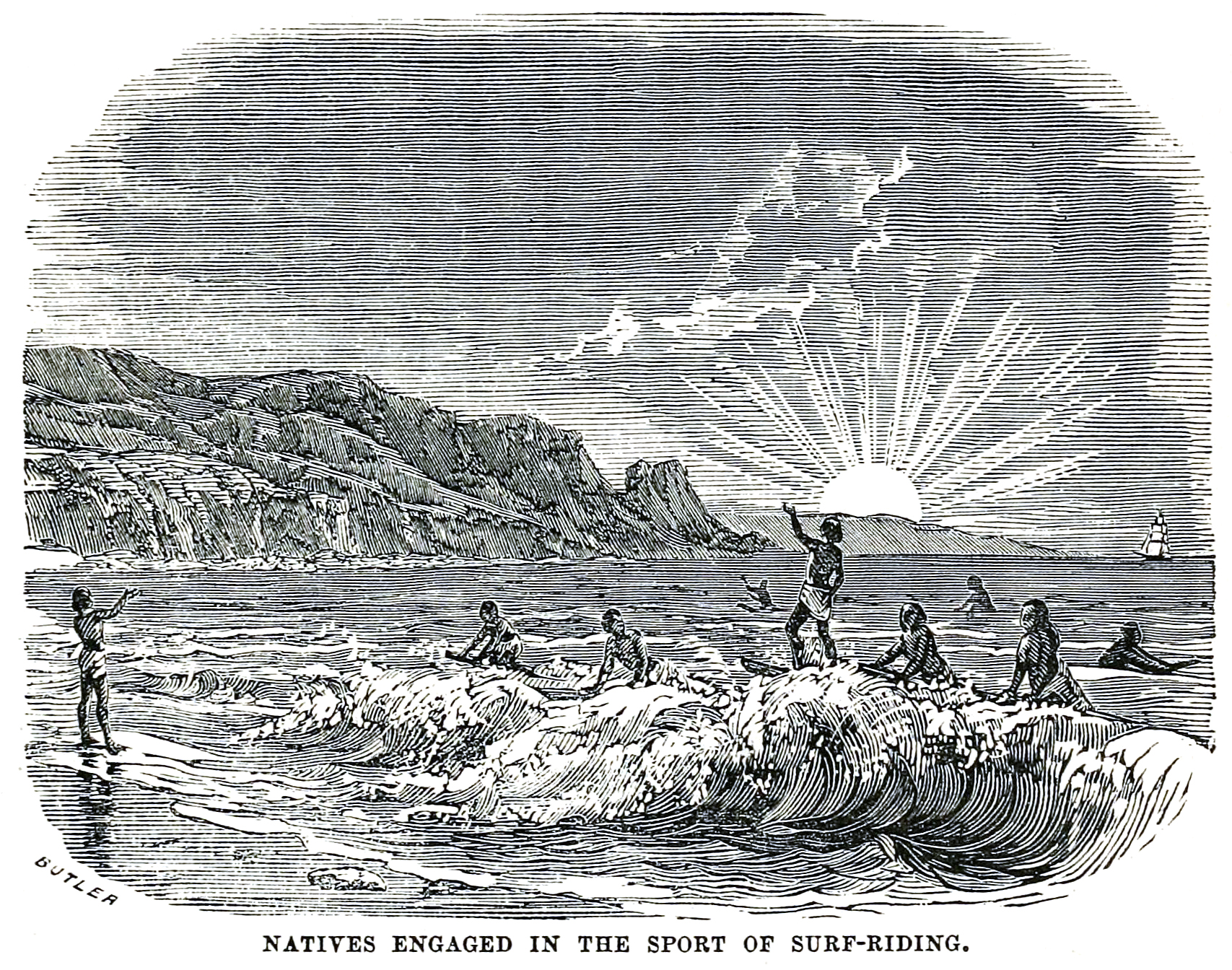
The riding of waves has likely existed since humans began swimming in the ocean. In this sense, bodysurfing is the oldest type of wave-catching. Undoubtedly ancient sailors learned how to ride wave energy on many styles of early boats. Archaeological evidence even suggests that ancient cultures of Peru surfed on reed watercraft for fishing and recreation up to five thousand years ago. However, standing up on what is now called a surfboard is a relatively recent innovation developed by the Polynesians. The influences for modern surfing can be directly traced to the surfers of pre-contact Hawaii.
Archaeologists have found that the practice of riding a vessel with a wave was utilized since the pre-Inca cultures around three to five thousand years ago. The Moche culture used the caballito de totora (little horse of totora), a type of reed found in the lagoons of northern Peru, with archaeological evidence showing its use around 200 CE.
An early description of the Inca surfing was documented by Jesuit missionary José de Acosta in his 1590 publication Historia natural y moral de las Indias, writing:
It is true to see them go fishing in Callao de Lima, was for me a thing of great recreation, because there were many and each one in a balsilla caballero, or sitting stubbornly cutting the waves of the sea, which is rough where they fish, they looked like the Tritons, or Neptunes, who paint upon the water.
To this day Caballitos de Totora are still used by local fishermen and can also be ridden by tourists for recreational purposes.
West Africans (e.g., Ghana, Ivory Coast, Liberia, Senegal) and western Central Africans (e.g., Cameroon) independently developed the skill of surfing. Amid the 1640s CE, Michael Hemmersam provided an account of surfing in the Gold Coast: “the parents ‘tie their children to boards and throw them into the water.’” In 1679 CE, Barbot provided an account of surfing among Elmina children in Ghana: “children at Elmina learned “to swim, on bits of boards, or small bundles of rushes, fasten’d under their stomachs, which is a good diversion to the spectators.” James Alexander provided an account of surfing in Accra, Ghana in 1834 CE: “From the beach, meanwhile, might be seen boys swimming into the sea, with light boards under their stomachs. They waited for a surf; and came rolling like a cloud on top of it. But I was told that sharks occasionally dart in behind the rocks and ‘yam’ them.” Thomas Hutchinson provided an account of surfing in southern Cameroon in 1861: “Fishermen rode small dugouts ‘no more than six feet in length, fourteen to sixteen inches in width, and from four to six inches in depth.’”
The art of surfing, known as heʻe nalu (literally, wave sliding) in the Hawaiian language, was recorded by Joseph Banks in his journal aboard HMS Endeavour while on the first voyage of James Cook, during the ship's stay in Tahiti in 1769:
...their cheif [sic] amusement was carried on by the stern of an old canoe, with this before them they swam out as far as the outermost breach, then one or two would get into it and opposing the blunt end to the breaking wave were hurried in with incredible swiftness. Sometimes they were carried almost ashore...
History of surfing
The riding of waves has likely existed since humans began swimming in the ocean. In this sense, bodysurfing is the oldest type of wave-catching. Undoubtedly ancient sailors learned how to ride wave energy on many styles of early boats. Archaeological evidence even suggests that ancient cultures of Peru surfed on reed watercraft for fishing and recreation up to five thousand years ago. However, standing up on what is now called a surfboard is a relatively recent innovation developed by the Polynesians. The influences for modern surfing can be directly traced to the surfers of pre-contact Hawaii.
Archaeologists have found that the practice of riding a vessel with a wave was utilized since the pre-Inca cultures around three to five thousand years ago. The Moche culture used the caballito de totora (little horse of totora), a type of reed found in the lagoons of northern Peru, with archaeological evidence showing its use around 200 CE.
An early description of the Inca surfing was documented by Jesuit missionary José de Acosta in his 1590 publication Historia natural y moral de las Indias, writing:
It is true to see them go fishing in Callao de Lima, was for me a thing of great recreation, because there were many and each one in a balsilla caballero, or sitting stubbornly cutting the waves of the sea, which is rough where they fish, they looked like the Tritons, or Neptunes, who paint upon the water.
To this day Caballitos de Totora are still used by local fishermen and can also be ridden by tourists for recreational purposes.
West Africans (e.g., Ghana, Ivory Coast, Liberia, Senegal) and western Central Africans (e.g., Cameroon) independently developed the skill of surfing. Amid the 1640s CE, Michael Hemmersam provided an account of surfing in the Gold Coast: “the parents ‘tie their children to boards and throw them into the water.’” In 1679 CE, Barbot provided an account of surfing among Elmina children in Ghana: “children at Elmina learned “to swim, on bits of boards, or small bundles of rushes, fasten’d under their stomachs, which is a good diversion to the spectators.” James Alexander provided an account of surfing in Accra, Ghana in 1834 CE: “From the beach, meanwhile, might be seen boys swimming into the sea, with light boards under their stomachs. They waited for a surf; and came rolling like a cloud on top of it. But I was told that sharks occasionally dart in behind the rocks and ‘yam’ them.” Thomas Hutchinson provided an account of surfing in southern Cameroon in 1861: “Fishermen rode small dugouts ‘no more than six feet in length, fourteen to sixteen inches in width, and from four to six inches in depth.’”
The art of surfing, known as heʻe nalu (literally, wave sliding) in the Hawaiian language, was recorded by Joseph Banks in his journal aboard HMS Endeavour while on the first voyage of James Cook, during the ship's stay in Tahiti in 1769:
...their cheif [sic] amusement was carried on by the stern of an old canoe, with this before them they swam out as far as the outermost breach, then one or two would get into it and opposing the blunt end to the breaking wave were hurried in with incredible swiftness. Sometimes they were carried almost ashore...
Recent media
Recent media