Hubbry Logo
Hoity ToityHoity ToityMain
Open search
Hoity Toity
Community hub
Hoity Toity
logo
8 pages, 0 posts
0 subscribers
Be the first to start a discussion here.
Hoity Toity
Hoity Toity
from Wikipedia
Hoity Toity
DesignersKlaus Teuber
PublishersÜberplay
Players2 to 6
Setup timeapprox. 5 minutes
Playing time> 45 minutes
ChanceCard shuffling
Age range12 years and up
SkillsBluffing

Hoity Toity (German: Adel Verpflichtet, pronounced [ˈaːdl̩ fɛɐ̯ˈp͡flɪçtət], lit.'Noblesse oblige') is a board game created by Klaus Teuber in 1990.

Publication history

[edit]

German game designer Klaus Teuber created Adel Verpflichtet in 1990, and it was published in Germany by F.X. Schmid. It was also distributed in the United Kingdom under the name Fair Means or Foul, and in the United States both under its German name and as By Hook or Crook. In 2008, Überplay re-released it in the United States using the name Hoity Toity. The game won several awards.

Gameplay

[edit]

The players in the game represent the members of the pretentious Antique Club who collectively wager which one of them can acquire, by purchase or theft, the most expensive collection of objets d'art in one day. Each member has at their disposal a detective and two thieves.[1]

During each turn, each player must choose to either go to the auction house or go to the castle.[1]

If a player goes to the auction house, the player can either bid on an item in a secret bid process, or send a thief. If only one thief is sent, the thief steals all the cash that was used for bidding. If more than one player sends a thief, then neither is able to steal the cash and the auction proceeds. The auctioned item then goes to the highest bidder.[1]

If a player goes to the castle, the player has three options: exhibit the items collected thus far, which will enable the player to move around the board further towards the end; send a thief to steal something; or send the detective to arrest any thief who is present.[1]

The player who completes a circuit of the board and arrives back in the club first is the winner.[1]

Reception

[edit]

In the July 1990 edition of Games International, Adel Verpflichtet was featured as "Game of the Month". Brian Walker admired the components, calling them "absolutely top class: beautiful artwork, top quality card stock, and a first class board." He also lauded the element of bluff in the game, saying, "Like so many great games, you must know your opponents, for it is against them you are competing, not the game itself." He also called the movement system "both extremely clever and original." He concluded by giving the game a perfect rating of 10 out of 10, saying, "Believe me, this is a great game in every respect."[1]

Reviews

[edit]

Awards

[edit]

References

[edit]
[edit]
Revisions and contributorsEdit on WikipediaRead on Wikipedia
from Grokipedia
Hoity Toity is a light strategy board game designed by German game designer Klaus Teuber and first published in 1990 by F.X. Schmid under its original German title, Adel Verpflichtet (meaning "Noblesse Oblige"). In the game, 2 to 6 players take on the roles of eccentric antique collectors who move around a club board, using cards to buy, steal, or bluff over "collectibles" like rusty swords, old vases, and quirky artifacts, aiming to assemble the most valuable or historically significant set by the end of play. The gameplay emphasizes simultaneous action selection and psychological bluffing, where players must anticipate opponents' moves during tense rounds of bidding and swapping, typically lasting about 45 minutes. The game's theme revolves around high-society antiquarians exhibiting their treasures at a grand banquet, with that reward clever deduction and risk-taking over deep . Each round, players select actions secretly via cards—such as searching for items in the "" or peeking at others' collections—before revealing and resolving them in order, often leading to humorous thefts or failed bluffs. Victory is determined by scoring based on collection size, age of items (older artifacts score higher), and special bonuses for complete sets, encouraging players to balance quantity with quality. Recommended for ages 12 and up, Hoity Toity appeals to families and casual gamers for its accessible rules and replayability through variable card draws. Upon its release, Hoity Toity quickly gained acclaim, winning the 1990 —the German Game of the Year award—for its innovative blend of interaction and simplicity, marking Teuber's second such honor after The Settlers of Catan years later. It also received the 1990 in the family/adult category, solidifying its status as a modern classic. The English edition, published by Uberplay in 2004, retained the core mechanics while adapting the artwork to a more whimsical British aristocratic vibe, and it has seen re-releases to keep it accessible today. Despite its age, the game remains popular in circles for demonstrating Teuber's early talent in creating engaging, social experiences without complex components.

Development and Publication

Design and Creation

Klaus Teuber, a German dental technician who pursued as a hobby to manage work-related stress, created Adel Verpflichtet (later known in English as Hoity Toity) in 1990, building directly on his experience with his debut published game, Barbarossa, released two years earlier. Teuber's early career involved rapid iteration, as he developed and published multiple titles in the late , including Adel Verpflichtet amid a burst of six games following Barbarossa. The game was conceptualized in the late , with Teuber drawing inspiration from personal stories and books to craft immersive experiences centered on themes of , antiques collection, and . Its German title, Adel Verpflichtet, translates to "nobility obliges," evoking the French concept of —the idea that privilege entails responsibility—and infusing the design with elements of aristocratic bluffing and intrigue, possibly nodding to a 1949 German of the same name. Development emphasized playtesting by Teuber's family, refining bluffing mechanics tied to auctions and theft to ensure intuitive, luck-infused that encouraged social interaction over deep strategy. A core innovation in Adel Verpflichtet lies in blending board-based player movement across themed locations with simultaneous action resolution, employing a rock-paper-scissors-like system where choices like spying or robbing interact in cyclic dominance to heighten tension and unpredictability. This approach marked an early evolution in Teuber's style toward accessible yet psychologically engaging designs, paving the way for his landmark success with in 1995.

Release History and Editions

Hoity Toity, originally designed by , was first released in in 1990 under the title Adel Verpflichtet by publisher F.X. Schmid. The game quickly gained international attention following its win as in 1990, leading to several localized editions in the early 1990s. A German re-edition was published by Alea in 1999, featuring updated artwork and components. In the , it was published in 1991 by Games as Fair Means or Foul. The saw its debut the same year under the title By Hook or Crook, released by , which supported 2 to 5 players and retained much of the original German artwork featuring cartoonish depictions of antiques and aristocratic thieves. A notable re-release occurred in 2004 when Überplay published the game in the as Hoity Toity, expanding player capacity to 2 to 6 and introducing minor updates to the artwork for a more whimsical, colorful aesthetic while preserving the core theme of high-society intrigue. This edition featured improved component quality, including thicker card stock and a sturdier game board compared to the earlier version, enhancing durability for repeated play. English-language versions generally adapted the artwork to appeal to broader audiences, with simplified illustrations of collectible items like pipes and chamber pots, though the fundamental card designs remained consistent across editions. No official expansions have been produced for the game, and there have been no major reprints or new editions since the 2004 Überplay release. As of 2025, copies are primarily available through second-hand markets such as online auctions and resale platforms, with the Überplay edition being the most sought-after for its enhanced components.

Gameplay

Components and Setup

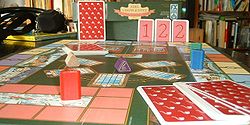
Hoity Toity includes a multi-panel game board that illustrates the interior of an exclusive Antique Club, complete with key locations such as the Club Room starting area, the Auction House featuring two display windows and a , the Exhibit, the Dinner Banquet hall, and a section with six cells, all connected by a movement path along a scoring track marked by castles and houses. The player pieces consist of six large wooden triangular figures, each in a distinct color—purple, white, black, blue, red, and green—and adorned with a for thematic flair. These figures represent the players as club members navigating the board. Additionally, the game provides cardboard components for and via the action cards, with each player receiving one detective card and two thief cards as part of their personalized deck, resulting in a total of six detectives and twelve thieves across all players. The card components comprise 51 collectible antique cards, categorized into six distinct types such as vases, lamps, clocks, and similar artifacts, where each card's value is determined by its depicted age or date, with older items holding higher worth. There are also 60 action and place cards in total, divided evenly among the six colors with ten cards per set; these include two place cards per player (one for the Auction House and one for the Castle Exhibit, functioning as movement enablers) and eight action cards (four money cards, two thieves, one detective, and one exhibit card). A separate set of six castle cards is used solely for initial color selection during setup. To set up the game, first shuffle the six castle cards face down and have each player draw one to determine their color and corresponding pieces. Each player then takes their ten matching action and place cards, while any unused sets for absent colors are set aside. Place all player figures in the Club Room starting space on the board. Shuffle the 51 antique cards and deal four face down to each player, who may examine their own; divide the remaining cards into two face-up stacks positioned in the Auction House's display windows. The game accommodates 2 to 6 players, with adjustments for smaller groups by removing the unused action and place cards associated with missing colors, thereby reducing the total number of available detectives and to maintain balance.

Core Mechanics

The gameplay of Hoity Toity proceeds in a series of rounds, each divided into four distinct phases that emphasize simultaneous decision-making and bluffing among players. In Phase I ("Where?"), all players secretly select their intended location by playing one of their Place cards face down in front of themselves, choosing either the Auction House to acquire new antiques or the to display collections and engage in potential or arrests. These Place cards, consisting of one Auction House card and one card per player, are revealed simultaneously once everyone has chosen, determining the groups for subsequent actions. Following location selection, Phase II ("What?") involves players secretly designating their specific action by playing an Action card face down from their hand of eight such cards, which include options for bidding (Cash cards), stealing (Thief cards), exhibiting (Exhibit card), or arresting ( cards). Players at the Auction House can opt to bid by playing a Cash card valued from 1 to 5 or to steal by playing a Thief card numbered 1 to 3, while those at the can choose to exhibit by playing their Exhibit card, steal with a Thief card, or arrest with a Detective card numbered 1 to 3. These Action cards are also revealed simultaneously within each location group, setting up the resolutions without direct placement of figures on the board locations themselves. In Phase III, actions at the Auction House are resolved first: players who chose to bid play their Cash cards face up to a shared register, with the highest total value choosing one collectible card from either of the two face-up stacks in the display windows; ties are broken by the preprinted numbers on the cash cards, and the winner adds the to their hand. If cash cards were bid, the single highest thief (if only one) steals all cash cards from the register; multiple thieves result in no theft, and all thief cards are discarded. If no cash was played, thieves achieve nothing and are discarded. At the in Phase IV, exhibitors must display at least three Collectibles cards from their hand in by antique name, with the most valuable set (based on the greatest number of cards, with ties broken by the oldest artifact in the set) advancing its owner's figure along the board's castle track by the higher number in the current octagonal space, and the second-most valuable by the lower number. Thieves then attempt to steal one Collectibles card each from any exhibitor's display (highest thief number acts first), provided at least one occurred; finally, any detectives arrest all thieves if present, sending them to the central jail (rotating cells ), and the detective players advance based on their among detectives (1st advances 1 space, 2nd advances 2 spaces, etc.). Player figures, represented as colored triangles, start in the Club Room and advance only along the linear path of on the board following successful or at the , with no movement occurring at the Auction House. Action cards, including Place cards, are returned to their owners' hands after each round for reuse, maintaining the fixed hand size of eight, while Collectibles cards won or stolen are added to the player's personal collection face down, with no explicit maximum but practically limited by requirements and game length. Interactions between players are driven by the of and : succeed against exhibitors only if no detectives are present in the that round, but arrested are temporarily detained in jail cells, freeing up only when subsequent push them out (returning the card to the owner's hand at the end of the round); this creates tension as repeated can cycle back into play, with jail occupancy allowing up to six simultaneous detentions, one per player color.

Resolution and Winning

After players simultaneously select and conceal their actions at either the Auction Hall or a Castle, all chosen actions are revealed together to resolve the round. At the Castle, participants play one of three action types: Exhibit, Thief, or . This creates a rock-paper-scissors dynamic where Thieves beat Exhibitors by stealing one Collectible card from any exhibit; beat Thieves by automatically jailing all Thieves present, regardless of whether theft occurred; and Exhibitors beat Detectives, as a Detective played without any Thieves yields no effect or points, allowing Exhibitors to score unhindered. Exhibits are resolved first among qualifying players, who must display at least three Collectible cards in uninterrupted alphabetical sequences (e.g., AAA or AABBC) to participate. The most valuable Exhibit—determined by the greatest number of cards, with ties broken by the oldest artifact (lowest age value)—earns advancement equal to the higher number on the current board space (e.g., 3 spaces forward). The second-most valuable Exhibit advances by the lower number (e.g., 2 spaces). then act in descending order of their card numbers, each taking one card from any valid exhibit. If Detectives are present, all are immediately jailed and moved to the track, where they cycle through cells (one per round) before returning to their owner's hand; jailed retain any stolen cards but receive no further punishment for failed attempts. Detectives score advancement equal to their ranking among the detectives played that round (1 space for 1st, 2 for 2nd, etc.) if thieves are present. Actions that fail due to counters or lack of targets simply have no effect, with no additional penalties. In the Auction Hall, players reveal Cash cards or Thieves simultaneously. The player with the highest value claims one face-up Collectible card from either display stack; all other Cash cards are returned to their owners, while the winning bid is placed in the register. Ties for the highest bid are resolved by the preprinted numbers on the cash cards. A single Thief steals the entire register's contents if cash was played; if no Cash was played, the thief gets nothing; multiple Thieves result in no theft entirely. Successful Thieves add the stolen to their hand, enhancing future bids. The game concludes when any player's figure reaches the Dinner Banquet space, triggering a final round of Exhibits without Thieves or Detectives. Each player assembles their best possible Exhibit from remaining Collectibles, scored identically to regular Exhibits but awarding fixed advancements of 8 spaces for the most valuable and 4 spaces for the second-most valuable. The player positioned farthest along the board circuit wins; in case of ties, the victor is the one holding the single most valuable (oldest) Collectible card overall, with multiple winners possible if still tied after this . Throughout the game, there are six categories (A through F), and Exhibit value emphasizes the largest and oldest collections within these types to maximize card count and tie resolution.

Reception and Legacy

Awards and Recognition

Hoity Toity, originally released as Adel Verpflichtet in , won the prestigious award in 1990, 's premier accolade for family-oriented titles. The jury selected it for its innovative use of bluffing mechanics combined with simultaneous action selection, making it accessible yet engaging for a broad audience. The game also claimed first place in the 1990, an award voted on by enthusiasts in , , and , recognizing excellence in more strategic board games. This dual victory highlighted its balance of light strategy and social interaction, a rare achievement shared by only a handful of titles. In the July 1990 issue of Games International magazine, Adel Verpflichtet was named "Game of the Month," praised for its high-quality components and suitability for 2 to 6 players, emphasizing its quick playtime and replayability. Following its 2004 English-language re-release by Uberplay, Hoity Toity did not receive additional major awards, though it maintains enduring recognition as a classic in histories of both the and .

Critical and Player Reception

Upon its release, Hoity Toity received positive attention from critics for its innovative bluffing mechanics and accessible gameplay. In a July 1990 review featured as "Game of the Month" in Games International magazine, the game was lauded for its high-quality components and effective bluffing elements, praised for its fast-paced gameplay and strong replay value, with a typical playtime of around 45 minutes. The title's win of the prestigious award that year further highlighted its appeal as a light emphasizing social interaction through deception. Reviewers and players alike appreciated the game's light , engaging bluffing that fosters lively table talk, and charming artwork depicting antique-collecting , making it well-suited for families and casual gaming sessions. Its simultaneous action selection keeps rounds dynamic and prevents dominance by , contributing to its enduring popularity as a party-style filler. However, some critiques noted potential issues with player , particularly in six-player games where waiting for resolutions can slow the pace. Additionally, the reliance on card draws introduced elements of luck that could disrupt balance and lead to frustrating outcomes for some participants. Community feedback has remained consistently favorable through the , with players valuing its nostalgic charm and group fun dynamic, especially in 4-6 player counts. On , the game holds an average rating of approximately 6.5 out of 10 based on over 5,500 user ratings as of 2025, underscoring its reputation as a reliable, interactive bluffing experience.

Modern Availability and Influence

As of 2025, Hoity Toity remains , with its last commercial editions ceasing production around 2008, limiting new physical copies to second-hand markets such as and Noble Knight Games, where used versions are occasionally available for $20–$50 depending on condition. Digital accessibility is partially addressed through free online rules and play aids hosted on sites like UltraBoardGames, allowing enthusiasts to recreate the game without owning components, though no digital adaptation or app exists. No reprints or new editions have been announced or released between 2020 and 2025 by publishers like Rio Grande Games or its German origins at F.X. Schmid. The game's community influence persists in the 2020s, particularly within online forums like , where a 2023 discussion thread debated its ongoing relevance amid modern alternatives, with users praising its timeless bluffing dynamics and recommending it for group play despite its age. Retrospectives on winners in 2024, such as those from The Opinionated Gamers, highlighted Hoity Toity among enduring favorites for its accessibility and replayability, reinforcing its status in hobbyist conversations about classic light strategy games. Culturally, Hoity Toity has left a legacy in shaping light bluffing mechanics, influencing subsequent titles through its simultaneous action selection that encourages and without heavy , as noted in analyses of bluffing game evolution. It endures in gaming circles as an effective tool for introducing simultaneous resolution concepts, where players' hidden choices resolve collectively to simulate rivalry, a feature echoed in threads on action mechanics. Occasional YouTube reviews, such as a 2016 Spiel des Jahres retrospective series, continue to spotlight it for educational value in bluffing and quick-play design, maintaining visibility among newer audiences. However, the absence of modern editions restricts broader accessibility, and while fan interest in digital ports exists, no verified adaptations have emerged, leaving potential for app-based revivals untapped.

References

Add your contribution
Related Hubs
User Avatar
No comments yet.