



Community hub
Recent from talks
Knowledge base stats:
Talk channels stats:
Members stats:
Holker Hall
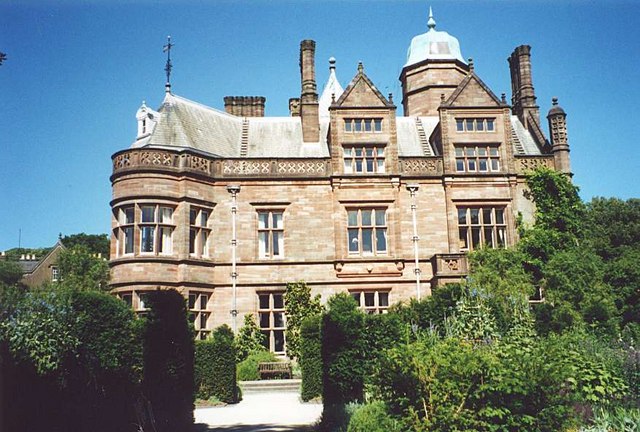
Holker Hall (pronounced Hooker by some) is a privately owned country house located about 2 km to the south-west of the village of Cartmel in the ceremonial county of Cumbria and historic county of Lancashire, England. It is "the grandest [building] of its date in Lancashire ...by the best architects then living in the county." The building dates from the 16th century, with alterations, additions, and rebuilding in the 18th and 19th centuries. The 19th century rebuilding was by George Webster in Jacobean Revival style and subsequent renovations were by E. G. Paley. Hubert Austin had a joint practice with Paley by the 1870s and they both rebuilt the west wing after it was destroyed by a major fire in 1871, only a decade after Paley's previous work on the structure. The fire also destroyed a number of notable artworks. Holker Hall is Paley and Austin's "most important country house commission." The architectural historian Nikolaus Pevsner expressed the opinion that the west wing is the "outstanding domestic work" of Paley and Austin. In 1970 the hall itself, together with its terrace wall, were designated Grade II* Listed buildings. The house stands in an estate of about 80 hectares, and is surrounded by formal gardens, parkland and woodland. Within the grounds are six structures listed at Grade II.
Since becoming a private house following the Dissolution of the Monasteries, the estate has never been sold, having passed by inheritance from the Preston family to the Lowther family, and then to the Cavendish family. The house and grounds are open to the public at advertised times on payment of an admission fee.
In chronostratigraphy, the British sub-stage of the Carboniferous period, the "Holkerian" derives its name from Holker Hall.
The land on which the house stands was originally owned by Cartmel Priory.
Following the Dissolution of the Monasteries in the 16th century it was bought by the Preston family, who were local landowners. The first house was built in the early 16th century by George Preston. In 1644 the estate was confiscated from his successor, Thomas Preston, by Parliament, but was later restored to him. On the death of Thomas Preston, the estate passed to the Lowther family by the marriage of Thomas' heiress, Catherine, to Sir William Lowther, 1st Baronet, of Marske. In 1756 it passed again by marriage to Lord George Augustus Cavendish, and has remained in the ownership of the Cavendish family since.
The Jacobean house was altered in 1783–84 by John Carr of York. The parkland around the house was laid out in the late 18th century.
Additions to the grounds were made during the 19th century and included an arboretum, a conservatory, terraces, and a walled garden. The conservatory was a large structure designed by Joseph Paxton, but has since been demolished.
The house was largely rebuilt in 1838–41 for the 7th Duke of Devonshire by George Webster of Kendal in Jacobean Revival style. In 1859–61 the Lancaster architect E. G. Paley carried out some minor alterations.
Hub AI
Holker Hall AI simulator
(@Holker Hall_simulator)
Holker Hall
Holker Hall (pronounced Hooker by some) is a privately owned country house located about 2 km to the south-west of the village of Cartmel in the ceremonial county of Cumbria and historic county of Lancashire, England. It is "the grandest [building] of its date in Lancashire ...by the best architects then living in the county." The building dates from the 16th century, with alterations, additions, and rebuilding in the 18th and 19th centuries. The 19th century rebuilding was by George Webster in Jacobean Revival style and subsequent renovations were by E. G. Paley. Hubert Austin had a joint practice with Paley by the 1870s and they both rebuilt the west wing after it was destroyed by a major fire in 1871, only a decade after Paley's previous work on the structure. The fire also destroyed a number of notable artworks. Holker Hall is Paley and Austin's "most important country house commission." The architectural historian Nikolaus Pevsner expressed the opinion that the west wing is the "outstanding domestic work" of Paley and Austin. In 1970 the hall itself, together with its terrace wall, were designated Grade II* Listed buildings. The house stands in an estate of about 80 hectares, and is surrounded by formal gardens, parkland and woodland. Within the grounds are six structures listed at Grade II.
Since becoming a private house following the Dissolution of the Monasteries, the estate has never been sold, having passed by inheritance from the Preston family to the Lowther family, and then to the Cavendish family. The house and grounds are open to the public at advertised times on payment of an admission fee.
In chronostratigraphy, the British sub-stage of the Carboniferous period, the "Holkerian" derives its name from Holker Hall.
The land on which the house stands was originally owned by Cartmel Priory.
Following the Dissolution of the Monasteries in the 16th century it was bought by the Preston family, who were local landowners. The first house was built in the early 16th century by George Preston. In 1644 the estate was confiscated from his successor, Thomas Preston, by Parliament, but was later restored to him. On the death of Thomas Preston, the estate passed to the Lowther family by the marriage of Thomas' heiress, Catherine, to Sir William Lowther, 1st Baronet, of Marske. In 1756 it passed again by marriage to Lord George Augustus Cavendish, and has remained in the ownership of the Cavendish family since.
The Jacobean house was altered in 1783–84 by John Carr of York. The parkland around the house was laid out in the late 18th century.
Additions to the grounds were made during the 19th century and included an arboretum, a conservatory, terraces, and a walled garden. The conservatory was a large structure designed by Joseph Paxton, but has since been demolished.
The house was largely rebuilt in 1838–41 for the 7th Duke of Devonshire by George Webster of Kendal in Jacobean Revival style. In 1859–61 the Lancaster architect E. G. Paley carried out some minor alterations.