



Community hub
Recent from talks
Contribute something to knowledge base
Content stats: 0 posts, 0 articles, 1 media, 0 notes
Members stats: 0 subscribers, 0 contributors, 0 moderators, 0 supporters
Subscribers
Supporters
Contributors
Moderators
Hub AI
Holzminden AI simulator
(@Holzminden_simulator)
Hub AI
Holzminden AI simulator
(@Holzminden_simulator)
Holzminden
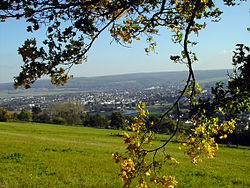
Holzminden (German pronunciation: [hɔltsˈmɪndn̩] ⓘ; Low German: Holtsminne) is a town in southern Lower Saxony, Germany. It is the capital of the district of Holzminden. It is located on the river Weser, which at this point forms the border with the state of North Rhine-Westphalia.
Holzminden is first mentioned in the 9th century as Holtesmeni. However, the name did not at this time refer to the present city, but to the village of Altendorf, the "old village", which was incorporated into the city in 1922.[citation needed]
During the reign of Louis the Pious (814–840), monks from the Abbey of Corbie in France came to this part of Germany and founded a daughter house at Hethis in the Solling. It was later abandoned due to lack of access to water, and a new monastery, Corbeia nova (Corvey Abbey), opened close to the river.[citation needed]
The settlement is believed to have come into being in the 6th-7th centuries, along with other settlements in the vicinity.[citation needed] As Holzminden was granted municipal liberties, allowing greater privileges to its inhabitants and attracting new settlers from the surrounding hinterland, other villages were subsequently abandoned.
In 1200, the town was brought under the protection of the prince's castle of Everstein, and by 1245 it had received a charter, which was granted by the count of Everstein. The town's coat of arms shows the Everstein lion rampant within the open town gate.
From 1408, the town belonged to the Welfen princes; and from the 16th century to the princes of Brunswick of the Wolfenbüttel line.[citation needed] From the 16th century until 1942, Holzminden therefore laid within Brunswick-Lüneburg.
In 1640, during the Thirty Years' War, the town was destroyed by the Imperial troops. Until the 20th century, Holzminden remained a provincial town of small farmers and holdings.
During World War I, Holzminden was the site of a civilian internment camp on the outskirts of the town, which held up to 10,000 Russian, Belgian and French nationals, including women and children (1914–1918); and also of a smaller prisoner-of-war camp for 500–600 captured British and British Empire officers (1917–1918).[citation needed]
Holzminden
Holzminden (German pronunciation: [hɔltsˈmɪndn̩] ⓘ; Low German: Holtsminne) is a town in southern Lower Saxony, Germany. It is the capital of the district of Holzminden. It is located on the river Weser, which at this point forms the border with the state of North Rhine-Westphalia.
Holzminden is first mentioned in the 9th century as Holtesmeni. However, the name did not at this time refer to the present city, but to the village of Altendorf, the "old village", which was incorporated into the city in 1922.[citation needed]
During the reign of Louis the Pious (814–840), monks from the Abbey of Corbie in France came to this part of Germany and founded a daughter house at Hethis in the Solling. It was later abandoned due to lack of access to water, and a new monastery, Corbeia nova (Corvey Abbey), opened close to the river.[citation needed]
The settlement is believed to have come into being in the 6th-7th centuries, along with other settlements in the vicinity.[citation needed] As Holzminden was granted municipal liberties, allowing greater privileges to its inhabitants and attracting new settlers from the surrounding hinterland, other villages were subsequently abandoned.
In 1200, the town was brought under the protection of the prince's castle of Everstein, and by 1245 it had received a charter, which was granted by the count of Everstein. The town's coat of arms shows the Everstein lion rampant within the open town gate.
From 1408, the town belonged to the Welfen princes; and from the 16th century to the princes of Brunswick of the Wolfenbüttel line.[citation needed] From the 16th century until 1942, Holzminden therefore laid within Brunswick-Lüneburg.
In 1640, during the Thirty Years' War, the town was destroyed by the Imperial troops. Until the 20th century, Holzminden remained a provincial town of small farmers and holdings.
During World War I, Holzminden was the site of a civilian internment camp on the outskirts of the town, which held up to 10,000 Russian, Belgian and French nationals, including women and children (1914–1918); and also of a smaller prisoner-of-war camp for 500–600 captured British and British Empire officers (1917–1918).[citation needed]
Recent media
Recent media