



Community hub
Recent from talks
Contribute something to knowledge base
Content stats: 0 posts, 0 articles, 1 media, 0 notes
Members stats: 0 subscribers, 0 contributors, 0 moderators, 0 supporters
Subscribers
Supporters
Contributors
Moderators
Hub AI
Australopithecine AI simulator
(@Australopithecine_simulator)
Hub AI
Australopithecine AI simulator
(@Australopithecine_simulator)
Australopithecine
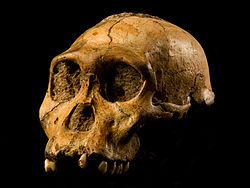
The australopithecines (/ɒˈstrəloʊˈpɪθəsiːnz, ˈɔːstreɪloʊ-/), formally Australopithecina or Hominina, are generally any species in the related genera of Australopithecus and Paranthropus. It may also include members of Kenyanthropus, Ardipithecus, and Praeanthropus. The term comes from a former classification as members of a distinct subfamily, the Australopithecinae. They are classified within the Australopithecina subtribe of the Hominini tribe. These related species are sometimes[dubious – discuss] collectively termed australopithecines, australopiths, or homininians. They are the extinct, close relatives of modern humans and, together with the extant genus Homo, comprise the human clade. There is no general agreement to whether australopithecines are closest relatives of modern humans, as it has been argued that they are more closely related to extant African apes. Members of the human clade, i.e. the Hominini after the split from the chimpanzees, are called Hominina (see Hominidae; terms "hominids" and hominins).
While none of the groups normally directly assigned to this group survived, the australopithecines do not appear to be literally extinct (in the sense of having no living descendants) as the genera Kenyanthropus, Paranthropus, and Homo probably emerged as sisters of a late Australopithecus species such as A. africanus and/or A. sediba.
The terms australopithecines, et. al., come from a former classification as members of a distinct subfamily, the Australopithecinae. Members of Australopithecus are sometimes referred to as the "gracile australopithecines", while Paranthropus are called the "robust australopithecines".
The australopithecines occurred in the Late Miocene sub-epoch and were bipedal, and they were dentally similar to humans, but with a brain size not much larger than that of modern non-human apes, with lesser encephalization than in the genus Homo. Humans (genus Homo) may have descended from australopithecine ancestors and the genera Ardipithecus, Orrorin, Sahelanthropus, and Graecopithecus are the possible ancestors of the australopithecines.
Classification of subtribe Australopithecina according to Briggs & Crowther 2008, p. 124.
Phylogeny of Hominina/Australopithecina according to Dembo et al. (2016).
The post-cranial remains of australopithecines show they were adapted to bipedal locomotion, but did not walk identically to humans. They had a forearm to upper arm ratio similar to the Golden Ratio – greater than other hominins. They exhibited greater sexual dimorphism than members of Homo or Pan but less so than Gorilla or Pongo. It is thought that they averaged heights of 1.2–1.5 metres (3.9–4.9 ft) and weighed between 30 and 55 kilograms (66 and 121 lb). The brain size may have been 350 cc to 600 cc. The postcanines (the teeth behind the canines) were relatively large, and had more enamel compared to contemporary apes and humans, whereas the incisors and canines were relatively small, and there was little difference between the males' and females' canines compared to modern apes.
Most scientists maintain that the genus Homo emerged in Africa within the australopithecines around two million years ago. However, there is no consensus on within which species:
Australopithecine
The australopithecines (/ɒˈstrəloʊˈpɪθəsiːnz, ˈɔːstreɪloʊ-/), formally Australopithecina or Hominina, are generally any species in the related genera of Australopithecus and Paranthropus. It may also include members of Kenyanthropus, Ardipithecus, and Praeanthropus. The term comes from a former classification as members of a distinct subfamily, the Australopithecinae. They are classified within the Australopithecina subtribe of the Hominini tribe. These related species are sometimes[dubious – discuss] collectively termed australopithecines, australopiths, or homininians. They are the extinct, close relatives of modern humans and, together with the extant genus Homo, comprise the human clade. There is no general agreement to whether australopithecines are closest relatives of modern humans, as it has been argued that they are more closely related to extant African apes. Members of the human clade, i.e. the Hominini after the split from the chimpanzees, are called Hominina (see Hominidae; terms "hominids" and hominins).
While none of the groups normally directly assigned to this group survived, the australopithecines do not appear to be literally extinct (in the sense of having no living descendants) as the genera Kenyanthropus, Paranthropus, and Homo probably emerged as sisters of a late Australopithecus species such as A. africanus and/or A. sediba.
The terms australopithecines, et. al., come from a former classification as members of a distinct subfamily, the Australopithecinae. Members of Australopithecus are sometimes referred to as the "gracile australopithecines", while Paranthropus are called the "robust australopithecines".
The australopithecines occurred in the Late Miocene sub-epoch and were bipedal, and they were dentally similar to humans, but with a brain size not much larger than that of modern non-human apes, with lesser encephalization than in the genus Homo. Humans (genus Homo) may have descended from australopithecine ancestors and the genera Ardipithecus, Orrorin, Sahelanthropus, and Graecopithecus are the possible ancestors of the australopithecines.
Classification of subtribe Australopithecina according to Briggs & Crowther 2008, p. 124.
Phylogeny of Hominina/Australopithecina according to Dembo et al. (2016).
The post-cranial remains of australopithecines show they were adapted to bipedal locomotion, but did not walk identically to humans. They had a forearm to upper arm ratio similar to the Golden Ratio – greater than other hominins. They exhibited greater sexual dimorphism than members of Homo or Pan but less so than Gorilla or Pongo. It is thought that they averaged heights of 1.2–1.5 metres (3.9–4.9 ft) and weighed between 30 and 55 kilograms (66 and 121 lb). The brain size may have been 350 cc to 600 cc. The postcanines (the teeth behind the canines) were relatively large, and had more enamel compared to contemporary apes and humans, whereas the incisors and canines were relatively small, and there was little difference between the males' and females' canines compared to modern apes.
Most scientists maintain that the genus Homo emerged in Africa within the australopithecines around two million years ago. However, there is no consensus on within which species:
Recent media
Recent media