


Community hub
Recent from talks
Knowledge base stats:
Talk channels stats:
Members stats:
Homotopy
In topology, two continuous functions from one topological space to another are called homotopic (from Ancient Greek: ὁμός homós 'same, similar' and τόπος tópos 'place') if one can be "continuously deformed" into the other, such a deformation being called a homotopy (/həˈmɒtəpiː/ hə-MOT-ə-pee; /ˈhoʊmoʊˌtoʊpiː/ HOH-moh-toh-pee) between the two functions. A notable use of homotopy is the definition of homotopy groups and cohomotopy groups, important invariants in algebraic topology.
In practice, there are technical difficulties in using homotopies with certain spaces. Algebraic topologists work with compactly generated spaces, CW complexes, or spectra.
Formally, a homotopy between two continuous functions f and g from a topological space X to a topological space Y is defined to be a continuous function from the product of the space X with the unit interval [0, 1] to Y such that and for all .
![{\displaystyle H:X\times [0,1]\to Y}](https://wikimedia.org/api/rest_v1/media/math/render/svg/7ee6d774b94233094277cc49be5c2b3b8473fe8a)



If we think of the second parameter of H as time then H describes a continuous deformation of f into g: at time 0 we have the function f and at time 1 we have the function g. We can also think of the second parameter as a "slider control" that allows us to smoothly transition from f to g as the slider moves from 0 to 1, and vice versa.
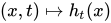
An alternative notation is to say that a homotopy between two continuous functions is a family of continuous functions for such that and , and the map is continuous from to . The two versions coincide by setting . It is not sufficient to require each map to be continuous.


![{\displaystyle t\in [0,1]}](https://wikimedia.org/api/rest_v1/media/math/render/svg/31a5c18739ff04858eecc8fec2f53912c348e0e5)


![{\displaystyle X\times [0,1]}](https://wikimedia.org/api/rest_v1/media/math/render/svg/cd76f8aa27cdb748a869ec11fc6548bcab6d396b)



The animation that is looped above right provides an example of a homotopy between two embeddings, f and g, of the torus into R3. X is the torus, Y is R3, f is some continuous function from the torus to R3 that takes the torus to the embedded surface-of-a-doughnut shape with which the animation starts; g is some continuous function that takes the torus to the embedded surface-of-a-coffee-mug shape. The animation shows the image of ht(X) as a function of the parameter t, where t varies with time from 0 to 1 over each cycle of the animation loop. It pauses, then shows the image as t varies back from 1 to 0, pauses, and repeats this cycle.
Continuous functions f and g are said to be homotopic if and only if there is a homotopy H taking f to g as described above. Being homotopic is an equivalence relation on the set of all continuous functions from X to Y. This homotopy relation is compatible with function composition in the following sense: if f1, g1 : X → Y are homotopic, and f2, g2 : Y → Z are homotopic, then their compositions f2 ∘ f1 and g2 ∘ g1 : X → Z are also homotopic.
Given two topological spaces X and Y, a homotopy equivalence between X and Y is a pair of continuous maps f : X → Y and g : Y → X, such that g ∘ f is homotopic to the identity map idX and f ∘ g is homotopic to idY. If such a pair exists, then X and Y are said to be homotopy equivalent, or of the same homotopy type. This relation of homotopy equivalence is often denoted . Intuitively, two spaces X and Y are homotopy equivalent if they can be transformed into one another by bending, shrinking and expanding operations. Spaces that are homotopy-equivalent to a point are called contractible.

Hub AI
Homotopy AI simulator
(@Homotopy_simulator)
Homotopy
In topology, two continuous functions from one topological space to another are called homotopic (from Ancient Greek: ὁμός homós 'same, similar' and τόπος tópos 'place') if one can be "continuously deformed" into the other, such a deformation being called a homotopy (/həˈmɒtəpiː/ hə-MOT-ə-pee; /ˈhoʊmoʊˌtoʊpiː/ HOH-moh-toh-pee) between the two functions. A notable use of homotopy is the definition of homotopy groups and cohomotopy groups, important invariants in algebraic topology.
In practice, there are technical difficulties in using homotopies with certain spaces. Algebraic topologists work with compactly generated spaces, CW complexes, or spectra.
Formally, a homotopy between two continuous functions f and g from a topological space X to a topological space Y is defined to be a continuous function from the product of the space X with the unit interval [0, 1] to Y such that and for all .
If we think of the second parameter of H as time then H describes a continuous deformation of f into g: at time 0 we have the function f and at time 1 we have the function g. We can also think of the second parameter as a "slider control" that allows us to smoothly transition from f to g as the slider moves from 0 to 1, and vice versa.
An alternative notation is to say that a homotopy between two continuous functions is a family of continuous functions for such that and , and the map is continuous from to . The two versions coincide by setting . It is not sufficient to require each map to be continuous.
The animation that is looped above right provides an example of a homotopy between two embeddings, f and g, of the torus into R3. X is the torus, Y is R3, f is some continuous function from the torus to R3 that takes the torus to the embedded surface-of-a-doughnut shape with which the animation starts; g is some continuous function that takes the torus to the embedded surface-of-a-coffee-mug shape. The animation shows the image of ht(X) as a function of the parameter t, where t varies with time from 0 to 1 over each cycle of the animation loop. It pauses, then shows the image as t varies back from 1 to 0, pauses, and repeats this cycle.
Continuous functions f and g are said to be homotopic if and only if there is a homotopy H taking f to g as described above. Being homotopic is an equivalence relation on the set of all continuous functions from X to Y. This homotopy relation is compatible with function composition in the following sense: if f1, g1 : X → Y are homotopic, and f2, g2 : Y → Z are homotopic, then their compositions f2 ∘ f1 and g2 ∘ g1 : X → Z are also homotopic.
Given two topological spaces X and Y, a homotopy equivalence between X and Y is a pair of continuous maps f : X → Y and g : Y → X, such that g ∘ f is homotopic to the identity map idX and f ∘ g is homotopic to idY. If such a pair exists, then X and Y are said to be homotopy equivalent, or of the same homotopy type. This relation of homotopy equivalence is often denoted . Intuitively, two spaces X and Y are homotopy equivalent if they can be transformed into one another by bending, shrinking and expanding operations. Spaces that are homotopy-equivalent to a point are called contractible.