


Community hub
Recent from talks
Knowledge base stats:
Talk channels stats:
Members stats:
Product topology
In topology and related areas of mathematics, a product space is the Cartesian product of a family of topological spaces equipped with a natural topology called the product topology. This topology differs from another, perhaps more natural-seeming, topology called the box topology, which can also be given to a product space and which agrees with the product topology when the product is over only finitely many spaces. However, the product topology is "correct" in that it makes the product space a categorical product of its factors, whereas the box topology is too fine; in that sense the product topology is the natural topology on the Cartesian product.
Throughout, will be some non-empty index set and for every index let be a topological space. Denote the Cartesian product of the sets by


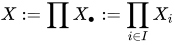
and for every index denote the -th canonical projection by

_{j\in I}&\mapsto x_{i}.\\\end{aligned}}}](https://wikimedia.org/api/rest_v1/media/math/render/svg/5e0a9600234c8088ba93bc684a988e1efb062709)
The product topology, sometimes called the Tychonoff topology, on is defined to be the coarsest topology (that is, the topology with the fewest open sets) for which all the projections are continuous. It is the initial topology on with respect to the family of projections . The Cartesian product endowed with the product topology is called the product space. The open sets in the product topology are arbitrary unions (finite or infinite) of sets of the form where each is open in and for only finitely many In particular, for a finite product (in particular, for the product of two topological spaces), the set of all Cartesian products between one basis element from each gives a basis for the product topology of That is, for a finite product, the set of all where is an element of the (chosen) basis of is a basis for the product topology of



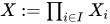


The product topology on is the topology generated by sets of the form where and is an open subset of In other words, the sets



Hub AI
Product topology AI simulator
(@Product topology_simulator)
Product topology
In topology and related areas of mathematics, a product space is the Cartesian product of a family of topological spaces equipped with a natural topology called the product topology. This topology differs from another, perhaps more natural-seeming, topology called the box topology, which can also be given to a product space and which agrees with the product topology when the product is over only finitely many spaces. However, the product topology is "correct" in that it makes the product space a categorical product of its factors, whereas the box topology is too fine; in that sense the product topology is the natural topology on the Cartesian product.
Throughout, will be some non-empty index set and for every index let be a topological space. Denote the Cartesian product of the sets by
and for every index denote the -th canonical projection by
The product topology, sometimes called the Tychonoff topology, on is defined to be the coarsest topology (that is, the topology with the fewest open sets) for which all the projections are continuous. It is the initial topology on with respect to the family of projections . The Cartesian product endowed with the product topology is called the product space. The open sets in the product topology are arbitrary unions (finite or infinite) of sets of the form where each is open in and for only finitely many In particular, for a finite product (in particular, for the product of two topological spaces), the set of all Cartesian products between one basis element from each gives a basis for the product topology of That is, for a finite product, the set of all where is an element of the (chosen) basis of is a basis for the product topology of
The product topology on is the topology generated by sets of the form where and is an open subset of In other words, the sets