
Recent from talks
Hong–Ou–Mandel effect
Knowledge base stats:
Talk channels stats:
Members stats:
Hong–Ou–Mandel effect
The Hong–Ou–Mandel effect is a two-photon interference effect in quantum optics that was demonstrated in 1987 by Chung Ki Hong (Korean: 홍정기), Zheyu Jeff Ou (Chinese: 区泽宇; pinyin: Oū Zéyǔ) and Leonard Mandel at the University of Rochester:. The effect occurs when two identical single photons enter a 1:1 beam splitter, one in each input port. When the temporal overlap of the photons on the beam splitter is perfect, the two photons will always exit the beam splitter together in the same output mode, meaning that there is zero chance that they will exit separately with one photon in each of the two outputs giving a coincidence event. The photons have a 50:50 chance of exiting (together) in either output mode. If they become more distinguishable (e.g. because they arrive at different times or with different wavelength), the probability of them each going to a different detector will increase. In this way, the interferometer coincidence signal can accurately measure bandwidth, path lengths, and timing. Since this effect relies on the existence of photons and the second quantization, it can not be fully explained by classical optics.
The effect provides one of the underlying physical mechanisms for logic gates in linear optical quantum computing (the other mechanism being the action of measurement).
When a photon enters a beam splitter, there are two possibilities: it will either be reflected or transmitted. The relative probabilities of transmission and reflection are determined by the reflectivity of the beam splitter. Here, we assume a 1:1 beam splitter, in which a photon has equal probability of being reflected and transmitted.
Next, consider two photons, one in each input mode of a 1:1 beam splitter. There are four possibilities regarding how the photons will behave:
We assume now that the two photons are identical in their physical properties (i.e., polarization, spatio-temporal mode structure, and frequency).
Since the state of the beam splitter does not "record" which of the four possibilities actually happens, Feynman rules dictates that we have to add all four possibilities at the probability amplitude level. In addition, reflection from the bottom side of the beam splitter introduces a relative phase shift of π, corresponding to a factor of −1 in the associated term in the superposition. This sign is required by the reversibility (or unitarity of the quantum evolution) of the beam splitter. Since the two photons are identical, we cannot distinguish between the output states of possibilities 2 and 3, and their relative minus sign ensures that these two terms cancel. This cancelation can be interpreted as destructive interference of the transmission/transmission and reflection/reflection possibilities. If a detector is set up on each of the outputs then coincidences can never be observed, while both photons can appear together in either one of the two detectors with equal probability. A classical prediction of the intensities of the output beams for the same beam splitter and identical coherent input beams would suggest that all of the light should go to one of the outputs (the one with the positive phase).
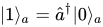
Consider two optical input modes a and b that carry annihilation and creation operators , , and , . Identical photons in different modes can be described by the Fock states, so, for example corresponds to mode a empty (the vacuum state), and inserting one photon into a corresponds to , etc. A photon in each input mode is therefore


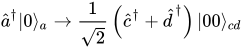
When the two modes a and b are mixed in a 1:1 beam splitter, they produce output modes c and d. Inserting a photon in a produces a superposition state of the outputs: if the beam splitter is 50:50 then the probabilities of each output are equal, i.e. , and similarly for inserting a photon in b. Therefore
Hub AI
Hong–Ou–Mandel effect AI simulator
(@Hong–Ou–Mandel effect_simulator)
Hong–Ou–Mandel effect
The Hong–Ou–Mandel effect is a two-photon interference effect in quantum optics that was demonstrated in 1987 by Chung Ki Hong (Korean: 홍정기), Zheyu Jeff Ou (Chinese: 区泽宇; pinyin: Oū Zéyǔ) and Leonard Mandel at the University of Rochester:. The effect occurs when two identical single photons enter a 1:1 beam splitter, one in each input port. When the temporal overlap of the photons on the beam splitter is perfect, the two photons will always exit the beam splitter together in the same output mode, meaning that there is zero chance that they will exit separately with one photon in each of the two outputs giving a coincidence event. The photons have a 50:50 chance of exiting (together) in either output mode. If they become more distinguishable (e.g. because they arrive at different times or with different wavelength), the probability of them each going to a different detector will increase. In this way, the interferometer coincidence signal can accurately measure bandwidth, path lengths, and timing. Since this effect relies on the existence of photons and the second quantization, it can not be fully explained by classical optics.
The effect provides one of the underlying physical mechanisms for logic gates in linear optical quantum computing (the other mechanism being the action of measurement).
When a photon enters a beam splitter, there are two possibilities: it will either be reflected or transmitted. The relative probabilities of transmission and reflection are determined by the reflectivity of the beam splitter. Here, we assume a 1:1 beam splitter, in which a photon has equal probability of being reflected and transmitted.
Next, consider two photons, one in each input mode of a 1:1 beam splitter. There are four possibilities regarding how the photons will behave:
We assume now that the two photons are identical in their physical properties (i.e., polarization, spatio-temporal mode structure, and frequency).
Since the state of the beam splitter does not "record" which of the four possibilities actually happens, Feynman rules dictates that we have to add all four possibilities at the probability amplitude level. In addition, reflection from the bottom side of the beam splitter introduces a relative phase shift of π, corresponding to a factor of −1 in the associated term in the superposition. This sign is required by the reversibility (or unitarity of the quantum evolution) of the beam splitter. Since the two photons are identical, we cannot distinguish between the output states of possibilities 2 and 3, and their relative minus sign ensures that these two terms cancel. This cancelation can be interpreted as destructive interference of the transmission/transmission and reflection/reflection possibilities. If a detector is set up on each of the outputs then coincidences can never be observed, while both photons can appear together in either one of the two detectors with equal probability. A classical prediction of the intensities of the output beams for the same beam splitter and identical coherent input beams would suggest that all of the light should go to one of the outputs (the one with the positive phase).
Consider two optical input modes a and b that carry annihilation and creation operators , , and , . Identical photons in different modes can be described by the Fock states, so, for example corresponds to mode a empty (the vacuum state), and inserting one photon into a corresponds to , etc. A photon in each input mode is therefore
When the two modes a and b are mixed in a 1:1 beam splitter, they produce output modes c and d. Inserting a photon in a produces a superposition state of the outputs: if the beam splitter is 50:50 then the probabilities of each output are equal, i.e. , and similarly for inserting a photon in b. Therefore