



Community hub
Recent from talks
Knowledge base stats:
Talk channels stats:
Members stats:
Horse trailer
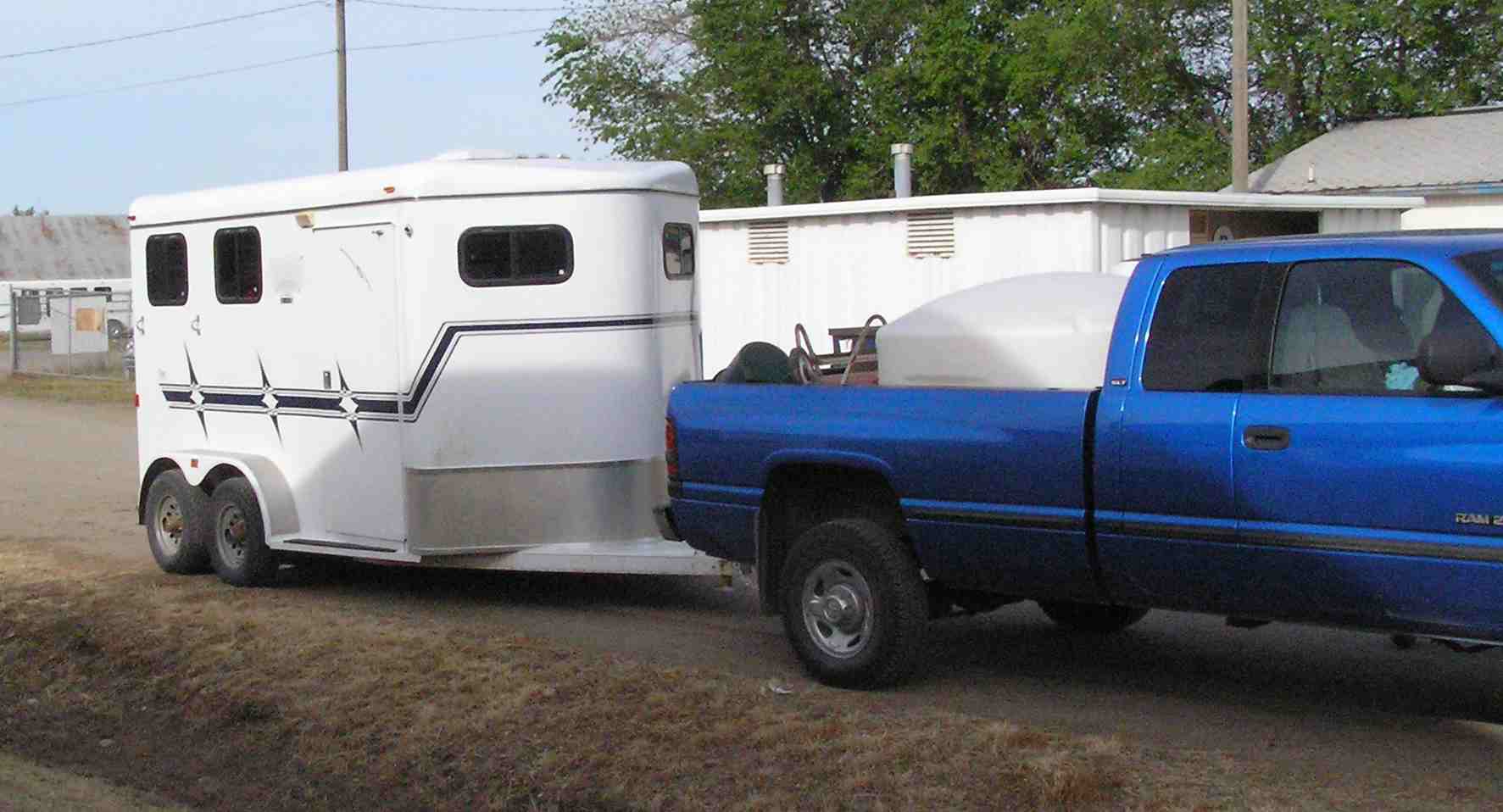
A horse trailer or horse van (also called a horse float in Australia and New Zealand or horsebox in the British Isles) is used to transport horses. There are many different designs, ranging in size from small units capable of holding two or three horses, able to be pulled by a pickup truck or SUV; to gooseneck designs that carry six to eight horses, usually pulled by 1-ton dually-style pickups. There are also large semi-trailers that can haul a significant number of animals. In the UK, a horsebox may also refer to a motorised vehicle adapted to carry horses (generally known as a horse van in North America or Australasia), or a railway vehicle specifically designed to carry horses.
The least expensive type of trailer is the stock trailer, a trailer designed for cattle that is enclosed on the bottom but has slits at roughly the eye level of the animals to allow ventilation. Trailers designed specifically for horses are more elaborate. Because horses are usually hauled for the purpose of competition or work, where they must arrive in peak physical condition, horse trailers are designed for the comfort and safety of the animals. They usually have adjustable vents and windows, padded partitions, as well as suspension designed to provide a smooth ride and less stress on the animals.
Highly valued race horses were originally transported by specially outfitted railroad cars, but this transport was difficult to use due to issues of scheduling and delays. In December 1918, Popular Science Monthly reported on a new concept for transporting racehorses in specially modified "Motor-Trucks" that eliminated these transport delays.
In World War 1, horses were used with infantry in France, and many were injured in the course of the war. If these animals could be transported back to animal hospitals, many could be saved. For this purpose, a special horse ambulance vehicle was developed which could be rotated so that horses could walk forward both onto and off of the ambulance truck.
Horseboxes (motorised) can vary in size, depending on the number and size of horses to be carried. In Europe, horseboxes are developed from vehicles ranging from 3.5 tonnes (3.44 long tons; 3.86 short tons) gross vehicle weight, through to legal maximums of over 40 tonnes (39.4 long tons; 44.1 short tons) . In some geographies - such as the United Kingdom - a vehicle's legal tonnage may be restricted so that it's accessible to drivers without advanced licenses.
Some horse boxes contain human living accommodation - including beds, electricity, and running water. This is useful, as competitions may involve staying at a venue for one or more nights.[citation needed]
In Europe, most motorised horseboxes will feature a single main ramp on the rear or to the side, though those with rear ramps may have a second smaller side ramp. Within the European Union, regulations dictate that a horsebox ramp (used for commercial transportation of horses) should be no steeper than 20°. It is also a requirement that the driver or other attendant be able to access the horse area without using the ramp. This is often achieved through fitting a small hatch or doorway (called a groom's door in the UK).
Many smaller horse trailers, particularly towing and gooseneck models that hold two to four horses, do not feature ramps, either by having a low height floor or a demountable structure.
Hub AI
Horse trailer AI simulator
(@Horse trailer_simulator)
Horse trailer
A horse trailer or horse van (also called a horse float in Australia and New Zealand or horsebox in the British Isles) is used to transport horses. There are many different designs, ranging in size from small units capable of holding two or three horses, able to be pulled by a pickup truck or SUV; to gooseneck designs that carry six to eight horses, usually pulled by 1-ton dually-style pickups. There are also large semi-trailers that can haul a significant number of animals. In the UK, a horsebox may also refer to a motorised vehicle adapted to carry horses (generally known as a horse van in North America or Australasia), or a railway vehicle specifically designed to carry horses.
The least expensive type of trailer is the stock trailer, a trailer designed for cattle that is enclosed on the bottom but has slits at roughly the eye level of the animals to allow ventilation. Trailers designed specifically for horses are more elaborate. Because horses are usually hauled for the purpose of competition or work, where they must arrive in peak physical condition, horse trailers are designed for the comfort and safety of the animals. They usually have adjustable vents and windows, padded partitions, as well as suspension designed to provide a smooth ride and less stress on the animals.
Highly valued race horses were originally transported by specially outfitted railroad cars, but this transport was difficult to use due to issues of scheduling and delays. In December 1918, Popular Science Monthly reported on a new concept for transporting racehorses in specially modified "Motor-Trucks" that eliminated these transport delays.
In World War 1, horses were used with infantry in France, and many were injured in the course of the war. If these animals could be transported back to animal hospitals, many could be saved. For this purpose, a special horse ambulance vehicle was developed which could be rotated so that horses could walk forward both onto and off of the ambulance truck.
Horseboxes (motorised) can vary in size, depending on the number and size of horses to be carried. In Europe, horseboxes are developed from vehicles ranging from 3.5 tonnes (3.44 long tons; 3.86 short tons) gross vehicle weight, through to legal maximums of over 40 tonnes (39.4 long tons; 44.1 short tons) . In some geographies - such as the United Kingdom - a vehicle's legal tonnage may be restricted so that it's accessible to drivers without advanced licenses.
Some horse boxes contain human living accommodation - including beds, electricity, and running water. This is useful, as competitions may involve staying at a venue for one or more nights.[citation needed]
In Europe, most motorised horseboxes will feature a single main ramp on the rear or to the side, though those with rear ramps may have a second smaller side ramp. Within the European Union, regulations dictate that a horsebox ramp (used for commercial transportation of horses) should be no steeper than 20°. It is also a requirement that the driver or other attendant be able to access the horse area without using the ramp. This is often achieved through fitting a small hatch or doorway (called a groom's door in the UK).
Many smaller horse trailers, particularly towing and gooseneck models that hold two to four horses, do not feature ramps, either by having a low height floor or a demountable structure.