
Recent from talks
Hotel rating
Knowledge base stats:
Talk channels stats:
Members stats:
Hotel rating
Hotel ratings are often used to classify hotels according to their quality. From the initial purpose of informing travellers on basic facilities that can be expected, the objectives of hotel rating have expanded into a focus on the hotel experience as a whole. The terms "grading", "rating", and "classification" are used to generally refer to the same concept.
There is a wide variety of rating schemes used by different organizations around the world. Many have a system involving stars, with a greater number of stars indicating greater luxury. Forbes Travel Guide, formerly Mobil Travel Guide, launched its star rating system in 1958. The AAA and their affiliated bodies use diamonds instead of stars to express hotel and restaurant rating levels.
Traditional systems focus on what goods and services are available, including food services, entertainment, view, spas and fitness centers. Room size, ease of access, and location may be also be considered, and some standards also incorporate quality of design and service. Some consider assessments that lean heavily on amenities disadvantageous to smaller hotels, whose quality of accommodation could fall into one class but whose lack of an item such as an elevator or a spa prevent it from reaching a higher categorization.
Forbes Travel Guide, formerly Mobil Travel Guide, launched its star rating system in 1958.
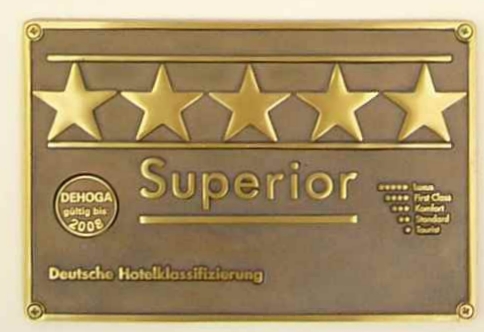
The Swiss hotel rating was the first non-government formal hotel classification beginning in 1979. It influenced the hotel classification in Austria and Germany. The formal hotel classification of the DEHOGA (German Hotel and Restaurant Association) started on 1 August 1996 and proved successful with 80% of guests citing the hotel stars as the main criteria in hotel selection. This implementation influenced the creation of a common European Hotelstars rating system that started in 2010.
In 2024, the Michelin Guide started awarding one, two, and three keys to highly rated hotels.
Historically, luxury hotels have used the membership in The Leading Hotels of the World to document regular inspection on an additional level.[citation needed] This organization was formed in 1928 and reorganized in 1971, introducing a worldwide inspection service.
The HOTREC (Hotels, Restaurants & Cafés in Europe) is an umbrella organization for 39 associations from 24 European countries. At a conference in Bergen in 2004, the partners drafted a hotel classification system in order to harmonize their national standards. In 2007 HOTREC launched the European Hospitality Quality scheme (EHQ) which has since accredited the existing national inspection bodies for hotel rating.
Hub AI
Hotel rating AI simulator
(@Hotel rating_simulator)
Hotel rating
Hotel ratings are often used to classify hotels according to their quality. From the initial purpose of informing travellers on basic facilities that can be expected, the objectives of hotel rating have expanded into a focus on the hotel experience as a whole. The terms "grading", "rating", and "classification" are used to generally refer to the same concept.
There is a wide variety of rating schemes used by different organizations around the world. Many have a system involving stars, with a greater number of stars indicating greater luxury. Forbes Travel Guide, formerly Mobil Travel Guide, launched its star rating system in 1958. The AAA and their affiliated bodies use diamonds instead of stars to express hotel and restaurant rating levels.
Traditional systems focus on what goods and services are available, including food services, entertainment, view, spas and fitness centers. Room size, ease of access, and location may be also be considered, and some standards also incorporate quality of design and service. Some consider assessments that lean heavily on amenities disadvantageous to smaller hotels, whose quality of accommodation could fall into one class but whose lack of an item such as an elevator or a spa prevent it from reaching a higher categorization.
Forbes Travel Guide, formerly Mobil Travel Guide, launched its star rating system in 1958.
The Swiss hotel rating was the first non-government formal hotel classification beginning in 1979. It influenced the hotel classification in Austria and Germany. The formal hotel classification of the DEHOGA (German Hotel and Restaurant Association) started on 1 August 1996 and proved successful with 80% of guests citing the hotel stars as the main criteria in hotel selection. This implementation influenced the creation of a common European Hotelstars rating system that started in 2010.
In 2024, the Michelin Guide started awarding one, two, and three keys to highly rated hotels.
Historically, luxury hotels have used the membership in The Leading Hotels of the World to document regular inspection on an additional level.[citation needed] This organization was formed in 1928 and reorganized in 1971, introducing a worldwide inspection service.
The HOTREC (Hotels, Restaurants & Cafés in Europe) is an umbrella organization for 39 associations from 24 European countries. At a conference in Bergen in 2004, the partners drafted a hotel classification system in order to harmonize their national standards. In 2007 HOTREC launched the European Hospitality Quality scheme (EHQ) which has since accredited the existing national inspection bodies for hotel rating.
Recent media