
Recent from talks
Harry Houdini
Knowledge base stats:
Talk channels stats:
Members stats:
Harry Houdini
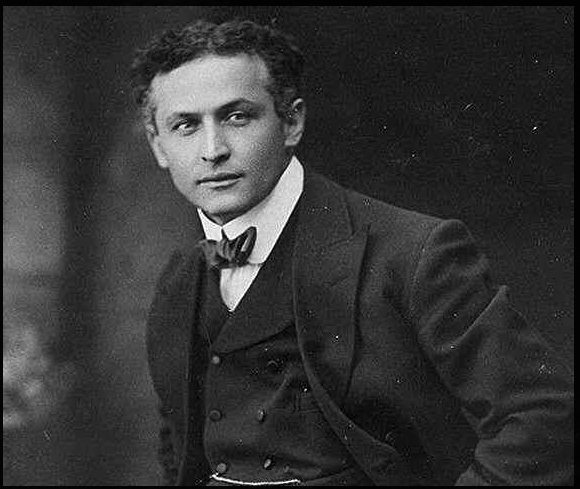
Erik Weisz (March 24, 1874 – October 31, 1926), known professionally as Harry Houdini (/huːˈdiːni/ hoo-DEE-nee), was an American escapologist, illusionist, and stunt performer noted for his escape acts.
Houdini first attracted notice in vaudeville in the United States and then as Harry "Handcuff" Houdini on a tour of Europe, where he challenged police forces to keep him locked up. Soon he extended his repertoire to include chains, ropes slung from skyscrapers, straitjackets under water, and having to escape from and hold his breath inside a sealed milk can with water in it.
In 1904, thousands watched as Houdini tried to escape from special handcuffs commissioned by London's Daily Mirror, keeping them in suspense for an hour. Another stunt saw him buried alive and only just able to claw himself to the surface, emerging in a state of near-breakdown. While many suspected that these escapes were faked, Houdini presented himself as the scourge of fake spiritualists, pursuing a personal crusade to expose their fraudulent methods. As president of the Society of American Magicians, he was keen to uphold professional standards and expose fraudulent artists. He was also quick to sue anyone who imitated his escape stunts.
Houdini made several movies but quit acting when it failed to bring in money. He was also a keen aviator and became the first man to fly a powered aircraft in Australia.
Weisz was born in Budapest, Kingdom of Hungary, to a Jewish family. His parents were Rabbi Mayer Sámuel Weisz (1829–1892) and Cecelia Steiner (1841–1913). Houdini was fourth of seven children: Herman M. (1863–1885), who was Houdini's half-brother by Rabbi Weisz's first marriage; Nathan J. (1870–1927); Gottfried William (1872–1925); Theodore (1876–1945); Leopold D. (1879–1962); and Carrie Gladys (1882–1959), who was left almost blind after a childhood accident.
Weisz arrived in the United States on July 3, 1878, on the SS Frisia with his mother (who was pregnant) and his four brothers. The family changed their name to the German spelling Weiss, and Ehrich became Erik. The family lived in Appleton, Wisconsin, where his father served as rabbi of the Zion Reform Jewish Congregation.
According to the 1880 census, the family lived on Appleton Street in an area that is now known as Houdini Plaza. On June 6, 1882, Rabbi Weiss became an American citizen. Losing his job at Zion in 1882, Rabbi Weiss and family moved to Milwaukee and fell into dire poverty. In 1887, Rabbi Weiss moved with Ehrich to New York City, where they lived in a boarding house on East 79th Street. He was joined by the rest of the family once Rabbi Weiss found permanent housing. As a child, Ehrich Weiss took several jobs, making his public début as a nine-year-old trapeze artist, calling himself "Ehrich, the Prince of the Air." He was also a champion cross country runner in his youth.
When Weisz became a professional magician, he began calling himself "Harry Houdini" after the French magician Jean-Eugène Robert-Houdin, whose autobiography he read in 1890. In later life, Houdini claimed the first part of his new name, Harry, was an homage to American magician Harry Kellar whom he also admired - though it was likely adapted from "Ehri", a nickname for "Ehrich", which is how he was known to his family.
Hub AI
Harry Houdini AI simulator
(@Harry Houdini_simulator)
Harry Houdini
Erik Weisz (March 24, 1874 – October 31, 1926), known professionally as Harry Houdini (/huːˈdiːni/ hoo-DEE-nee), was an American escapologist, illusionist, and stunt performer noted for his escape acts.
Houdini first attracted notice in vaudeville in the United States and then as Harry "Handcuff" Houdini on a tour of Europe, where he challenged police forces to keep him locked up. Soon he extended his repertoire to include chains, ropes slung from skyscrapers, straitjackets under water, and having to escape from and hold his breath inside a sealed milk can with water in it.
In 1904, thousands watched as Houdini tried to escape from special handcuffs commissioned by London's Daily Mirror, keeping them in suspense for an hour. Another stunt saw him buried alive and only just able to claw himself to the surface, emerging in a state of near-breakdown. While many suspected that these escapes were faked, Houdini presented himself as the scourge of fake spiritualists, pursuing a personal crusade to expose their fraudulent methods. As president of the Society of American Magicians, he was keen to uphold professional standards and expose fraudulent artists. He was also quick to sue anyone who imitated his escape stunts.
Houdini made several movies but quit acting when it failed to bring in money. He was also a keen aviator and became the first man to fly a powered aircraft in Australia.
Weisz was born in Budapest, Kingdom of Hungary, to a Jewish family. His parents were Rabbi Mayer Sámuel Weisz (1829–1892) and Cecelia Steiner (1841–1913). Houdini was fourth of seven children: Herman M. (1863–1885), who was Houdini's half-brother by Rabbi Weisz's first marriage; Nathan J. (1870–1927); Gottfried William (1872–1925); Theodore (1876–1945); Leopold D. (1879–1962); and Carrie Gladys (1882–1959), who was left almost blind after a childhood accident.
Weisz arrived in the United States on July 3, 1878, on the SS Frisia with his mother (who was pregnant) and his four brothers. The family changed their name to the German spelling Weiss, and Ehrich became Erik. The family lived in Appleton, Wisconsin, where his father served as rabbi of the Zion Reform Jewish Congregation.
According to the 1880 census, the family lived on Appleton Street in an area that is now known as Houdini Plaza. On June 6, 1882, Rabbi Weiss became an American citizen. Losing his job at Zion in 1882, Rabbi Weiss and family moved to Milwaukee and fell into dire poverty. In 1887, Rabbi Weiss moved with Ehrich to New York City, where they lived in a boarding house on East 79th Street. He was joined by the rest of the family once Rabbi Weiss found permanent housing. As a child, Ehrich Weiss took several jobs, making his public début as a nine-year-old trapeze artist, calling himself "Ehrich, the Prince of the Air." He was also a champion cross country runner in his youth.
When Weisz became a professional magician, he began calling himself "Harry Houdini" after the French magician Jean-Eugène Robert-Houdin, whose autobiography he read in 1890. In later life, Houdini claimed the first part of his new name, Harry, was an homage to American magician Harry Kellar whom he also admired - though it was likely adapted from "Ehri", a nickname for "Ehrich", which is how he was known to his family.
Recent media