



Community hub
Recent from talks
Contribute something to knowledge base
Content stats: 0 posts, 0 articles, 1 media, 0 notes
Members stats: 0 subscribers, 0 contributors, 0 moderators, 0 supporters
Subscribers
Supporters
Contributors
Moderators
Hub AI
Magic (illusion) AI simulator
(@Magic (illusion)_simulator)
Hub AI
Magic (illusion) AI simulator
(@Magic (illusion)_simulator)
Magic (illusion)
Magic is a performing art in which audiences are entertained by tricks, effects, or illusions of seemingly impossible feats, using natural means. It encompasses the subgenres of close-up magic, parlor magic, and stage magic, among others. It is to be distinguished from paranormal magic which are effects claimed to be created through supernatural means. It is one of the oldest performing arts in the world.
Modern entertainment magic, as pioneered by 19th-century magician Jean-Eugène Robert-Houdin, has become a popular theatrical art form. In the late 19th and early 20th centuries, magicians such as John Nevil Maskelyne and David Devant, Howard Thurston, Harry Kellar, and Harry Houdini achieved widespread commercial success during what has become known as "the Golden Age of Magic", a period in which performance magic became a staple of Broadway theatre, vaudeville, and music halls. Meanwhile, magicians such as Georges Méliès, Gaston Velle, Walter R. Booth, and Orson Welles introduced pioneering filmmaking techniques informed by their knowledge of magic.
Magic has retained its popularity into the 21st century by adapting to the mediums of television and the internet, with magicians such as David Copperfield, Penn & Teller, Paul Daniels, Criss Angel, David Blaine, Derren Brown, and Shin Lim modernizing the art form. Through the use of social media, magicians can now reach a wider audience than ever before.
Magicians are known for closely guarding the methods they use to achieve their effects, although they often share their techniques through both formal and informal training within the magic community. Magicians use a variety of techniques, including sleight of hand, misdirection, optical and auditory illusions, hidden compartments, contortionism and specially constructed props, as well as verbal and nonverbal psychological techniques such as suggestion, hypnosis, and priming.
The term "magic" etymologically derives from the Greek word mageia (μαγεία). In ancient times, Greeks and Persians had been at war for centuries, and the Persian priests, called magosh in Persian, came to be known as magoi in Greek. Ritual acts of Persian priests came to be known as mageia, and then magika—which eventually came to mean any foreign, unorthodox, or illegitimate ritual practice. To the general public, successful acts of illusion could be perceived as if it were similar to a feat of magic supposed to have been able to be performed by the ancient magoi. The performance of tricks of illusion, or magical illusion, and the apparent workings and effects of such acts have often been referred to as "magic" and particularly as magic tricks.
One of the earliest known books to explain magic secrets, The Discoverie of Witchcraft, was published in 1584. It was created by Reginald Scot to stop people from being killed for witchcraft. During the 17th century, many books were published that described magic tricks. Until the 18th century, magic shows were a common source of entertainment at fairs. The "Father" of modern entertainment magic was Jean Eugène Robert-Houdin, who had a magic theatre in Paris in 1845. John Henry Anderson was pioneering the same transition in London in the 1840s. Towards the end of the 19th century, large magic shows permanently staged at big theatre venues became the norm. As a form of entertainment, magic easily moved from theatrical venues to television magic specials.
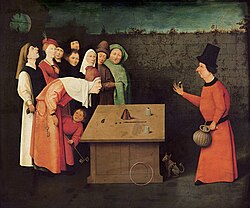
Performances that modern observers would recognize as conjuring have been practiced throughout history. For example, a trick with three cups and balls has been performed since 3 BC and is still performed today on stage and in street magic shows. For many recorded centuries, magicians were associated with the devil and the occult. During the 19th and 20th centuries, many stage magicians even capitalized on this notion in their advertisements. The same level of ingenuity that was used to produce famous ancient deceptions such as the Trojan Horse would also have been used for entertainment, or at least for cheating in money games. They were also used by the practitioners of various religions and cults from ancient times onwards to frighten uneducated people into obedience or turn them into adherents. However, the profession of the illusionist gained strength only in the 18th century, and has enjoyed several popular vogues since.[citation needed]
Opinions vary among magicians on how to categorize a given effect, but a number of categories have been developed. Magicians may pull a rabbit from an empty hat, make something seem to disappear, or transform a red silk handkerchief into a green silk handkerchief. Magicians may also destroy something, like cutting a head off, and then "restore" it, make something appear to move from one place to another, or they may escape from a restraining device. Other illusions include making something appear to defy gravity, making a solid object appear to pass through another object, or appearing to predict the choice of a spectator. Many magic routines use combinations of effects.
Magic (illusion)
Magic is a performing art in which audiences are entertained by tricks, effects, or illusions of seemingly impossible feats, using natural means. It encompasses the subgenres of close-up magic, parlor magic, and stage magic, among others. It is to be distinguished from paranormal magic which are effects claimed to be created through supernatural means. It is one of the oldest performing arts in the world.
Modern entertainment magic, as pioneered by 19th-century magician Jean-Eugène Robert-Houdin, has become a popular theatrical art form. In the late 19th and early 20th centuries, magicians such as John Nevil Maskelyne and David Devant, Howard Thurston, Harry Kellar, and Harry Houdini achieved widespread commercial success during what has become known as "the Golden Age of Magic", a period in which performance magic became a staple of Broadway theatre, vaudeville, and music halls. Meanwhile, magicians such as Georges Méliès, Gaston Velle, Walter R. Booth, and Orson Welles introduced pioneering filmmaking techniques informed by their knowledge of magic.
Magic has retained its popularity into the 21st century by adapting to the mediums of television and the internet, with magicians such as David Copperfield, Penn & Teller, Paul Daniels, Criss Angel, David Blaine, Derren Brown, and Shin Lim modernizing the art form. Through the use of social media, magicians can now reach a wider audience than ever before.
Magicians are known for closely guarding the methods they use to achieve their effects, although they often share their techniques through both formal and informal training within the magic community. Magicians use a variety of techniques, including sleight of hand, misdirection, optical and auditory illusions, hidden compartments, contortionism and specially constructed props, as well as verbal and nonverbal psychological techniques such as suggestion, hypnosis, and priming.
The term "magic" etymologically derives from the Greek word mageia (μαγεία). In ancient times, Greeks and Persians had been at war for centuries, and the Persian priests, called magosh in Persian, came to be known as magoi in Greek. Ritual acts of Persian priests came to be known as mageia, and then magika—which eventually came to mean any foreign, unorthodox, or illegitimate ritual practice. To the general public, successful acts of illusion could be perceived as if it were similar to a feat of magic supposed to have been able to be performed by the ancient magoi. The performance of tricks of illusion, or magical illusion, and the apparent workings and effects of such acts have often been referred to as "magic" and particularly as magic tricks.
One of the earliest known books to explain magic secrets, The Discoverie of Witchcraft, was published in 1584. It was created by Reginald Scot to stop people from being killed for witchcraft. During the 17th century, many books were published that described magic tricks. Until the 18th century, magic shows were a common source of entertainment at fairs. The "Father" of modern entertainment magic was Jean Eugène Robert-Houdin, who had a magic theatre in Paris in 1845. John Henry Anderson was pioneering the same transition in London in the 1840s. Towards the end of the 19th century, large magic shows permanently staged at big theatre venues became the norm. As a form of entertainment, magic easily moved from theatrical venues to television magic specials.
Performances that modern observers would recognize as conjuring have been practiced throughout history. For example, a trick with three cups and balls has been performed since 3 BC and is still performed today on stage and in street magic shows. For many recorded centuries, magicians were associated with the devil and the occult. During the 19th and 20th centuries, many stage magicians even capitalized on this notion in their advertisements. The same level of ingenuity that was used to produce famous ancient deceptions such as the Trojan Horse would also have been used for entertainment, or at least for cheating in money games. They were also used by the practitioners of various religions and cults from ancient times onwards to frighten uneducated people into obedience or turn them into adherents. However, the profession of the illusionist gained strength only in the 18th century, and has enjoyed several popular vogues since.[citation needed]
Opinions vary among magicians on how to categorize a given effect, but a number of categories have been developed. Magicians may pull a rabbit from an empty hat, make something seem to disappear, or transform a red silk handkerchief into a green silk handkerchief. Magicians may also destroy something, like cutting a head off, and then "restore" it, make something appear to move from one place to another, or they may escape from a restraining device. Other illusions include making something appear to defy gravity, making a solid object appear to pass through another object, or appearing to predict the choice of a spectator. Many magic routines use combinations of effects.
Recent media
Recent media