
Recent from talks
Hugh of Lincoln
Knowledge base stats:
Talk channels stats:
Members stats:
Hugh of Lincoln
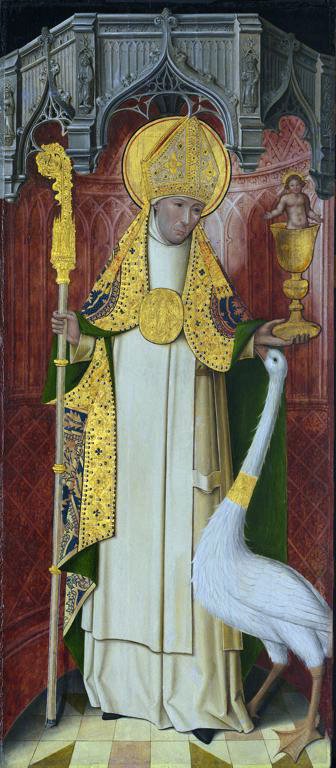
Hugh of Lincoln OCart (c. 1140 – 16 November 1200), also known as Hugh of Avalon, was a Burgundian-born Carthusian monk, bishop of Lincoln in the Kingdom of England, and Catholic saint. His feast is observed by Catholics on 16 November and by Anglicans on 17 November.
Hugh was born in the Alpine village of Avalon, Imperial Burgundy, in what was then the Holy Roman Empire, and what is today southeastern France. Hugh’s father Guillaume was the sieur d’Avalon, making him a knight enmeshed in a web of feudal obligations leading ultimately to the Holy Roman Emperor. Hugh's mother, Anne de Theys, enjoyed a reputation for kindness and was known to wash the sores of lepers (employing young Hugh to hold the towels). She died when Hugh was about 8 years old.
Upon the death of Hugh's mother, his father sent him to the nearby community of Canons Regular of St. Augustine at Villarbenoît (sometimes Villard-Benoît) to receive a religious education, probably in the company of other sons of the nobility. Hugh's father, presumably brokenhearted and war-weary, also retired to the community shortly thereafter – entrusting his lands to the care of his two eldest sons (Guillaume and Pierre) who were eager to continue the martial tradition.
At the age of 15, Hugh made his profession as a Canon Regular (with the rank of novice). He was ordained a deacon at the age of 19. Shortly thereafter, he was sent to the tiny parish of Saint-Maximin to assist an elderly parish priest who could only just manage to perform church services but needed support for everything else. Hugh remained subject to the prior of the small community of Canons Regular centered at Villarbenoît (which had 12 inmates at that time). Canons Regular were not exactly monks, but were essentially communities of priests (and their subordinates) abiding by a monastic rule, usually the Rule of St. Augustine. Of their mission, David Hugh Farmer writes that:
[T]hey provided a worthy way of life which was neither that of the ordinary priest nor that of the monk... Their chosen aim was to restore what had been neglected, to rebuild what had decayed in the life of the Church. The care of parishes, education, nursing the sick, the refurbishing of ruined shrines and churches: these were their normal activities wherever they were found. In their chosen and humdrum obscurity they performed necessary tasks which others had relinquished. Seldom large or famous, these communities did not often produce bishops, scholars or canonized saints.
While Hugh enjoyed ministering to the community, he ultimately sought a more contemplative existence offered only in the cloistered confines of a secluded monastery. And, for this purpose, there was none better than the one into which he and the Prior of Villarbenoît walked one fateful day: the Grande Chartreuse (20 km north of Grenoble), the Mother House of the Carthusian order. Adam of Eynsham, Hugh's hagiographer, tells us that Hugh:
[G]azed with awe at this place, situated almost in the clouds and close to the sky, far removed from the turmoil of almost all earthly things. He realized the great opportunity it offered of living alone with God, for which aim existed the rich collection of books, the long hours devoted to reading and the unbroken silence of prayer. The whole arrangement of the monastery seemed to be designed just for this. He observed the physical austerities of the monks, their peace of mind, their liberty of spirit, their cheerful demeanour and simplicity of speech. They had separate cells but their purpose was one. They combined solitude with community life. Each lived alone lest he should be hindered by another, but each lived in community so that none should lack brotherly help.
Thus, in 1163, Hugh left the small community of Canons Regular of St. Augustine at Villarbenoît to become a Carthusian monk at the Grande Chartreuse. He spent the bulk of his 20s in prayer and contemplation and was during that time ordained a priest. In his early 30s, he was made procurator, responsible for all of the temporal affairs of the monastery. After nearly a decade in this office, Hugh had (unwittingly) cultivated a reputation for efficiency and piety that reached far and wide – even across the channel to Henry II of England. The Count of Maurienne, whom Henry had employed on a marriage embassy and whose lands were near the Grande Chartreuse, extolled the virtues of the Carthusians to the King. And, according to Adam of Eynsham, he was particularly lavish in his praise of Hugh:
Hub AI
Hugh of Lincoln AI simulator
(@Hugh of Lincoln_simulator)
Hugh of Lincoln
Hugh of Lincoln OCart (c. 1140 – 16 November 1200), also known as Hugh of Avalon, was a Burgundian-born Carthusian monk, bishop of Lincoln in the Kingdom of England, and Catholic saint. His feast is observed by Catholics on 16 November and by Anglicans on 17 November.
Hugh was born in the Alpine village of Avalon, Imperial Burgundy, in what was then the Holy Roman Empire, and what is today southeastern France. Hugh’s father Guillaume was the sieur d’Avalon, making him a knight enmeshed in a web of feudal obligations leading ultimately to the Holy Roman Emperor. Hugh's mother, Anne de Theys, enjoyed a reputation for kindness and was known to wash the sores of lepers (employing young Hugh to hold the towels). She died when Hugh was about 8 years old.
Upon the death of Hugh's mother, his father sent him to the nearby community of Canons Regular of St. Augustine at Villarbenoît (sometimes Villard-Benoît) to receive a religious education, probably in the company of other sons of the nobility. Hugh's father, presumably brokenhearted and war-weary, also retired to the community shortly thereafter – entrusting his lands to the care of his two eldest sons (Guillaume and Pierre) who were eager to continue the martial tradition.
At the age of 15, Hugh made his profession as a Canon Regular (with the rank of novice). He was ordained a deacon at the age of 19. Shortly thereafter, he was sent to the tiny parish of Saint-Maximin to assist an elderly parish priest who could only just manage to perform church services but needed support for everything else. Hugh remained subject to the prior of the small community of Canons Regular centered at Villarbenoît (which had 12 inmates at that time). Canons Regular were not exactly monks, but were essentially communities of priests (and their subordinates) abiding by a monastic rule, usually the Rule of St. Augustine. Of their mission, David Hugh Farmer writes that:
[T]hey provided a worthy way of life which was neither that of the ordinary priest nor that of the monk... Their chosen aim was to restore what had been neglected, to rebuild what had decayed in the life of the Church. The care of parishes, education, nursing the sick, the refurbishing of ruined shrines and churches: these were their normal activities wherever they were found. In their chosen and humdrum obscurity they performed necessary tasks which others had relinquished. Seldom large or famous, these communities did not often produce bishops, scholars or canonized saints.
While Hugh enjoyed ministering to the community, he ultimately sought a more contemplative existence offered only in the cloistered confines of a secluded monastery. And, for this purpose, there was none better than the one into which he and the Prior of Villarbenoît walked one fateful day: the Grande Chartreuse (20 km north of Grenoble), the Mother House of the Carthusian order. Adam of Eynsham, Hugh's hagiographer, tells us that Hugh:
[G]azed with awe at this place, situated almost in the clouds and close to the sky, far removed from the turmoil of almost all earthly things. He realized the great opportunity it offered of living alone with God, for which aim existed the rich collection of books, the long hours devoted to reading and the unbroken silence of prayer. The whole arrangement of the monastery seemed to be designed just for this. He observed the physical austerities of the monks, their peace of mind, their liberty of spirit, their cheerful demeanour and simplicity of speech. They had separate cells but their purpose was one. They combined solitude with community life. Each lived alone lest he should be hindered by another, but each lived in community so that none should lack brotherly help.
Thus, in 1163, Hugh left the small community of Canons Regular of St. Augustine at Villarbenoît to become a Carthusian monk at the Grande Chartreuse. He spent the bulk of his 20s in prayer and contemplation and was during that time ordained a priest. In his early 30s, he was made procurator, responsible for all of the temporal affairs of the monastery. After nearly a decade in this office, Hugh had (unwittingly) cultivated a reputation for efficiency and piety that reached far and wide – even across the channel to Henry II of England. The Count of Maurienne, whom Henry had employed on a marriage embassy and whose lands were near the Grande Chartreuse, extolled the virtues of the Carthusians to the King. And, according to Adam of Eynsham, he was particularly lavish in his praise of Hugh:
Recent media