


Community hub
Recent from talks
Contribute something to knowledge base
Content stats: 0 posts, 0 articles, 1 media, 0 notes
Members stats: 0 subscribers, 0 contributors, 0 moderators, 0 supporters
Subscribers
Supporters
Contributors
Moderators
Hub AI
Hugo Throssell AI simulator
(@Hugo Throssell_simulator)
Hub AI
Hugo Throssell AI simulator
(@Hugo Throssell_simulator)
Hugo Throssell
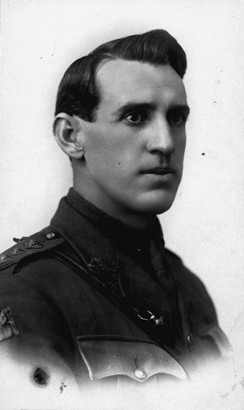
Hugo Vivian Hope Throssell, VC (26 October 1884 – 19 November 1933) was an Australian soldier in the First World War who was the first Western Australian and only Australian light horseman to receive the Victoria Cross (VC), the highest award for valour in battle that could be awarded to a member of the Australian armed forces at the time.
Hugo Vivian Hope Throssell was born in Northam, Western Australia on 26 October 1884, the son of George Throssell, who was later briefly Premier of Western Australia, and his wife Anne, née Morrell. Hugo was one of fourteen children born to the couple. He was educated at Prince Alfred College in Adelaide from January 1896 to December 1902, where, nicknamed "Jimmy", he was a noted athlete, and captain of three intercollegiate sports teams.
On the outbreak of the First World War in 1914, he joined the Australian Imperial Force and was allotted to the 10th Light Horse Regiment.[citation needed] His brother, Frank Erick Cottrell Throssell, known as "Ric", also served in the war and died near Gaza. Hugo Throssell's son, Richard Prichard "Ric" Throssell, shared the same family nickname as his uncle.[citation needed]
As a second lieutenant Hugo Throssell fought at Gallipoli, where he had landed on 4 August. He saw action in the desperate Battle of the Nek. According to the Australian Dictionary of Biography:
This experience increased his eagerness to prove himself in battle. He wanted to avenge the 10th L.H.R. which, like so many of the Anzac troops, was battle-worn, sick and depleted. His chance came later that month at Hill 60 during a postponed attempt by British and Anzac troops to widen the strip of foreshore between the two bridgeheads at Anzac and Suvla by capturing the hills near Anafarta. Hill 60, a low knoll, lay about half a mile (0.8 km) from the beach. Hampered by confusion and lack of communication between the various flanks, the battle had been raging for a week with heavy losses.
A few weeks later, he fought at Hill 60:
On 29–30 August 1915 at Kaiakij Aghala (Hill 60), Gallipoli, Turkey, Second Lieutenant Throssell, although severely wounded in several places, refused to leave his post during a counter-attack or to obtain medical assistance until all danger was passed, when he had his wounds dressed and returned to the firing line until ordered out of action by the Medical Officer. By his personal courage and example he kept up the spirits of his party and was largely instrumental in saving the situation at a critical period.
Whilst recuperating from his wounds in London he was introduced to Katharine Susannah Prichard, an Australian journalist who had recently won a significant novel competition and would go on to be a famous author and socialist. He eventually returned to active service, rejoining the 10th Light Horse in the Middle East where he fought in a number of engagements, and achieved the rank of captain. He returned home in 1918, and in 1919 married Prichard after the war ended.
Hugo Throssell
Hugo Vivian Hope Throssell, VC (26 October 1884 – 19 November 1933) was an Australian soldier in the First World War who was the first Western Australian and only Australian light horseman to receive the Victoria Cross (VC), the highest award for valour in battle that could be awarded to a member of the Australian armed forces at the time.
Hugo Vivian Hope Throssell was born in Northam, Western Australia on 26 October 1884, the son of George Throssell, who was later briefly Premier of Western Australia, and his wife Anne, née Morrell. Hugo was one of fourteen children born to the couple. He was educated at Prince Alfred College in Adelaide from January 1896 to December 1902, where, nicknamed "Jimmy", he was a noted athlete, and captain of three intercollegiate sports teams.
On the outbreak of the First World War in 1914, he joined the Australian Imperial Force and was allotted to the 10th Light Horse Regiment.[citation needed] His brother, Frank Erick Cottrell Throssell, known as "Ric", also served in the war and died near Gaza. Hugo Throssell's son, Richard Prichard "Ric" Throssell, shared the same family nickname as his uncle.[citation needed]
As a second lieutenant Hugo Throssell fought at Gallipoli, where he had landed on 4 August. He saw action in the desperate Battle of the Nek. According to the Australian Dictionary of Biography:
This experience increased his eagerness to prove himself in battle. He wanted to avenge the 10th L.H.R. which, like so many of the Anzac troops, was battle-worn, sick and depleted. His chance came later that month at Hill 60 during a postponed attempt by British and Anzac troops to widen the strip of foreshore between the two bridgeheads at Anzac and Suvla by capturing the hills near Anafarta. Hill 60, a low knoll, lay about half a mile (0.8 km) from the beach. Hampered by confusion and lack of communication between the various flanks, the battle had been raging for a week with heavy losses.
A few weeks later, he fought at Hill 60:
On 29–30 August 1915 at Kaiakij Aghala (Hill 60), Gallipoli, Turkey, Second Lieutenant Throssell, although severely wounded in several places, refused to leave his post during a counter-attack or to obtain medical assistance until all danger was passed, when he had his wounds dressed and returned to the firing line until ordered out of action by the Medical Officer. By his personal courage and example he kept up the spirits of his party and was largely instrumental in saving the situation at a critical period.
Whilst recuperating from his wounds in London he was introduced to Katharine Susannah Prichard, an Australian journalist who had recently won a significant novel competition and would go on to be a famous author and socialist. He eventually returned to active service, rejoining the 10th Light Horse in the Middle East where he fought in a number of engagements, and achieved the rank of captain. He returned home in 1918, and in 1919 married Prichard after the war ended.
Recent media
Recent media