



Community hub
Recent from talks
Knowledge base stats:
Talk channels stats:
Members stats:
Huixtocihuatl
In Aztec religion, Huixtocihuatl[pronunciation?] (or Uixtochihuatl, Uixtociuatl) was a fertility goddess who presided over salt and salt water. The Aztecs considered her to be the older sister of the rain gods, including Tlaloc in most sources. Much of the information known about Huixtocihuatl and how the Aztecs celebrated her comes from Bernardino de Sahagún's manuscripts. His Florentine Codex explains how Huixtocihuatl became the salt god. It records that Huixtocihuatl angered her younger brothers, the Tlaloques, by mocking them, so they banished her to the salt beds. It was there where she discovered salt and how it was created. As described in the second book of the Florentine Codex, during Tecuilhuitontli, the seventh month of the Aztec calendar, there was a festival in honor of Huixtocihuatl. The festival culminated with the sacrifice of Huixtocihuatl's ixiptla, the embodiment of the deity in human form.
Huixtocihuatl was considered a provider god along with Chicomecoatl and Chalchiuhtlicue. The three were sisters who together provided people with three life essentials: salt, food, and water.
In Codex Telleriano-Remensis, Huixtocihuatl is associated with the goddess Ixcuina, who represented filth and excrement. This relationship suggests that Huixtocihuatl was likely associated with urine, which was seen as salty and impure. Her association with the provider gods was not necessarily positive, and her association with urine and filth was not necessarily negative. The Aztecs recognized filth and disorder as a vital stage in the patterns of growth and renewal.
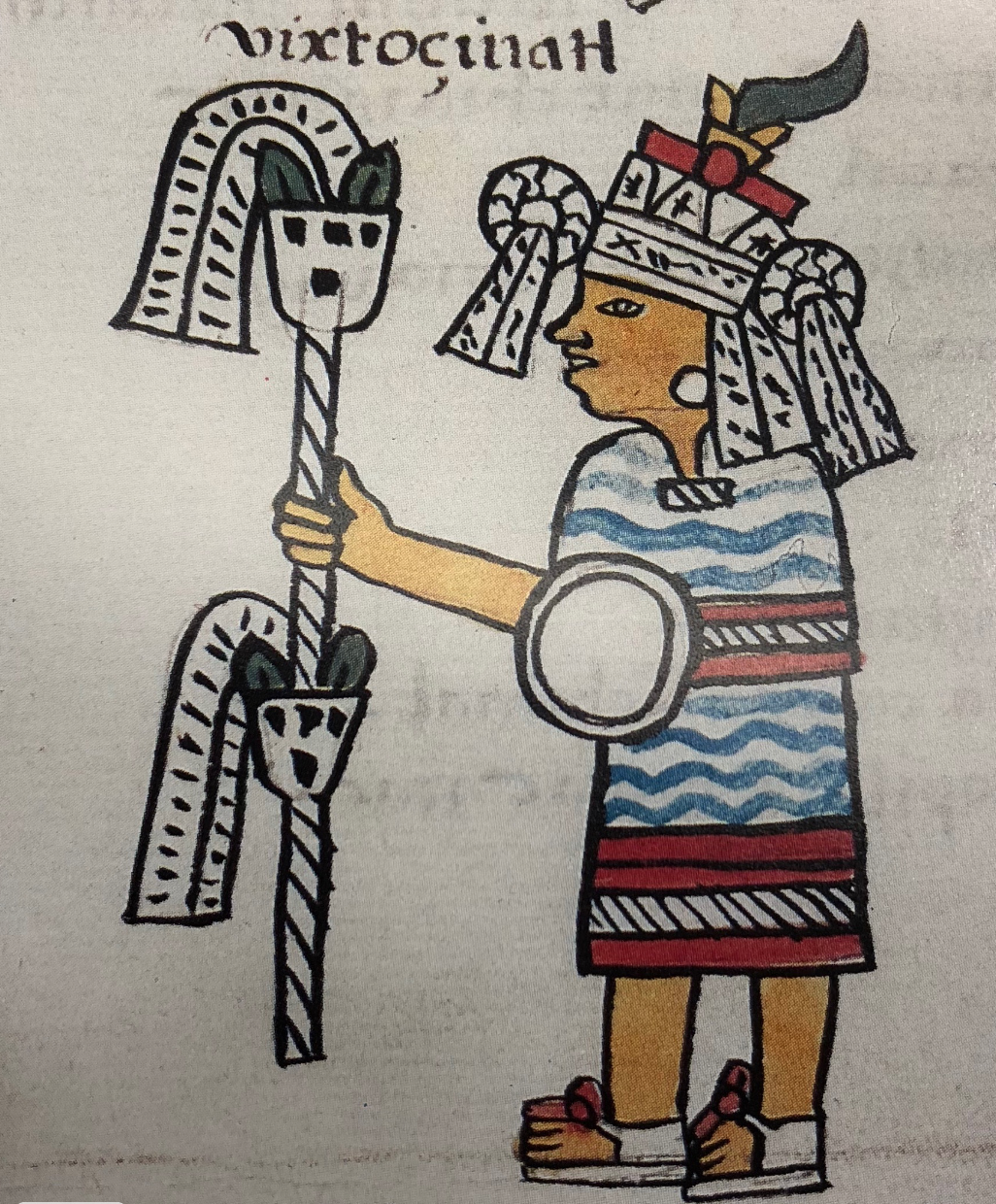
Primeros Memoriales, a manuscript written by Bernardino de Sahagún before his Florentine Codex, contains a description of Huixtocihuatl paired with an illustration. The Aztecs believed that the essence of a deity could be captured by a human impersonator, or ixiptla, of the god. Primeros Memoriales therefore illustrates and describes the likeness of Huixtocihuatl, who would have embodied the salt god. Sahagun's description closely follows its associated illustration, saying,
"Her facial paint is yellow./ Her paper crown has a quetzal feather crest./ Her gold ear plugs./ Her shift has the water design./ Her skirt has the water design./ Her small bells./ Her sandals./ Her shield has the water lily design./ In her hand is her reed staff."
In the Florentine Codex, Sahagún expands upon his description of Huixtocihuatl, describing the appearance of the deity captured by the impersonator. Sahagun likens her face paint, costume, and feathers to a maize plant at antithesis. He says,
"Her [face] paint and ornamentation were yellow. This was of yellow ochre or the [yellow] of maize blossoms. And [she wore] her paper cap with quetzal feathers in the form of a tassel of maize. It was of many quetzal feathers, full of quetzal feathers, so that it was covered with green, streaming down, glistening like precious green feathers."
Sahagún goes on to describe Huixtocihuatl's other notable characteristics. He points out that her shirt and skirt were both embroidered with a design emulating water. The border of her shirt and skirt had a cloud design. These features, more closely related to water than to salt, may reflect Huixtocihuatl's familial ties to the water gods. Sahagún also points out that bells bound to an ocelot skin were attached to her ankles and legs. These bells made a symphony of noise when she walked. Sahagún furthermore provides details about Huixtocihuatl's sandals, shield, and reed staff. Her shield was covered with a water lily leaf design, hung with yellow parrot feathers, and swung around by the ixiptla when she danced. The reed staff also held an important role for the ixiptla, as it was what she used to mark the beat of songs during the festival in her honor.
Hub AI
Huixtocihuatl AI simulator
(@Huixtocihuatl_simulator)
Huixtocihuatl
In Aztec religion, Huixtocihuatl[pronunciation?] (or Uixtochihuatl, Uixtociuatl) was a fertility goddess who presided over salt and salt water. The Aztecs considered her to be the older sister of the rain gods, including Tlaloc in most sources. Much of the information known about Huixtocihuatl and how the Aztecs celebrated her comes from Bernardino de Sahagún's manuscripts. His Florentine Codex explains how Huixtocihuatl became the salt god. It records that Huixtocihuatl angered her younger brothers, the Tlaloques, by mocking them, so they banished her to the salt beds. It was there where she discovered salt and how it was created. As described in the second book of the Florentine Codex, during Tecuilhuitontli, the seventh month of the Aztec calendar, there was a festival in honor of Huixtocihuatl. The festival culminated with the sacrifice of Huixtocihuatl's ixiptla, the embodiment of the deity in human form.
Huixtocihuatl was considered a provider god along with Chicomecoatl and Chalchiuhtlicue. The three were sisters who together provided people with three life essentials: salt, food, and water.
In Codex Telleriano-Remensis, Huixtocihuatl is associated with the goddess Ixcuina, who represented filth and excrement. This relationship suggests that Huixtocihuatl was likely associated with urine, which was seen as salty and impure. Her association with the provider gods was not necessarily positive, and her association with urine and filth was not necessarily negative. The Aztecs recognized filth and disorder as a vital stage in the patterns of growth and renewal.
Primeros Memoriales, a manuscript written by Bernardino de Sahagún before his Florentine Codex, contains a description of Huixtocihuatl paired with an illustration. The Aztecs believed that the essence of a deity could be captured by a human impersonator, or ixiptla, of the god. Primeros Memoriales therefore illustrates and describes the likeness of Huixtocihuatl, who would have embodied the salt god. Sahagun's description closely follows its associated illustration, saying,
"Her facial paint is yellow./ Her paper crown has a quetzal feather crest./ Her gold ear plugs./ Her shift has the water design./ Her skirt has the water design./ Her small bells./ Her sandals./ Her shield has the water lily design./ In her hand is her reed staff."
In the Florentine Codex, Sahagún expands upon his description of Huixtocihuatl, describing the appearance of the deity captured by the impersonator. Sahagun likens her face paint, costume, and feathers to a maize plant at antithesis. He says,
"Her [face] paint and ornamentation were yellow. This was of yellow ochre or the [yellow] of maize blossoms. And [she wore] her paper cap with quetzal feathers in the form of a tassel of maize. It was of many quetzal feathers, full of quetzal feathers, so that it was covered with green, streaming down, glistening like precious green feathers."
Sahagún goes on to describe Huixtocihuatl's other notable characteristics. He points out that her shirt and skirt were both embroidered with a design emulating water. The border of her shirt and skirt had a cloud design. These features, more closely related to water than to salt, may reflect Huixtocihuatl's familial ties to the water gods. Sahagún also points out that bells bound to an ocelot skin were attached to her ankles and legs. These bells made a symphony of noise when she walked. Sahagún furthermore provides details about Huixtocihuatl's sandals, shield, and reed staff. Her shield was covered with a water lily leaf design, hung with yellow parrot feathers, and swung around by the ixiptla when she danced. The reed staff also held an important role for the ixiptla, as it was what she used to mark the beat of songs during the festival in her honor.