
Recent from talks
Human, All Too Human
Knowledge base stats:
Talk channels stats:
Members stats:
Human, All Too Human
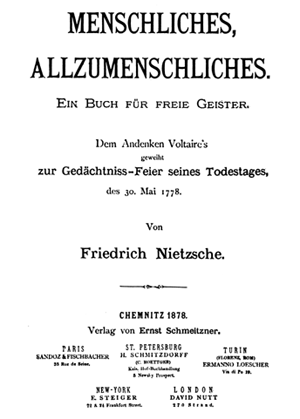
Human, All Too Human: A Book for Free Spirits (German: Menschliches, Allzumenschliches: Ein Buch für freie Geister) is a book by 19th-century philosopher Friedrich Nietzsche, originally published in 1878. A second part, Assorted Opinions and Maxims (Vermischte Meinungen und Sprüche), was published in 1879, and a third part, The Wanderer and his Shadow (Der Wanderer und sein Schatten), followed in 1880.
The book is Nietzsche's first in the aphoristic style that would come to dominate his writings, discussing a variety of concepts in short paragraphs or sayings. Reflecting an admiration of Voltaire as a free thinker, but also a break in his friendship with composer Richard Wagner two years earlier, Nietzsche dedicated the original 1878 edition of Human, All Too Human "to the memory of Voltaire on the celebration of the anniversary of his death, May 30, 1778". Instead of a preface, the first part originally included a quotation from Descartes's Discourse on the Method. Nietzsche later republished all three parts as a two-volume edition in 1886, adding a preface to each volume, and removing the Descartes quotation as well as the dedication to Voltaire.
In 1876, Nietzsche broke with Wagner, and in the same year his increasingly bad health (possibly the early effects of a brain tumor, or on another theory, CADASIL) compelled him to request a leave of absence from his academic duties at the University of Basel. In the autumn of 1876, he joined his friend Paul Rée in Sorrento, at the home of a wealthy patron of the arts, Malwida von Meysenbug, and began work on Human, All Too Human.
The genre of the aphorism was already well established at the time of writing this book: in the German tradition, Nietzsche's most important predecessor was a figure of the Enlightenment, Georg Christoph Lichtenberg, whose writing Nietzsche greatly admired. Nietzsche's work is indebted also to Schopenhauer's, particularly his Aphorisms for Practical Wisdom (1851). Above all else is the "debt to the French tradition of the aphorism – for Nietzsche's work is a deliberate turn westward". Nietzsche cites the French aphorists Jean de La Bruyère and Prosper Mérimée, and in Aphorism 221 celebrates Voltaire.
At the beginning of the second section, Nietzsche mentions La Rochefoucauld—named here as a model, the epitome of the aphorist—and it is known that Nietzsche had a copy of La Rochefoucauld's Sentences et maximes (1665) in his library. He had been reading it shortly before beginning to write Human, All Too Human, on the train ride to Sorrento. More than that of the other French aphorists mentioned, it is La Rochefoucauld's work that lies behind that of Nietzsche.[citation needed]
Unlike his first book, The Birth of Tragedy, which was written in essay style, Human, All Too Human is a collection of aphorisms, a style which Nietzsche would use in many of his subsequent works.
The aphorisms of Human, All Too Human range from a few words to a few pages, but most are short paragraphs. The 638 aphorisms of the first installment are divided by subject into nine sections, with a short poem as an epilogue. The eponymous phrase itself appears in Aphorism 35 (originally conceived as the first aphorism) "when Nietzsche observes that maxims about human nature can help in overcoming life's hard moments". Implicit also, is a drive to overcome what is human, all too human through understanding it, through philosophy. The second and third installments are an additional 408 and 350 aphorisms respectively.
Nietzsche's work, while inspired by the work of aphorists like La Rochefoucauld who came before him, "is unique";
Hub AI
Human, All Too Human AI simulator
(@Human, All Too Human_simulator)
Human, All Too Human
Human, All Too Human: A Book for Free Spirits (German: Menschliches, Allzumenschliches: Ein Buch für freie Geister) is a book by 19th-century philosopher Friedrich Nietzsche, originally published in 1878. A second part, Assorted Opinions and Maxims (Vermischte Meinungen und Sprüche), was published in 1879, and a third part, The Wanderer and his Shadow (Der Wanderer und sein Schatten), followed in 1880.
The book is Nietzsche's first in the aphoristic style that would come to dominate his writings, discussing a variety of concepts in short paragraphs or sayings. Reflecting an admiration of Voltaire as a free thinker, but also a break in his friendship with composer Richard Wagner two years earlier, Nietzsche dedicated the original 1878 edition of Human, All Too Human "to the memory of Voltaire on the celebration of the anniversary of his death, May 30, 1778". Instead of a preface, the first part originally included a quotation from Descartes's Discourse on the Method. Nietzsche later republished all three parts as a two-volume edition in 1886, adding a preface to each volume, and removing the Descartes quotation as well as the dedication to Voltaire.
In 1876, Nietzsche broke with Wagner, and in the same year his increasingly bad health (possibly the early effects of a brain tumor, or on another theory, CADASIL) compelled him to request a leave of absence from his academic duties at the University of Basel. In the autumn of 1876, he joined his friend Paul Rée in Sorrento, at the home of a wealthy patron of the arts, Malwida von Meysenbug, and began work on Human, All Too Human.
The genre of the aphorism was already well established at the time of writing this book: in the German tradition, Nietzsche's most important predecessor was a figure of the Enlightenment, Georg Christoph Lichtenberg, whose writing Nietzsche greatly admired. Nietzsche's work is indebted also to Schopenhauer's, particularly his Aphorisms for Practical Wisdom (1851). Above all else is the "debt to the French tradition of the aphorism – for Nietzsche's work is a deliberate turn westward". Nietzsche cites the French aphorists Jean de La Bruyère and Prosper Mérimée, and in Aphorism 221 celebrates Voltaire.
At the beginning of the second section, Nietzsche mentions La Rochefoucauld—named here as a model, the epitome of the aphorist—and it is known that Nietzsche had a copy of La Rochefoucauld's Sentences et maximes (1665) in his library. He had been reading it shortly before beginning to write Human, All Too Human, on the train ride to Sorrento. More than that of the other French aphorists mentioned, it is La Rochefoucauld's work that lies behind that of Nietzsche.[citation needed]
Unlike his first book, The Birth of Tragedy, which was written in essay style, Human, All Too Human is a collection of aphorisms, a style which Nietzsche would use in many of his subsequent works.
The aphorisms of Human, All Too Human range from a few words to a few pages, but most are short paragraphs. The 638 aphorisms of the first installment are divided by subject into nine sections, with a short poem as an epilogue. The eponymous phrase itself appears in Aphorism 35 (originally conceived as the first aphorism) "when Nietzsche observes that maxims about human nature can help in overcoming life's hard moments". Implicit also, is a drive to overcome what is human, all too human through understanding it, through philosophy. The second and third installments are an additional 408 and 350 aphorisms respectively.
Nietzsche's work, while inspired by the work of aphorists like La Rochefoucauld who came before him, "is unique";
Recent media