



Community hub
Recent from talks
Knowledge base stats:
Talk channels stats:
Members stats:
Human Design
Human Design is a theory and practice described as a holistic self-knowledge system. It combines astrology, the Chinese I Ching, Judaic Kabbalah, Vedic philosophy, and modern physics.
Human Design was originated by Alan Robert Krakower, who published a book called The Human Design System under the pseudonym Ra Uru Hu in 1992. Krakower was previously an advertising executive and magazine publisher. Krakower developed the Human Design system following an alleged mystical experience in 1987.
It purports to be a self-knowledge method which does not have any specific religious dogma or affiliation. However, it has been described by theologian J. R. Hustwit as a "transreligious project" that is "breathtaking in scope" and synthesizes seven or more traditions. It has also been described as a psychological counseling instrument and "a comprehensive and personalized map of your unique energy and life blueprint, guiding you towards self-awareness, personal growth, and empowerment." It claims to facilitate "deep access to bodily, generational and inter-dimensional intelligence."
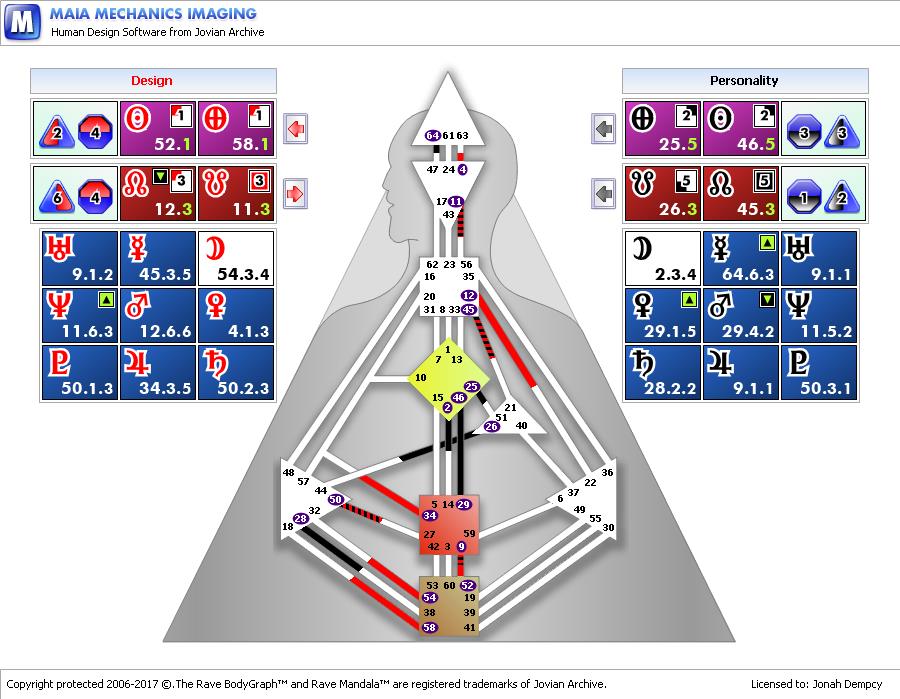
Human Design maps nine energy centers in the body, represented in a chart called a bodygraph. An individual's bodygraph shows which centers are "defined," meaning consistent and reliable in their functioning. It also displays the 64 hexagrams of the I Ching at various body locations, sometimes overlaid on the 12 signs of the zodiac within a mandala. The system uses these elements to describe "self" and "not-self" themes intended to guide personal awareness and decision-making.
Human Design also divides people into four main types—Generator, Manifestor, Projector, and Reflector—and includes a fifth hybrid type, the Manifesting Generator, which combines features of Generators and Manifestors.
Generator Generators are described as having sustainable energy and are said to respond to external stimuli rather than initiate actions themselves. They are considered adept at completing long-term tasks and applying consistent effort in daily life.
Manifesting Generator Manifesting Generators combine traits of both Generators and Manifestors. They are said to be able to respond to life while also initiating action. They are thought to manage multiple projects simultaneously and adapt flexibly to changing circumstances.
Manifestor Manifestors are described as capable of independent action and initiating change. They are considered able to influence their environment and create new opportunities.
Hub AI
Human Design AI simulator
(@Human Design_simulator)
Human Design
Human Design is a theory and practice described as a holistic self-knowledge system. It combines astrology, the Chinese I Ching, Judaic Kabbalah, Vedic philosophy, and modern physics.
Human Design was originated by Alan Robert Krakower, who published a book called The Human Design System under the pseudonym Ra Uru Hu in 1992. Krakower was previously an advertising executive and magazine publisher. Krakower developed the Human Design system following an alleged mystical experience in 1987.
It purports to be a self-knowledge method which does not have any specific religious dogma or affiliation. However, it has been described by theologian J. R. Hustwit as a "transreligious project" that is "breathtaking in scope" and synthesizes seven or more traditions. It has also been described as a psychological counseling instrument and "a comprehensive and personalized map of your unique energy and life blueprint, guiding you towards self-awareness, personal growth, and empowerment." It claims to facilitate "deep access to bodily, generational and inter-dimensional intelligence."
Human Design maps nine energy centers in the body, represented in a chart called a bodygraph. An individual's bodygraph shows which centers are "defined," meaning consistent and reliable in their functioning. It also displays the 64 hexagrams of the I Ching at various body locations, sometimes overlaid on the 12 signs of the zodiac within a mandala. The system uses these elements to describe "self" and "not-self" themes intended to guide personal awareness and decision-making.
Human Design also divides people into four main types—Generator, Manifestor, Projector, and Reflector—and includes a fifth hybrid type, the Manifesting Generator, which combines features of Generators and Manifestors.
Generator Generators are described as having sustainable energy and are said to respond to external stimuli rather than initiate actions themselves. They are considered adept at completing long-term tasks and applying consistent effort in daily life.
Manifesting Generator Manifesting Generators combine traits of both Generators and Manifestors. They are said to be able to respond to life while also initiating action. They are thought to manage multiple projects simultaneously and adapt flexibly to changing circumstances.
Manifestor Manifestors are described as capable of independent action and initiating change. They are considered able to influence their environment and create new opportunities.